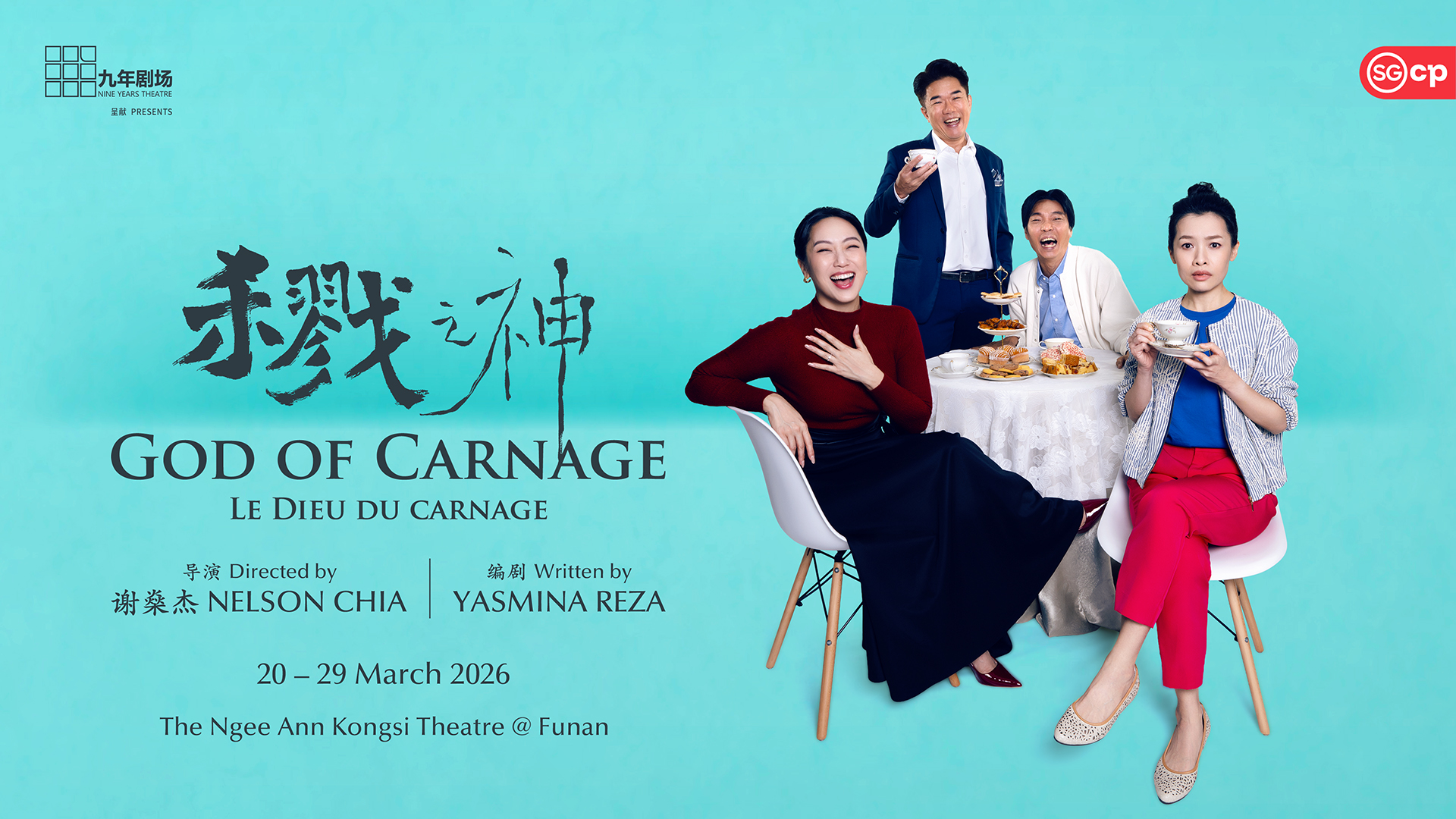
Nine Years Theatre heralds the start of its 2026 season by revisiting Yasmina Reza’s oeuvre, and staging a Mandarin adaptation of God of Carnage.
Director Nelson Chia and his cast (Mia Chee, Oon Shu Ann, Cavin Soh, and Tay Kong Hui) shed more light on the show and ponder about some of the themes in the following interview.
Synopsis
Two boys fight.
Four adults sit down to “talk things over civilly”.
In God of Carnage, Veronica and Michael invite Annette and Alan to their home to address their sons’ misbehaviour. Armed with art books, tulips, and homemade pastry, they are determined to handle the matter with grace and maturity.
But as the evening wears on, a relentlessly ringing phone, a missing hamster, and a bottle of fine rum become catalysts for an elegant evening gone spectacularly off the rails. Winner of both the Tony Award and the Laurence Olivier Award, this play reveals how alarmingly fragile our social facades become under pressure.
God of Carnage marks the second time Nine Years Theatre is adapting a work by Yasmina Reza. What is it about her writing that speaks to you, and why do you think it is important to stage this particular work now?
Nelson Chia: In her plays, Yasmina Reza often creates complex characters who are relatable because they are so flawed. This is achieved through dialogue that is nuanced and, at times, interestingly ambiguous. More importantly, I appreciate how she brings out difficult issues through comedic situations; laughter can sometimes be more effective than lectures.
Just look at the world we are living in now—the rule-based order has gone out of the window. This work seems important now because civility might just be a hoax.
What were some interesting insights that came out of the rehearsal process?
Nelson Chia: In my discussions with the cast, I came to realise that this is a play that starts out as a comedy and ends like a tragedy, yet is nothing less than an existential piece with the possibility of hope as an aftertaste.
Mia Chee: One of the most meaningful parts of the rehearsal process was how much we shared about our own relationships, both personal ones and relationships we have observed around us. We could all identify with different moments in the play. Human beings can behave and react very differently depending on the environment and the person they are interacting with. Nothing is ever absolute. People are complex beings who are influenced by context. As we continue rehearsing, we are discovering something new about the characters each day. What is so wonderful about this script is how real these characters can be, despite some incredible turns.
Tay Kong Hui: The production originates from a Western comedic tradition, yet its core themes—family values, personal belief systems, marital relationships, and child-rearing—took on new dimensions when placed on an Asian stage. Through the rehearsal process, we observed an intriguing interplay between Western narrative structures and Eastern ways of thinking, creating unexpected and meaningful cultural resonance.
Cavin Soh: I discovered that civility is basically a thin coat of paint and it chips very fast. The more seriously we played the stakes, the funnier it became.
Oon Shu An: This play gets really specific with conflict, and the characters hold on to their convictions so strongly that they cannot seem to resolve the conflict. It sounds silly, but I didn’t realise how much it would invite our own strong convictions into the conversation, and I think it will do the same for the audience. It has been so much fun working through the occasional heatedness and into the invigorating space of deep convictions meeting.
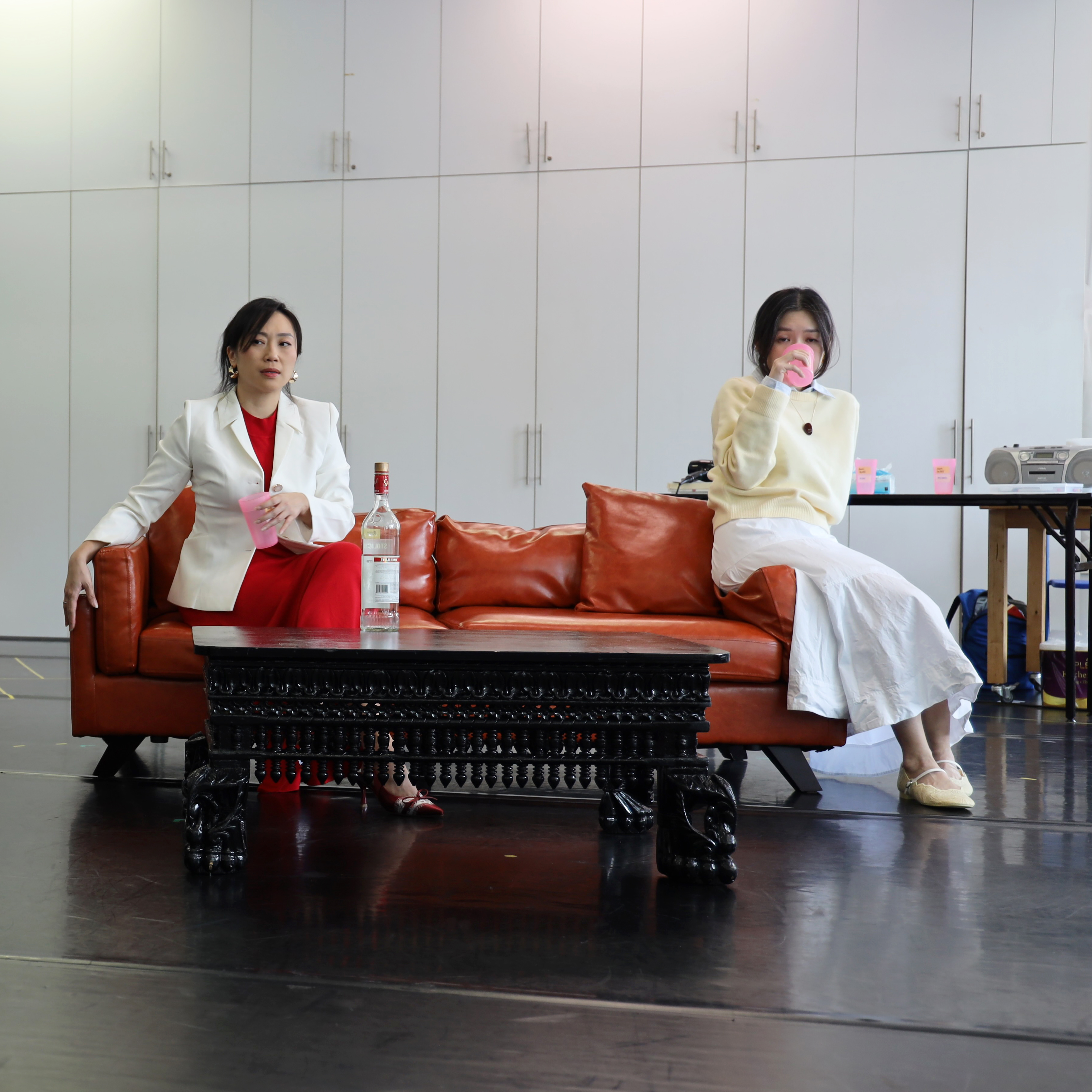
L-R: Oon Shu An and Mia Chee in rehearsal / Courtesy of Nine Years Theatre
How has your involvement in this production inform your outlook on dealing with disagreements?
Nelson Chia: It is a great reminder that we sometimes disagree not because we cannot understand one another, but because we care about different things in our lives—and that is hard to reconcile.
Mia Chee: I wish I could say this production has completely transformed how I deal with disagreements, but honestly, not quite. Ha! What it has reinforced for me is that I value my peace more than “winning” an argument, especially with people outside my family. There is a line somewhere, a boundary that, if crossed, only leads to rage or unnecessary damage on both sides.
That said, when it comes to truly important issues, I do believe in putting my foot down. I have been learning and am still learning how to express differences in a way that is elegant, clear, and effective. It is a lifelong process, and I suspect I will still be figuring it out even when I am well into old age.
Tay Kong Hui: This experience reinforced the understanding that even the most valid perspectives depend greatly on how they are expressed, to what extent, and at what moment. Absolute frankness or excessive politeness alone is not necessarily the most effective way to resolve a conflict. A multi-dimensional, multi-perspective approach to disagreement is far more constructive than relying on a single viewpoint or rigid belief system to address complex issues.
Cavin Soh: It’s made me realise most arguments aren’t about the actual issue; they’re about ego. Once pride enters the chat, logic quietly leaves the room.
Oon Shu An: I genuinely think I’ve gotten better at it… Hahaha! It brings you right into the thick of conflict! It doesn’t quite allow you to settle in a “middle ground” of a disagreement, which has really made me examine my opinions; how I express them, recognising sensitivities (my own included); and examining one’s approach. It’s excellent practice for 对事不对人 (dealing with the issue, not the person).
Nelson is very exacting and at the same time very open and reflective, I feel very lucky to be working with a director and cast who are robust in their approach and kind in the room.
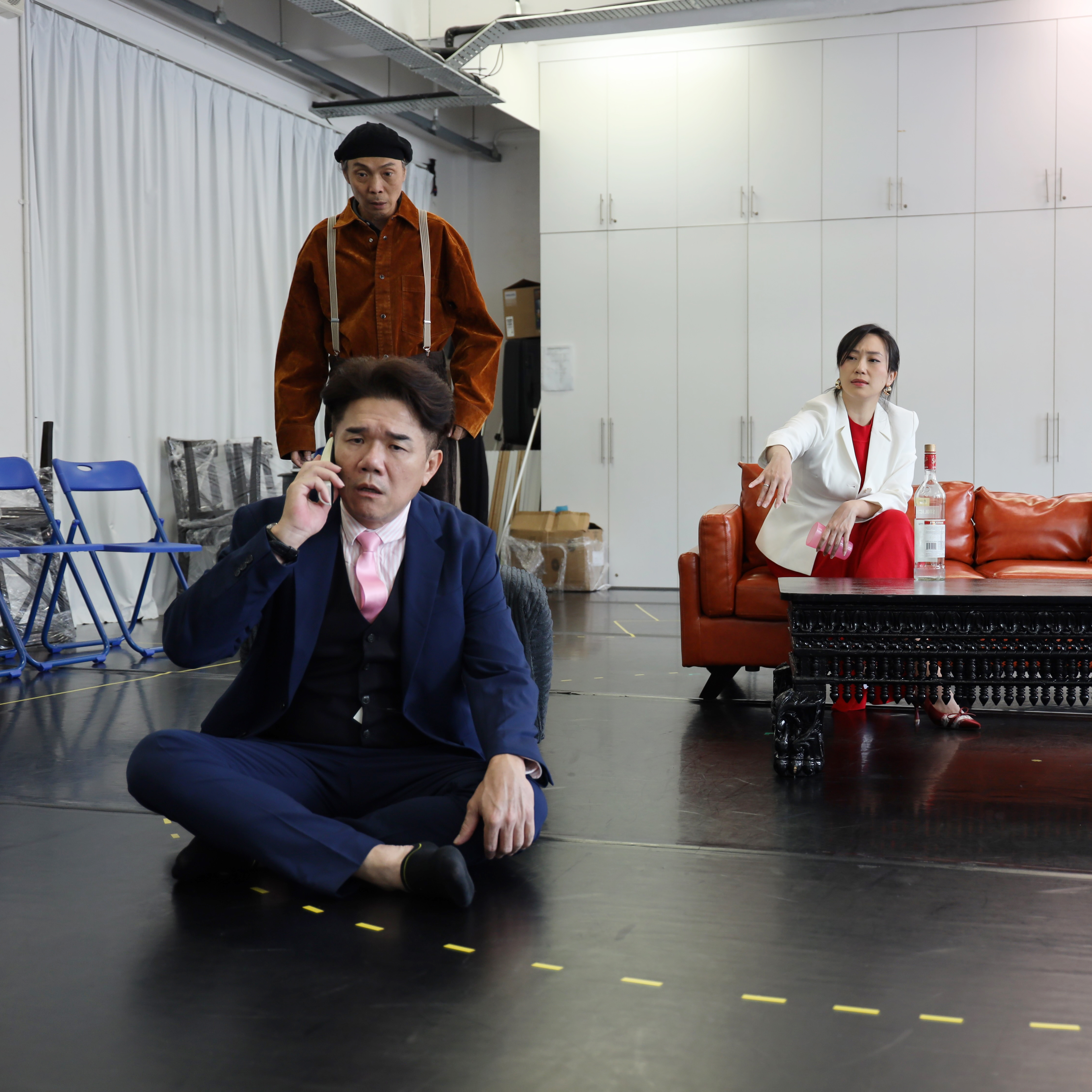
Front-Back: Cavin Soh, Tay Kong Hui, and Oon Shu An in rehearsal / Courtesy of Nine Years Theatre
The veneer of civility washes off in the course of the play. In your opinion, where is the line between civility and incivility? When is it ok to be “uncivil”
Nelson Chia: I’d just say this: We equate civility with progress, and humans seem to be the only living things that are obsessed with that idea. How odd is that?
Mia Chee: Civility is a social construct. Different societies and cultures define it differently. So what does it really mean to be “uncivil”? Is it raising your voice? Stopping polite conversation? Walking away? Or escalating to something physical? There are many degrees of what we might label as uncivil behaviour.
Perhaps the question is not about when it is okay to be uncivil, but more about with whom. The boundaries shift depending on the relationship. It is really important to have at least one relationship in your life where you can drop the performance of social politeness and do not always have to operate within the expectations carved out by society. True intimacy allows space for moments that are not perfectly “civil”, but are honest.
Tay Kong Hui: True peace, calm, and reconciliation must be grounded in fairness and balance—not imposed from a presumed position of moral or cultural superiority. What is often labeled as “civility” can, at times, mask a form of ideological dominance, where one standard of behavior is used to diminish or invalidate another.
Personally, when confronted with what I would describe as an uncivilized form of so-called civilization, I hold to one principle: if civility demands submission or self-erasure, then it loses its moral authority. In such moments, dignity lies not in compliance, but in asserting one’s voice and values with clarity and self-respect.
Cavin Soh: Civility is great until it becomes fake. I think it’s ok to be firm, blunt or even a little uncomfortable. But it’s not ok to be cruel. The line is crossed when you stop focusing on the issue and start attacking the person.
Oon Shu An: I guess incivility would be things like rudeness, no mutual respect, harmful behaviour. We are human so we make mistakes and we all have different world views and things may read differently. So it’s probably good to check if it truly was incivility first—clarifying intentions, and if it’s safe, open opportunities for repair in the case that it may have been a misunderstanding, and extend grace to others and ourselves when we mess up.
When is it ok to be “uncivil”? I actually don’t think we owe “politeness” or “civility” at the expense of our safety. When there is a power differential that’s being exploited, when there has been a violation of a social contract, abuse, manipulation, harm, discrimination. In those instances, the perpetrators are often banking on people being “civil” whilst being at the receiving end of injustice or harm. They’re not actually asking for civility, they’re asking for permission to continue harm, which is very different.
Catch It!
God of Carnage runs from 20 to 29 March 2026 at The Ngee Ann Kongsi Theatre @ Funan.
 Isaac Tan