[Theatre Review] Battlefield — Brook Makes Audience Battle Boredom

Battlefield

Battlefield
Peter Brook & Singapore Repertory Theatre
21 November 2015, 3 pm
Capitol Theatre
17–21 November 2015

I do not need to offer a synopsis of Battlefield for the story from Mahabharata should be somewhat familiar to most people. More importantly, the tales and parables are intimated so subtly that it could have been any other generic story.

Brook returns to story-telling traditions as the action—or lack thereof—takes place on a largely bare stage. Characters are indicated by the cloth they wear around their necks and the story is told through words, symbolic actions and manoeuvring of various cloths. However, the thousands of deaths and the struggles of the king are neither indicated by the expressions of the actors (Carole Karemera, Jared Mcneill, Ery Nazaramba, and Sean O’Callaghan) or the timbre of their voices.

Rather than bore you with details of this lacklustre performance, allow me to entertain you with a description of the drama that unfolded around me.

A bout of snoring from the left flank of the theatre marks the thirty-fifth minute of the show. I look to the left and about six to ten seats away from me, there is a man fast asleep as he reclines in his seat. Every few minutes, there is an intermittent pause in the snoring as he tries to find a more comfortable position to snooze in.

On four or five occasions, I hear the rustling of a plastic bag directly behind me. I am inclined to turn around to see what is in the plastic bag but I do not want to embarrass the person. While I am usually irritated by such nuisance, I only have the deepest of sympathies for my fellow audience member.

At the forty-five minute mark, a young man four seats to my left starts to get restless. Yielding to temptation, he rips open his bag that is fastened by Velcro and risks incurring the wrath of his fellow audience members. Nobody bats an eyelid. He takes out the programme, places it on his lap and starts flipping it in search of enlightenment or anything that would kill time.

Stepping out of the theatre, an Indian woman complains to the front-of-house about not being able to hear the actors. As I walk out of the lobby, a voice trails behind.

“Excuse me!” I turn around and it is the same Indian lady. “Did you just watch the Mahabharata?”

“Yes.”

“Were you sitting in the circle?”

“No… I was seated towards the back of the stalls.”

“Cannot hear the actors right?” I nodded in agreement.

“I mean sometimes they never pronounce their words clearly… but when they do, you could hardly hear it… very bad.”

“Yah.” I watch her walk off. She shakes her head in disappointment and points her finger forward either to emphasise her frustration to herself or perhaps to admonish an imaginary Peter Brook.

Unlike my colleague from The Straits Times, I shall not make excuses for the show as I can only report my experience. One may write all the books in the world but if the production does not reach out to the audience, it is a colossal failure.

Rather than get caught up with the glimmer of Brook’s halo, we should demand more from this experienced artist.

Other Reviews

“Art of story-telling at its finest in Peter Brook’s Battlefield” by Akshita Nanda, The Straits Times Life!

“Theatre Review: Battlefield by Mayo Martin, Today

“Theatre Review: Peter Brook’s Battlefield” by Alex Tham, Buro 24/7

“Singapore Repertory Theatre Presents: Battlefield by Peter Brook” by Nithia Devan, City Nomads

“Theatre Review (Singapore): ‘Battlefield’ by Peter Brook” by Sharmila Melissa Yogalingam, Blog Critics

Battlefield—An Indulgence of Ideas [Review]” by Seewah Ho, What’s Next

“The Final Scene from the Mahabharata by Imp (alias), Faerie Tales 

[Dance Review] ¡Magneta! — Not That Magnetic

Magneta

¡Magneta!
Flamenco Sin Fronteras
13 November 2015
Goodman Arts Centre Black Box
13–14 November 2015

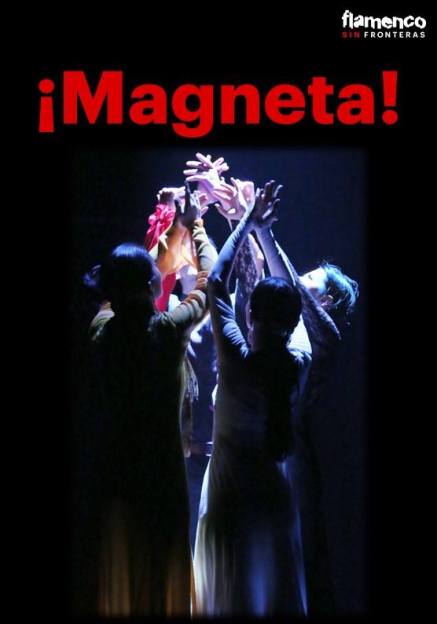
Spanning ten different items and six different palos (styles), ¡Magneta! strives to showcase the versatility and creativity of the company. Unfortunately, the attraction is not consistent.

The programme starts off with two weak performances. The first item plays on what the public would think of as flamenco music—Gipsy Kings. Against the sultry rendition of Volare by Toshiaki Konno, most of the dancers ignored the meaning of the song title as they dance with their wings clipped. Apart from Tilly Wong and Cheryl Ng who exude joy, the other dancers are extremely cautious and look as if they are counting the rhythms or recalling the next step. Thankfully, this feeble item ended quickly.

As the dancers leave the stage with a slight flourish, Saori Otsuka enters to perform the Cantiñas. While Otsuka is technically excellent, her guarded approach to the dance is puzzling given that she personally adapted the dance from a choreography by Alicia Marquez and Pilar Ogalla. Whatever attraction one feels to her strong and steady footwork is neutered.

To break the slumber, Toshiaki Konno bursts in with a barrage of footwork as he performs the Solea Por Bulerias. Konno exudes sheer confidence as he communicates with the musicians and the audience. Alternating between sleek moves and fiery footwork, he even finds time to toss a stray hair clip aside with nonchalance. The floor of the black box does an injustice to Konno’s dancing as it fails to convey the full timbre and musicality of his footwork.

Guitarist Sergio Muñoz lets us down gently from the euphoria of Konno’s performance with a heartfelt solo. As he strums and plucks the guitar strings, there is a sense of deep searching. In response, the faces of the audience light up. Unfortunately, this is not due to Muñoz’s virtuosity, but to their imbecility as they treat him like a street busker and fix their eyes on their phones. This selfish vigil also occurs in the latter half of the show when he performs another guitar solo.

Tilly Wong and Nobuyoshi Nakane kick the show up a notch as they take turns to perform different letras (verses) of the Alegrias. Wong radiates a quiet and infectious joy with her slight smile and her ease in handling the bata de cola (skirt with long train) as she sweeps across the stage. Nakane’s steely reserve serves as a nice counterpoint. His letra starts off quite conservatively as it consists mainly of ‘marking steps.’ He breaks away from that in his escobilla (series of footwork) with a lovely variation of the standard steps and takes more risks towards the end. The short duet in the end is wonderfully playful and the chemistry between both dancers is apparent. Wong and Nakane successfully capture the spirit of the dance.

Over the years, Carmen has become everyone’s favourite gypsy girl. Dark, mysterious, sensual, desirable, and exotic. Rather than presenting the usual seduction scene, Daphne Huang-Vargas (Carmen) and Pedro Simoni (Don José) take on the ambitious task of condensing the whole story into a few minutes.

Unfortunately, it is a few minutes too long.

Instead of using the language of flamenco to intimate what happened between the couple, Huang-Vargas performs a pointless scene in which she acts like a rebellious teenage gangster girl and asks us why we are staring at her in an exaggerated Singaporean accent. The script is as pointless as it is literal—later on, we see Don José saying how much he loves Carmen and asks why she has decided to leave him.

Any more literal and the stage manager will have to read the stage directions out loud.

Thankfully, Yuriko Kurose performing the Farruca returns us to something we can appreciate and enjoy. Attired in a red suede crop jacket, high-waisted black trousers, and hair tied into the ponytail, Kurose pays homage to Carmen Amaya (the Carmen we should all remember rather than the monstrosity popularised by Bizet). While Kurose does not have Amaya’s energy and magnetism, her Farruca is technically flawless which is enhanced by her crisp angular lines.

Mamiko Nakane’s Bulerias is surprisingly too short. However, she makes use of every single second on stage in giving a delightful performance. When the Zorongo started, I thought it was still part of the Bulerias. Despite the slight confusion, the synchronicity of the mantones (shawls) adds a certain visual spectacle as the show ends on a good note.

While the choreographies in ¡Magneta! are relatively traditional, it offers the audience a broad overview of the variety and colours that flamenco can offer. This is a small but important step to break flamenco away from the stereotype of it being merely about passion and sensuality.

[Theatre Review] A Twisted Kingdom — Definitely Not Fool’s Gold

twisted kingdom

Illustration: Marc Gabriel Loh

A Twisted Kingdom
Dark Matter Theatrics
12 November 2015
The Substation
12–14 November 2015

Just like the Tarot cards, The Fool (Lian Sutton) in A Twisted Kingdom goes on a journey through life’s mysteries and, in the process of doing so, drudge up his own personal memories and history. He embodies the everyman while telling a very personal story.

Playwright Christopher Fok showcases his mastery of the medium by seamlessly weaving the overarching story of the Fool in search of the prince, references to fairy tales, and the Fool’s painful past into one intriguing tapestry.

While the arrangement of the scenes may appear complicated, there is an indescribable logic to it. Fok achieves the sweet spot of preventing the audience from falling into a passive lull but not pitch it at such an esoteric level that one is unable to get a grip on what is going on.

How does one play the Fool and reopen old wounds at the same time? Sutton has part of the answer. One should not be fooled that a small stage space would make his job any easier. From jumping on the chair and turning it into a horse to donning a doctor’s coat and embodying different sorts of doctors, Sutton is a sensitive story-teller.

The ability to transit into the next scene which is of a very different nature from the previous speaks of an intense rehearsal process. Sutton may be overstretched at times, but the audience is always couple of paces behind the Fool as we eagerly follow him on his journey.

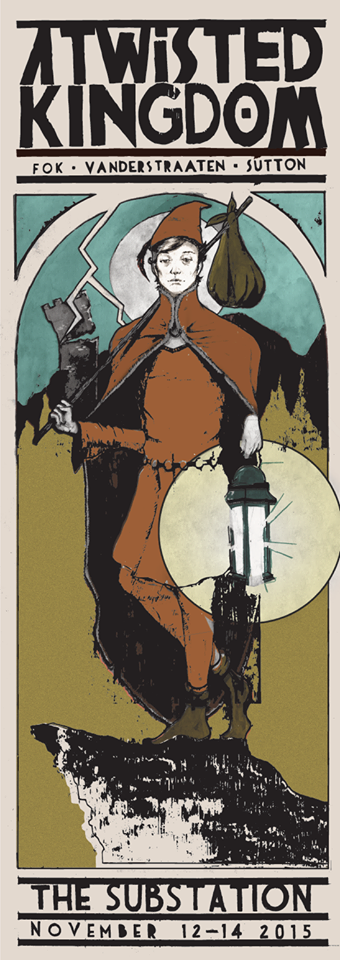
Despite the financial constraints of the production, the designers must be applauded for generously lending their talents. Marc Gabriel Loh’s illustration for the poster and the programme is the best I have seen in a while.

The programme informs us that this production marks Isa Ong’s first foray into music composition for theatre. This makes him one of those annoyingly talented individuals as his music does not indicate a beginner’s attempt. Chew Wei Shan’s haunting vocals towards the end of the show enhances the pathos.

Hakeem Kasban’s lighting design is simple yet effective. Faith Sim’s costume design may appear odd at first but it is wonderfully appropriate in the context of the show. Olivia Vong’s set design makes good use of the space and every item is significant to the story.

Indeed, “The Fool is welcomed everywhere he goes” as one cannot help but stop and listen to his story.

Other Reviews

“Twisted Tales” by Walter Chan, Centre 42 Citizens’ Reviews

[Listing] Beauty World

beauty world 2015 NO TEXT

This November, legendary duo Dick Lee and Michael Chiang reunite once again for Singapore’s number one musical, the iconic Beauty World!

This much-beloved musical, which has seen multiple stagings since its debut at the Singapore Arts Festival in 1988, traces the adventures of a small-town girl from Batu Pahat who sets out on a quest to find her father in Singapore With a mysterious jade pendant as her only clue, she winds up in a dubious cabaret, where she learns some heartbreaking truths about love and life.

This revival, which features Michael Chiang’s revised script from 2008, will be directed for the first time by co-creator and composer Dick Lee. The production will bring an exciting ensemble of formidable talents from theatre and television.

TV star Jeanette Aw sizzles as Lulu, the beautiful but vindictive cabaret queen, while Malaysian talent Cheryl Tan brings wide-eyed charm to the role of Ivy Chan, our innocent protagonist. Adding her touch of class to the mix is seasoned actress Janice Koh, appearing in her first musical as the wise and winsome Mummy.

Other theatre talents include Timothy Wan (Ah Hock the bouncer), Joshua Lim (Frankie the boyfriend), and Frances Lee (Rosemary the penpal).

While the plot remains unchanged, and the comedy is as enjoyable as ever, this new version promises to unveil a darker, more dangerous Beauty World.

Beauty World runs from 13 November to 12 December at Victoria Theatre. Tickets from Sistic.

[Dance Review] The Fleeting Moment — Capturing the Ephemeral

raw moves the fleeting moment

The Fleeting Moment
Teresa Ranieri & Raw Moves
5 November 2015
Goodman Arts Centre Black Box
5–7 November 2015

Choreographer Teresa Ranieri and I face a similar challenge in our respective endeavours. How do we capture an ephemeral experience and convey its impact in a way that others can experience it for themselves?

The first fleeting moment we see is dancer Kenneth Tan walking into a darkened room and behind a screen as a pastiche of images is projected onto it. A soundscape with repeated motifs fills the room as five other female dancers (Chiew Peishan, Neo Hong Chin, Melyn Chow, Liu Wen-Chun, Sherry Tay) emerge and observe Tan. Observation and mirroring dominate this piece as Tan navigates this mental and emotional landscape.

The ephemeral is suggested through the melding and separating of the dancers and media artist Bruno Perosa’s projection of the dancers’ images splintering. The amorphicity of memory is evoked through a repeated sequence of a dancer adopting a pose of another dancer while a third observes and reacts to it. Apart from the ephemeral, are there intimations of—as Ranieri puts it—instances that define our existence?

Throughout the course of the show, we see snatches of what could possibly be interpreted as death, rebirth, freedom, and struggle. Such vague terms, along with my qualification of providing possible interpretations, do not satisfy the reader and there lies the flaw of the show.

While there is a clear synergy in the way the dancers react to each other, they fail to achieve the “wild carousel of feelings and emotions” that Ranieri is gunning for. At times, this may be due to the guarded approach of the dancers. At others, the beautiful movement work simply fails to capture anything.

Ranieri also misses out on a couple of moments to develop on an interesting premise. At one point, the dancers suddenly split up as four square plots of light are thrown onto the space. I initially thought it is trying to evoke how we tend to compartmentalise our memory or emotions. However, no elaboration is provided apart from a couple of movement sequences and the dancers sliding into the square plots. This leaves me questioning my initial interpretation.

Fortunately, the show gains momentum in the second half which is signalled by a dancer tossing the paper cranes as the ensemble go on to evoke a sense of struggle. Perhaps, the most affecting moment appears towards the end as we see Kenneth Tan trying to gather the pieces of confetti while preventing another dancer from messing it up. He evokes a sense of pathos in salvaging the pieces of memory and emotions as he tries to make sense of it all.

While the choreography is sometimes conceptually hazy, The Fleeting Moment does offer glimpses of beauty that are worth waiting for.

Other Reviews

“Raw moves: Immerse in the moment” by Lisabel Ting, AsiaOne (originally published in The Straits Times Life!)

[Listing] Winter Wonderland by Singapore Lyric Opera’s Children’s Choir

Winter Wonderland

With a bit of sparkly tinsel and a sprinkling of snow, the beautiful merry voices of the children from SLO, proudly present- Winter Wonderland! Under the baton of choral conductor Ms Rose Loh, and accompanied by pianist Aloysius Foong, this year the SLO Children’s Choir together with Project W, a Singaporean musical ensemble of 20 musicians, are all set to entertain you with an eclectic mix of songs.

What is a Winter Wonderland concert without tunes from the famous “Frozen” phenomenon, popularised by Disney? Highlights of our programme include the enchanting Frozen theme song, Eatnemen Vuelie by Norwegian musician Frode Fjellheim and not forgetting, the global musical epidemic, “Let It Go”. The children will also be singing traditional favourites that reflect the wonders and emotions of the winter season, both sacred and secular. These include Italian carol Dormi Dormi, Mary Where Is Your Baby, composed by Dan Edwards and This Little Babe a movement from Benjamin Britten’s, A Ceremony of Carols. In support of our local talent, SLOCC will also be presenting two Singaporean compositions.

So do join us for a fantastical paradise as the children spread festive cheer and herald the good tidings of Christmas!

Programme List

A Cuckoo Flew Out of the Woods              arr. B Wayne Bisbee

Dormi Dormi                                                       arr. Mary Goetze

Rise Up, Shepherd and Follow                     arr. Mark Hahn

Mid-Winter                                                          Bob Chilcott

This Little Babe                                                   Benjamin Britten

O Great Mystery                                                 Nancy Telfer

All Things Bright and Beautiful                    Phillip Silvey

Land of Joy                                                            Zechariah Goh

Little Tree                                                               Daniel Drewbaker

Gonna Catch That Santa                                Andy Beck

For the Beauty of the Earth                           John Rutter

INTERVAL

Special Item by Project W Sin Jin How

When All the World Is Full of Snow          David V Montoya

Hanget Soi (Singing Snow)                            arr. AuvoSamanto

Let It Go                                                                  arr. MacHuff

Frozen (Choral Suite)                                        adapted by Roger Emerson

In Summer                                                             arr. Alan Billingsley

Christmas Is (Sing-along)                                arr. MacHuff


Catch Winter Wonderland on 5 December 2015 at SOTA Concert Hall. For more ticketing information, visit Sistic.

[Listing] Singapore Lyric Opera’s 25th Anniversary Gala Concert

SLO 25

This November, Singapore Lyric Opera (SLO) is excited to celebrate its 25th anniversary in the Esplanade Concert Hall with its greatest Gala Concert yet.

In celebration of this momentous occasion, multi-award winning local conductor, Joshua Kangming Tan, will lead the orchestra and singers in a night to remember with highlights and excerpts from over 20 operas staged by SLO in the last quarter century from the great composers – Mozart, Puccini, Lehar, Verdi, and including Singapore’s own, Leong Yoon Pin.

After 25 successful years of presenting some of the best western operas, SLO celebrates its silver jubilee with a sumptuous programme put together by Nancy Yuen, SLO’s first Honorary Artistic Director, reprising her role as the lead soprano for this year’s concert.

Joining Nancy Yuen on the stage will be some of the region’s best opera singers including, internationally acclaimed South Korean tenor, Lee Jae Wook and veteran Singaporean mezzo-soprano, Anna Koor. The line-up will also include two baritones extraordinaire, South Korean Song Kee Chang and our very own, Martin Ng.

Some of the excerpts and highlights include:

Hai già vinta la causa from Mozart’s Le Nozze di Figaro

E lucevan le stele from Puccini’s Tosca

Votre toast from Bizet’s Carmen

Les voici from Bizet’s Carmen

Che gelida manina from Puccini’s La Bohème

O soave fanciulla from Puccini’s La Bohème

Vogliatemi bene from Puccini’s Madama Butterfly

Nessun dorma from Puccini’s Turandot

Catch SLO’s 25th Anniversary Gala Concert on 13 November 2015 at Esplanade Concert Hall. For more ticketing information, visit Sistic.

[Dance Review] Torobaka — A Parley of Traditions

torobaka

Photo: Jean -Louis Fernandez

Torobaka
Akram Khan & Israel Galván
16 October 2015
Esplanade Theatre
16–17 October 2015
Part of da:ns Festival 2015

There is something uncomfortable about Torobaka. How is it possible for two dancers to collaborate on a show with the bull as its main metaphor when one of them comes from a culture which reveres the animal, while the other slays it?

“Anarchy” says the programme notes. The only solution is to go against tradition and come together as two dancing bodies.

The result: Two phenomenal dancers in a bullring that duel, complement, and play with each other.

One of the main impetuses of this performance is a response to a problem in most intercultural collaborations. Rather than digging deep by investigating the vocabularies and limits of both traditions, most performances are often a sophisticated version of dance school recitals. Both traditions are placed alongside each other and the audience is asked to draw up a list of similarities and differences between them.

Torobaka is definitely not one of them. In this work, we see Khan and Galván rolling up their sleeves, giving all that their traditions offer, and summarily tossing them out as well. In many ways, the dances are respecting their traditions in their truthful assessment of what they can offer.

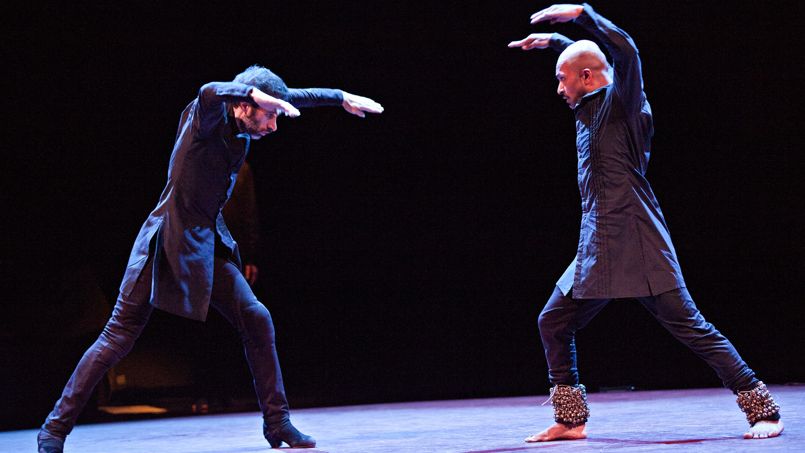
The show starts off with both dancers performing moves inspired by both traditions but expressed in their own way. While Galván’s angular flamenco lines and Khan’s fluid lines are still somewhat discernible, the audience will be hard-pressed to tease out which moves belong to which tradition. And that is the point.

The performance then progresses to a series of solos where both dancers openly defy both traditions. If “purists” were seething at both dancers before, they will go into cardiac arrest this time.

Think Khan dancing with hands in flamenco boots or silencing the jaleos (shouts of encouragement) by the Spanish palmero (rhythm clapper), Bobote.

Aside from his usual fare of breaking the lines expected of a flamenco dancer, Galván’s ferocious and primal solos were ornamented with playful squawks and gestures. At one point, I gasped as he stomps on Khan’s ghungaroos (ankle bells) and performs a series of footwork. However, with the jingling of the bells to accompany his footwork, it feels as if he is performing a duet with Khan.

In other solos, it is clear that both men are going back to the roots as if to remind the audience of where they came from. The show ends with the dancers coming full circle by locking horns and combating each other in the only way that they know how.

If the choreography is complex, the music that accompanies it tops that. It is a wondrous amalgamation of classical kathak and flamenco rhythms that are lyrically guided by songs from western classical and folk traditions.

Percussion enthusiasts would revel in B. C. Manjunath alternating between vocalising kathak rhythms and counting in Spanish while playing the pakhawaj (percussive drum comprising two kettle drums tied together) or duffali (hand drum).

Vocal and choral lovers will enjoy the interweaving of David Azurza’s counter-tenor vocals with Christine Leboutte’s lower range. Add Bobote’s clapping into the mix and we get music that is profoundly meditative, dramatic, and playful at various times.

Torobaka puts creativity, energy, and passion back into dance as it excavates the dynamics of human interaction as well as forming new movement vocabularies. In essence, Khan and Galván show us how anarchy and tradition can co-exist within the realm of human expression.

Other Reviews

“da:ns Fest 2015: Akram Khan, Israel Galvan go mano a mano” by Mayo Martin, Today

“Duality in Harmony” by Germaine Cheng, The Straits Times Life! 

“Torobaka Review” by Ezekiel Oliveria, Five Lines

[Dance Review] An Evening of Five Works — A Dazzling Constellation of Bodies

NDT2

An Evening of Five Works
Nederlands Dans Theater 2
9 October 2015
Esplanade Theatre
9–10 October 2015
Part of da:ns Festival 2015

The youth wing of Nederlands Dans Theater (NDT) graces the Esplanade stage again with five fresh works which premiered within the last five years.

The programme opens with “Schubert and Some Other Time” by Sol León and Paul Lightfoot. In Schubert, the choreographic duo mirrors the motifs of the music by creating motifs of angular and flowing actions that extend throughout the pas de deux. While it is an exploration of love, it refuses to fall into extremities. What unfolds is a meditative rumination of love that is enhanced by the beautiful lines and perfect control of the dancers.

Despite the monochromatic set design of “Some Other Time”, León and Lightfoot colour their dance with various movement vocabularies such as mime, contemporary, and ballet. The dancers are tasked to embody the feelings of oppression and breaking free set against screens being pushed around the stage which adds another layer of movement. The dancers showed superb versatility and flexibility as they coalesce into a constellation of bodies. At times, it is hard to pick out which represents oppression and which freedom because—apart from being too transfixed by the dancers—what constitutes either sometimes depend on one’s perspective.

Sharon Eyal’s and Gai Behar’s “Sara” opened the second segment as several dancers appear in nude tights while pulsating to trippy music. The set up consists of one girl mouthing the words of a song while the others forming a series of pseudo-tableaus but each dancer repeats a particular action like a cog in a machine. This is interspersed with synchronised movement sequences.  It is surprisingly wonderful that Eyal mentions that “[i]t springs from the subconscious, but is very humane at the same time” because there is a primal quality that emanates from the piece. Sara eludes any intellectual interpretation but there is a sense of it coming from a deep place in oneself that is seldom the focus of introspection.

To be able to seek and achieve mutual comfort requires a great deal of interaction. Edward Clug’s “Mutual Comfort” is like a physics experiment of how one body reacts when it comes into contact with another. The dancers handle the technical demands with aplomb and the crispness of their lines is something to behold. This piece presents the facets of human interaction at its most beautiful.

NDT 2 pulled out all the stops to ensure that the show ends with a bang. Cue dazzling lights, sixteen dancers, synchronised movement sequences, and baroque music at its most dramatic. These elements come together to form an extravagant presentation of…

“Cacti”.

An earlier review of this piece says that Alexander Ekman’s ability to be genuinely funny through the medium of dance is an achievement. Unfortunately, that sentiment is myopic. Ekman’s genius lies in the ability to satirise one’s art form and yet the audience will still takes what he is doing seriously after having a good laugh. Cacti is a riot of fun which showcases not only the physical abilities of the dancers, but their creativity as well. The voiceovers which include a monologue expounding on a supposedly profound fact and the running commentary of the silliness of the dance moves show how the production elements can really enhance the dance. More importantly, it also boasts of the dancers’ non-kinetic talents.

Rather than just being a showcase of five recent works, NDT 2 offers an exposition of the potentials of contemporary dance and the human body. One can only hope they formulate their next exposition as soon as possible.

Other Reviews

“Nederlands Dans Theater 2’s Five Works closes with a work that is profound and humorous” by Germaine Cheng, The Straits Times Life! 

[Listing] The Emperor’s New Clothes by W!ld Rice

Emperor's New Clothes

Once upon a time, in a kingdom not so far away, ruled a vain and pompous Emperor, who was crazy about his clothes, himself and little else. So obsessed with fashion was he that he decreed that the 50th anniversary of his reign be celebrated with the most extravagant National Dress Parade of all time. But, as he primped and preened, he neglected his citizens, who could only get his attention by complimenting him on his appearance.

One day, two cheeky tailors decide to teach him a lesson. Presenting the Emperor with an eye-popping ensemble literally woven out of thin air, they convince him that only the smartest and most competent people in the land can see it.

What can be done to stop the nation’s biggest wardrobe malfunction? Why won’t the Emperor’s courtiers and the aristocracy speak up? Is there anyone who’s brave enough to tell the naked truth?

This holiday season, W!ld Rice puts a Singaporean spin on Hans Christian Andersen’s timeless tale about the ultimate fashion victim. Directed by Pam Oei, The Emperor’s New Clothes is a brand new musical with a razor-sharp script by Joel Tan and a sparkling score by Julian Wong. Its stellar cast includes Lim Kay Siu as the Emperor, Benjamin Kheng of The Sam Willows, Singapore Idol’s Sezairi Sazali and Siti Khalijah Zainal—all playing musical instruments live on stage!

Fun and laughter never go out of fashion. Don’t miss the most hilarious, heartwarming musical of the holiday season!

Catch The Emperor’s New Clothes from 20 November – 12 December at the Drama Centre Theatre. For ticketing information, please visit Sistic.