[Theatre Review] Intrusions — “A World Beyond Common Sense”

Intrusions

Photo: Vasco Emidio

n.b.  I would like to inform my readers that I am currently helping Checkpoint Theatre to archive one of their upcoming productions. However, I strongly believe that this does not affect the integrity of my critique.

Intrusions
Jean Ng & Joavien Ng
31 March 2016
Esplanade Theatre Studio

31 March–2 April 2016

(After Tynan, 2 November 1958)

A studio filled with ephemera. It is scattered all over the place as it is evident it has been in a toss-up of trial and error. Towards the back, a banner reads “Our Dream Show.” Two performers are in the midst of the devising process.

Performer 1 (henceforth P1) is at the mirror making a series of weird faces. Performer 2 (henceforth P2) reacts by laughing. P1 occasionally checks the sound levels of P2, writes in a notebook, takes photos of some of her faces, and continues experimenting in the mirror.

P1: (while writing in her notebook) Ok, so that’s two motifs done.

P2:  (laughs a little) I really admire you man. Not only do you have a strong physicality, you have a rubber face; the variety of expressions you can do ah. (P1 takes pictures of some of her own expressions) Eh, you trust me that much?

P1:  Yea. But we still have to try them out on others… just to be safe (continues with her experimentation).

P2: Yea, play safe better.

P1: But not too safe, if not our show will be boring. (She writes up her notes and takes a break. She’s clearly exhausted). Oh yea–

P2: What?

P1: What is a good way of linking the motifs together?

P2: Hm… I’m not sure…

P1: Damn. We still need to create more sections…

P2: Well–

P1: Yup?

P2: If the motifs are good then maybe we don’t have to worry too much. We just use the usual link. (P1 is puzzled) Since our work has a post-modern flavour, we link it up by the usual movement as if we are being electrocuted or possessed.

P1: What?

P2: Don’t worry. As long as the motifs of the facial expressions and our subsequent material are amusing enough, I think the audience won’t mind too much about that.

P1: (looks at the decibel meter) I guess so. Ok let’s KIV this issue.

P2: Orh. What about our other materials ah?

P1: Let’s look at our journals. (Goes to a table and takes two dream journals and peruses them with P2).

P2: Eh see here… We both talk about mirrors!

P1:  Mirrors… Maybe we mirror each other in something…

P2: But don’t make it exactly alike.

P1: Same same but different… Perhaps like we are in a parallel existence or something. Then we do actions within in a similar theme but we are clearly in different spaces.

P2: Yea! Maybe different climate or we suggest that we exist in different era or culture. Not bad…

P1: Good, good. At the same time we can also confound expectations. Since we are both women right, maybe we randomly do some construction stuff and cook really badly in some parts.

P2: (laughs) Can. But do you think there’s something is missing for this part?

P1: Yea… but I don’t know how to say it.

P2: That’s right!

P1: Huh?

P2: We can’t communicate what it is… lost communication… (tries to come up with related concepts for a bit) Since we can’t just keep doing stuff willy-nilly, we should try to establish communication with each other.

P1: But we fail to do that! That’s great… At least the audience has something to follow. We also can throw in something for fun (looks around and sees a red telephone) like that one! (Both agree and write in their notebooks) Speaking of audience following us ah, maybe we should come up with something on top of us just moving all the time?

P2: Like what? Monologues ah?

P1: Yea… You can do that since you are the literary one.

P2: Eh but you must also help me to think.

P1: If you want audience to follow us… then throw in something about mothers or childhood. Make that one funny ah. Don’t just make it a trip down memory lane. The theatre shouldn’t add to the nostalgia fest.

P2: Ok… But I think we need to mix it up a bit. Not everything should be funny.

P1: Funny is good what. If the audience—and especially the critics—are happier, they might be more forgiving… But you’re also right… If we want serious, then have something that suggests violence but we don’t actually act it out.

P2: Haha… like in a Greek play… Something serious… You ok with rape?

P1: What?

P2: I mean of course no one is ok with rape. I’m talking about adding something about rape inside the show… it could be quite violent. Just checking because some people might be sensitive.

P1: But we don’t act it out right?… Then it’s fine.

P2: Ok cool. Oh yea, how should we frame this whole thing? I mean we have a bit of this and that, but how do we string them together?

P1: We ask questions.

P2: Huh? Why suddenly so profound?

P1: No, we are talking about dreams and fantasy right? We ask questions about it.

P2: Oh like those seemingly paradoxical ones?

P1: Yea. With that we can also use the lights to highlight certain things. That way, we have some sort of structure but we are free to explore.

P2: Dreams are such wonderful sandboxes. You can do anything.

Other Reviews

“Madly beautiful dreamscapes” by Akshita Nanda, The Straits Times Life!

“Intrusions by Jean Ng and Joavien Ng – Review” by Five Lines Asia

“Dreams, and what to do?” by Kei Franklin, Centre 42 Citizens’ Reviews

“不是痴人说梦” by Neo Hai Bin, Centre 42 Citizens’ Reviews

[Theatre Review] The Effect — Not Totally Effective

The Effect

n.b. Out of professional courtesy, I would like to inform my readers that I am currently helping Checkpoint Theatre to archive one of their upcoming productions. However, I strongly believe that this does not affect the integrity of my critique. None of the actors in The Effect are involved in the project I am working on.

The Effect
Pangdemonium!
13 March 2016, 3pm
Victoria Theatre
25 February–13 March 2016

Audiences and colleagues who have watched The Effect before me rightly pointed out that one of the themes of the play is about the nature and reality of love. However, if we were to look at the bigger picture, the play poses a more fundamental philosophical question: Can the self be reduced to the workings of the brain?

Prebble expounds on this question through two parallel relationships. On one hand, we have Tristan Frey (Linden Furnell) and Connie Hall (Nikki Muller) who are test subjects of the antidepressant drug, RLU37. When they fall in love, questions are raised over whether it is real or is it an effect of the drug.

On the other hand, we have Dr Lorna James (Tan Kheng Hua) and Dr Toby Sealey (Adrian Pang), researchers administering this drug trail. Apart from their professional relationship, this duo once had a turbulent romance.  James suffers from depression and Sealey wants to her to take the drug. James is reluctant as, apart from her doubts about its efficacy, she believes that medication does not solve everything.

And it is in the interactions of the couples that lie the greatest merit and demerit of any play that poses philosophical questions.  The former is seen in the Frey-Hall romance as the questions arise through the plot and conflicts the couple has.

The latter is seen in the doctors’ relationship as Prebble stages a flat-out debate with both characters expressing opposing arguments. Granted that Prebble does attempt to flesh out a past history between the doctors, the argument could still take place even if they were madly in love with each other. As if the main philosophical question is not complex enough, the doctors also debate about the ethics of marketing drugs.

As for the effect of the acting, the actors are competent but not impressive. Furnell and Muller wonderfully feed off each other’s energy and are completely at ease on stage. However, Muller adopts an accent that, while believable, restricts how she expresses herself. She sounds perpetually excited and there is hardly a modulation in tone. While Tristan Frey is Irish, Furnell makes the wise decision of adopting a very light Irish lilt to play his character. This gives him more space to work with the demands of the scene.

Oddly enough, Tan Kheng Hua and Adrian Pang decided not to adopt an English accent which makes it rather odd given that both actors are more than capable to do so. More importantly, they mar an otherwise good performance by not being able to sustain the energy in the quieter moments.  Even when Dr Lorna James unravels, Tan’s portrayal is too inward that I found it difficult to sympathise with her. Instead, it feels like I am observing a curiosity from afar.

While many productions do create multiple physical and psychological spaces within the confines of the same set, the division is not clear enough in this production. For some reason, it feels rather crowded when all four actors are on stage. Furthermore, even when the set is altered to suggest a different space,—such as when the doors of the lab are tilted diagonally outwards to suggest the open windows of an abandoned asylum—Furnell and Muller do not make the effort to create the sense of a new space.

That said, set designer Wai Yin Kwok must be praised for the futuristic and clinical set. This is complemented by Guo Ningru’s sound design of static noises or the humming of the machinery which create an unsettling atmosphere.

If my review were akin to the results of a drug trail, it would be what Dr Lorna James had expected: Some positive effects but these are ultimately inconclusive.

Other Reviews

“This is your brain on love: Pangdemonium’s The Effect by Akshita Nanda, The Straits Times Life! 

“Theatre Review: The Effect by Adibah Isa, Buro 24/7

“Is It Love, Or Is It The Dopamine: The Effect by Adelyn Tan, Word of Mouth – Raffles Press

“Theatre review: Romantic prescription in Pangdemonium’s The Effect by Naeem Kapadia, Today

“The Effect of love — in 4D” by Jeremiah Choy, Centre 42 Citizens’ Reviews

“The Effect of Love and Other Drugs” by Seewah Ho, What’s Next

[Book Review] Joel Tan: Plays Volume 1

12274384_10156137666015618_3856772621067894757_n

Joel Tan: Plays Volume 1

Lucas Ho (Ed.)

Checkpoint Theatre (2015)/ 408 pp./ SGD 29.90 + shipping costs

For more information, visit Checkpoint Theatre

If one were to peruse the syllabus of a Singapore English-Language Theatre module offered by the National University of Singapore (NUS), it categorises the playwrights into three generations. The publication of Joel Tan: Plays Volume 1 marks the start of the fourth generation.

The whole collection is tinged with a deep sense of ambivalence. Rather than focus on what constitutes Singapore theatre or champion certain issues which were the main concerns of the previous generations, Tan explores what it means to be living in Singapore and dealing with what life throws at you. To aid this exploration, he constantly uses the context of failed or unfulfilled relationships, in subtly different ways, to show the complexity and vulnerability of his characters.

In Family Outing, Joseph plans to come out to his family as a gay man. He gets electrocuted after a freak accident and his boyfriend, Daniel, tells his family the truth a year later. On the surface, this plot appears to be about a family accepting or rejecting the son’s sexual orientation. However, there underlies a certain uneasiness about family relationships and what it means to be a gay man.

After the initial outrage, Joseph’s mother and brother try to reconcile Joseph’s sexual orientation with the Joseph whom they know. Scenes from the past and present intersect one another on stage as they negotiate and come to terms with Joseph’s sexuality. While one’s sexual orientation is a fundamental aspect of one’s identity, does it mean that the Joseph the family knows is less of a person? If so, does one sexual orientation matter more to one’s identity as compared to other areas of one’s life?

Towards the end of the play, there are intimations that Joseph’s mother and brother have a slight inkling about his homosexuality but chose to ignore it due to their deep religious beliefs. This throws a new complexion on the matter as this has got to do with familial relationships and the violence members of family inflict on one another through denial or the supposed desire to protect. This estrangement is further enhanced when we realise that what we are seeing is Joseph’s fantasy which leaves open the possibility that the family might reject him instead.

With this being one of his earliest plays, Tan displays a great deal of sophistication in being able to pack all these into a light-hearted play which is brought out by the brother’s antics and the mother who is slightly prone to histrionics. While Tan manages to balance the moods of the play well, he is a little overambitious with including all these different layers in the play especially—as Tan himself admits— the fact that it is Joseph’s fantasy may not come across clearly.

The ambivalence of being a gay man is also seen in That Daniel but it focuses on a young man fitting into the gay culture. In this deeply personal monodrama, Tan displays his linguistic dexterity in expounding on the pressures of conforming to a certain type and how this might affect one’s relationship with food. This is best encapsulated by the metaphor of noodles as Daniel says:

“We are noodles, we begin life as lumps of human starchiness, sliced by the noodle-cutter of life into pretty shapes, acceptable to the human eye and fit for human consumption, palatable” (271).

The richness of the gastronomical descriptions enhances the poignancy of the play as Daniel realises that he has pursued unrequited love at the expense of a certain happiness that he finds in food. It might be tempting to say that everyone faces a similar pressure to conform, but—as Isherwood’s A Single Man points out—it unfairly whitewashes the experiences of the individual. While this play does not enlighten us about the particularities of the pressures faced by gay men, it compels sympathy and reflection that hopefully precedes conversation.

That said, I wished this play was a wee bit longer. Tan sees this play as an optimistic one because he sees Daniel making a positive change after coming to a certain realisation. However, we only see Daniel coming to terms with his hurt and it stops there. This realisation could have made a positive or negative impact on Daniel which is why there should be a hint of what is to come.

Aside from linguistic versatility, Tan is keen to experiment with form and structure which is clearly seen in Postgrads and People.

The phrase “true-to-life” has been used and abused by critics of all stripes, but this term is most apt for Postgrads. The trajectory of life’s events does not follow a curve of climax and resolution, some conversations are never had, and some relationships remain unfulfilled. More importantly, one does not necessarily have a clear reason for doing something. And that is what confounds a group of housemates who are postgraduate students when one of them decides to drop out of the PHD programme.

While the conversations consist of feel-good reminiscences, private regrets, and banal chatter, there is a mounting sense of resignation and sadness. The atmosphere may be relatively serene, but the conversations appear to be a desperate attempt to forestall the final goodbye. Despite the fact that the play is crafted in a certain way due to the demands of the commission, Tan excels in infusing a certain sensitivity and subtlety to his play and it does not feel that he is consciously working around certain limitations that were placed on him.

The vignettes in People, which are either monologues or duologues, make it the most ambitious play in the whole collection. Tan once again returns to the motif of estranged relationships and see variations of it play out across a cross-section of society.  Set in either Singapore or Tokyo, there is a distinctively urban sensibility to it as we see the characters relate to others either across geography, class, or on a spiritual level. Tan’s ear for dialogue is apparent as he captures the milieu that the characters operate in. The litmus test for any playwright with regard to Singaporean dialogue is to balance between Singlish and whatever language the working class character speaks. In the hands of a careless writer, the dialogue makes the character nothing more than a caricature. While Francis the mobile phone seller has certain speech quirks that one—rightly or wrongly—associates with the working class, Tan is careful not to overdo it. Additionally, Tan even experiments with verse in the monologues of Nicholas who decides to leave the priesthood.

Given that Tan allows the director to arrange the vignettes as she pleases, this play merits several re-stagings just to see what can be excavated from the text.

Speaking of estranged relationships, the one in Hotel is the most ugly and toxic. Within a few pages, Tan raises all the ugly implications of economic success through the explosive arguments of the rich couple. What is notable is that Tan resists any form of resolution—the argument at the end of the play is interrupted and will probably occur again. Bearing in mind that Hotel is supposed to be a reimagined history of The Arts House (Singapore’s former parliament house), the play serves as a fitting platform for Tan to rail against the excesses of Singapore. Its brevity also ensures that it does not go overboard.

Mosaic explores another form of emotional violence in our lives—the destruction of physical space, and the memories that go with it, in the name of progress. However, violence is also inflicted upon one’s memories if it is co-opted and turned into some kind of fetish or commercial enterprise. This play thus juxtaposes both forms of violence and expresses a deep sense of ambivalence towards the efficacy and appropriacy of popular causes such as heritage activism.

This is embodied by Sharon, the protagonist who ropes in her boyfriend and tries to organise a demonstration against the authorities tearing down an old playground. She is clearly unable to rally people to her cause and when asked what how she is going about the event, she retorts: “Nothing is going to happen, why must thing always happen? What we’re doing is symbolic […]” (212, original emphasis). Later on, she tells Rong Cheng, a passer-by who lives nearby and used to play in the playground that the “playground is like a tile in the giant mosaic that is the things I care about” (222). However, a mosaic on the whole should form a coherent picture but her specious replies and lack of planning cast doubts on the coherence of her pet causes. The conflict between Sharon and Rong Cheng also raises the question of whether someone can legitimately oppose any governmental re-development projects if she does not have any prior relationship to the place.

Tan’s talents are seen in how, on one level, the characters are symbolic of certain things and their conflicts and interactions becomes a dialectic about activism. On another level, the settings and situations are entirely naturalistic and the characters are not reduced to being mouthpieces for a certain position. At the end, Tan could not help but employ the same motif of a failed relationship to bring up themes of moving on, letting go, and the difficulty of doing so as we often have a complex relationship with the past.

The Way We Go is a reworking of Tan’s second full length play that was written as part of a playwriting module at NUS. In it, he explores what it means to love yourself and another by having two parallel romances; the lesbian relationship between two convent school students (Gillian and Lee-Ying) and that of the school’s principal and a cousin of her colleague (Agatha and Edmund). The former relationship fails due to a difference in temperament and goals while the latter is disrupted by death.

Tan employs counter-directional narratives to allow for the parallel relationships to be shown on stage in an economical way. It also shows Edmund dealing with the hurt and finding his way back to the first moment he saw Agatha. This allows him to find closure and begin again. This play rewards the careful reader as a careless one will only see it as containing snapshots of the lives of the characters and nothing more.

That said, Violet (Edmund’s cousin and Agatha’s colleague) feels like a convenient device for the couple to meet and the two romances could have been a little more inter-connected in some way.

Perhaps, it is due to this early and extended exploration of dealing with love, lost, and moving on that led Tan to re-use the motif of failed relationships over and over again. While there is an effort to use it in various ways, Tan has stretched it to its limits this early in his career.

However, this does not detract from the sensitivity, subtlety, and a strong voice which Tan clearly possesses. In this collection, he resists being didactic and focuses on the individual and sometimes painful story of simply dealing with everyday life. He has also shown that he can use this lens to reflect on wider societal issues.

In the interview that is included in the book, he says he is interested in writing political plays which are rooted in the experience of living in Singapore rather than those which preach to the choir. Judging from his output in this collection, I await the next phase of his writing career with much excitement.


[Theatre Review] The Emperor’s New Clothes — Joy of Playing Dress-up

The_Emperor_39_s_New_Clothes_by_W_LD_RICE_pic_3

Photo: Albert Lim KS / Courtesy of W!ld Rice

The Emperor’s New Clothes
W!ld Rice
21 November 2015
Drama Centre Theatre
10 November–12 December 2015

There is a difficulty in adapting the popular tale by Hans Christian Andersen as a pantomime. It needs to have wonderful costumes, it has to be fun, and—most importantly—it must not be pretentious as the main point of the story is to mock the pretentions of society.

W!ld Rice excels on all counts.

Nathan No Surname (Benjamin Kheng) and Khairul No Surname (Sezairi) are orphans who become tailors. They are commissioned by the  ministers in the hopes of getting them to create a wonderful outfit for the vainglorious Emperor Henry Lim Bay Kun (Lim Kay Siu) for free. Khairul eventually convinces Nathan that they should take it as it is a good exposure for their business. They later find out that the Emperor arrests all who take the attention away from his outfit during the National Dress Parade (NDP) and decide to teach the Emperor a lesson with his “new outfit” for the 50th NDP.

Nothing is safe from satire as Joel Tan’s witty script references Lee Kuan Yew, lawsuits against foreign media, incompetency of the ministers, ISA, banning  musical instruments during Thaipusam, mediocrity of Mediacorp dramas, SG 50, and absurdity of national day parades.

With Tan’s clever employment of puns, acronyms, and Singlish, the audience experiences a bellyache of laughs throughout the two hours. The greatest merit of this sparkling script is that it does not belabour the various criticisms that it puts across. This makes the play snappy while packing in quite a lot at the same time.

Additionally, its injection of self-deprecating jokes such as mentioning Ivana Heng, the crazy theatre director who designed a rainbow outfit for the Emperor, or the Emperor asking his Minister of Retribution (Andrew Lua) to keep tabs on Sam Willows (a band that Kheng is part of) makes it all the more delicious.

Director Pam Oei pulls out all the stops and makes her cast showcase whatever talent they have or even acquiring new ones just for the show. Most of them sing, dance, and play instruments live on stage.

Benjamin Kheng’s anxious Nathan is a nice contrast to Sezairi’s laidback Khairul. Aside from their singing which they are known for, their dancing is tight and there is a wonderful synergy between them as we can easily believe that they are “brothers from another mother.”

Lim Kay Siu (Emperor Henry Lim) brings out his youthful and vain side as he preens and poses throughout the show. Audrey Luo (Empress Jeanette How) plays the melodramatic caricature of local actress Jeanette Aw to the hilt. This could not come at a worse time as Aw is currently facing criticisms about her inability to sing in Beauty World.

Other notable performances include Siti Khalijah Zainal (Nafisa bte Jasmani, Minister of Finance), Andrew Lua’s  (Wong Bok Siu, Minister of Retribution), Benjamin Wong and his counter-tenor vocal range as the aptly named Aplhonsus Kan Sing Low, Andrew Marko as the Thai fashion reviewer, and Candice de Rozario as Arppeggio Chong.

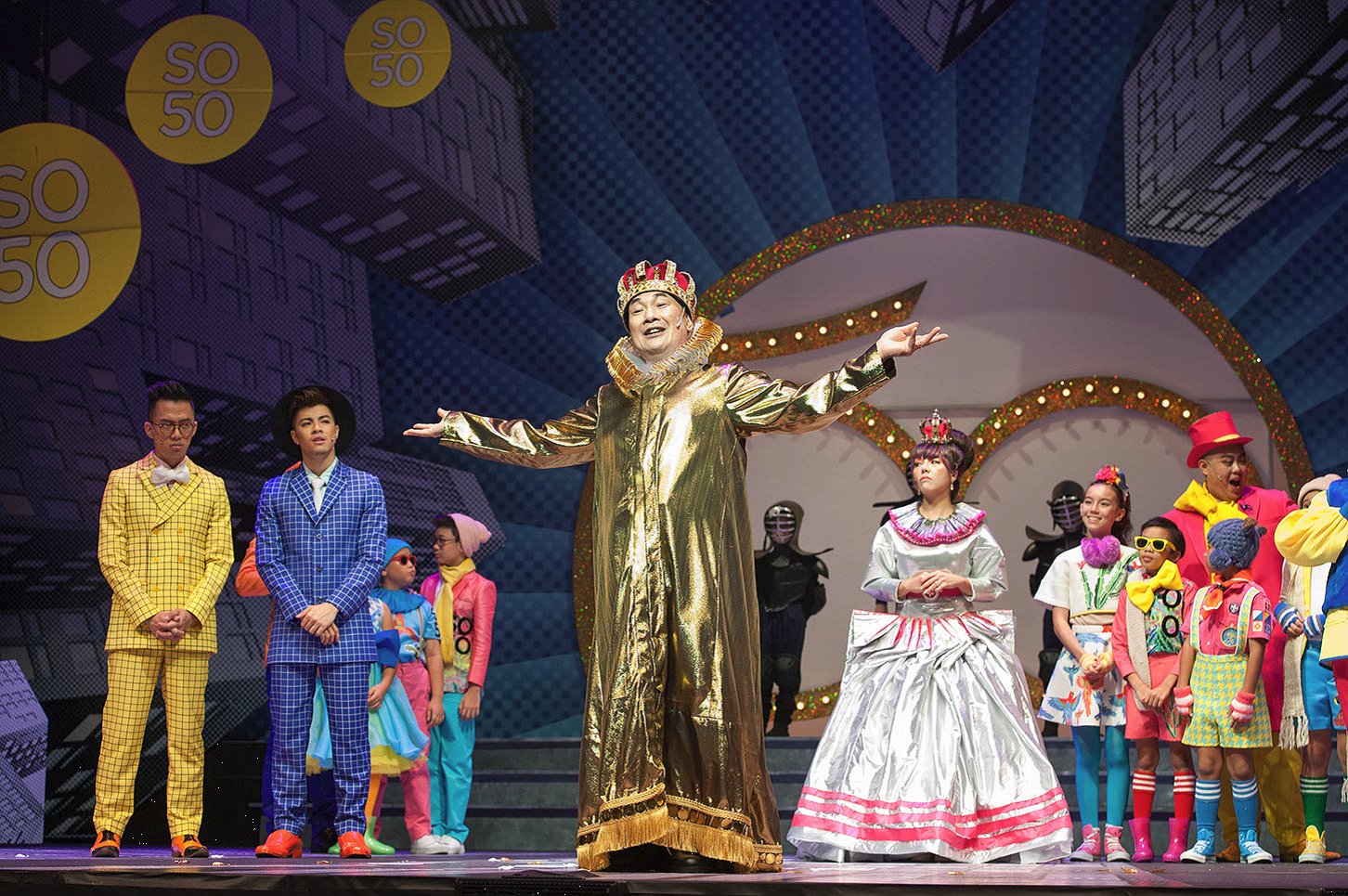
Julian Wong keeps our toes tapping with his catchy tunes that range from joget music to the moving, ballad-like “Open Up” when the tailors and the Empress confront the Emperor. Set designer Eucien Chia adopts the comic book aesthetic by having skyscrapers pointing inwards. The monochromatic set allows costume designers Phisit and Saxit from Tube Gallery to unleash a largely neon palette onto the stage.

All these elements make for a fun, energetic, zany, and hilarious musical that calls on the powers that be to reflect on their style of governance and perhaps renew their commitment to serving the people.

With Singapore celebrating her Jubilee and witnessing a heated election, I could not think of a more befitting production to end the year. If only we could nudge our ministers into the theatre.

Other Reviews

“The Emperor’s New Clothes pantomime has audience in stitches” by Akshita Nanda, The Straits Times Life!

“Time Out Singapore: ‘The Emperor’s New Clothes’ Review” by Gwen Pew, Gwen Pew (originally published in Time Out Singapore

“The Emperor’s New Clothes: Revisiting SG50 Through the Wittiest Musical” by Sheryl Teo, Popspoken

“Theatre Review (Singapore): ‘The Emperor’s New Clothes’ at Wild Rice” by Sharmila Melissa Yogalingam, BlogCritics

“The Emperor’s New Clothes: A Treat For All Ages” by Reuel Eugene, Reuel Writes

“The emperor’s new clothes” by Jes, Jesme

“Review: The Emperor’s New Clothes” by Jordan Chia, Youth.sg

[Theatre Review] Battlefield — Brook Makes Audience Battle Boredom

Battlefield

Battlefield
Peter Brook & Singapore Repertory Theatre
21 November 2015, 3 pm
Capitol Theatre
17–21 November 2015

I do not need to offer a synopsis of Battlefield for the story from Mahabharata should be somewhat familiar to most people. More importantly, the tales and parables are intimated so subtly that it could have been any other generic story.

Brook returns to story-telling traditions as the action—or lack thereof—takes place on a largely bare stage. Characters are indicated by the cloth they wear around their necks and the story is told through words, symbolic actions and manoeuvring of various cloths. However, the thousands of deaths and the struggles of the king are neither indicated by the expressions of the actors (Carole Karemera, Jared Mcneill, Ery Nazaramba, and Sean O’Callaghan) or the timbre of their voices.

Rather than bore you with details of this lacklustre performance, allow me to entertain you with a description of the drama that unfolded around me.

A bout of snoring from the left flank of the theatre marks the thirty-fifth minute of the show. I look to the left and about six to ten seats away from me, there is a man fast asleep as he reclines in his seat. Every few minutes, there is an intermittent pause in the snoring as he tries to find a more comfortable position to snooze in.

On four or five occasions, I hear the rustling of a plastic bag directly behind me. I am inclined to turn around to see what is in the plastic bag but I do not want to embarrass the person. While I am usually irritated by such nuisance, I only have the deepest of sympathies for my fellow audience member.

At the forty-five minute mark, a young man four seats to my left starts to get restless. Yielding to temptation, he rips open his bag that is fastened by Velcro and risks incurring the wrath of his fellow audience members. Nobody bats an eyelid. He takes out the programme, places it on his lap and starts flipping it in search of enlightenment or anything that would kill time.

Stepping out of the theatre, an Indian woman complains to the front-of-house about not being able to hear the actors. As I walk out of the lobby, a voice trails behind.

“Excuse me!” I turn around and it is the same Indian lady. “Did you just watch the Mahabharata?”

“Yes.”

“Were you sitting in the circle?”

“No… I was seated towards the back of the stalls.”

“Cannot hear the actors right?” I nodded in agreement.

“I mean sometimes they never pronounce their words clearly… but when they do, you could hardly hear it… very bad.”

“Yah.” I watch her walk off. She shakes her head in disappointment and points her finger forward either to emphasise her frustration to herself or perhaps to admonish an imaginary Peter Brook.

Unlike my colleague from The Straits Times, I shall not make excuses for the show as I can only report my experience. One may write all the books in the world but if the production does not reach out to the audience, it is a colossal failure.

Rather than get caught up with the glimmer of Brook’s halo, we should demand more from this experienced artist.

Other Reviews

“Art of story-telling at its finest in Peter Brook’s Battlefield” by Akshita Nanda, The Straits Times Life!

“Theatre Review: Battlefield by Mayo Martin, Today

“Theatre Review: Peter Brook’s Battlefield” by Alex Tham, Buro 24/7

“Singapore Repertory Theatre Presents: Battlefield by Peter Brook” by Nithia Devan, City Nomads

“Theatre Review (Singapore): ‘Battlefield’ by Peter Brook” by Sharmila Melissa Yogalingam, Blog Critics

Battlefield—An Indulgence of Ideas [Review]” by Seewah Ho, What’s Next

“The Final Scene from the Mahabharata by Imp (alias), Faerie Tales 

[Dance Review] ¡Magneta! — Not That Magnetic

Magneta

¡Magneta!
Flamenco Sin Fronteras
13 November 2015
Goodman Arts Centre Black Box
13–14 November 2015

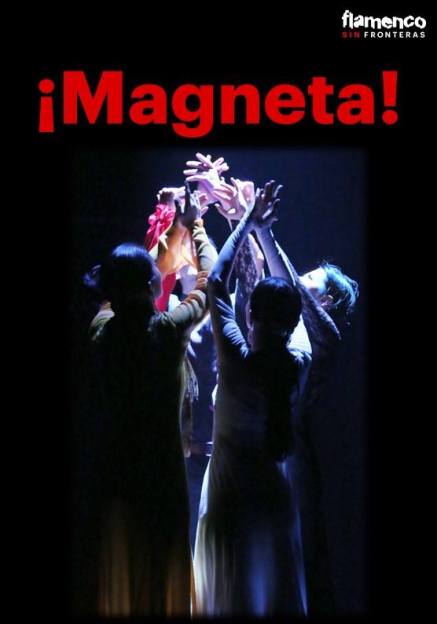
Spanning ten different items and six different palos (styles), ¡Magneta! strives to showcase the versatility and creativity of the company. Unfortunately, the attraction is not consistent.

The programme starts off with two weak performances. The first item plays on what the public would think of as flamenco music—Gipsy Kings. Against the sultry rendition of Volare by Toshiaki Konno, most of the dancers ignored the meaning of the song title as they dance with their wings clipped. Apart from Tilly Wong and Cheryl Ng who exude joy, the other dancers are extremely cautious and look as if they are counting the rhythms or recalling the next step. Thankfully, this feeble item ended quickly.

As the dancers leave the stage with a slight flourish, Saori Otsuka enters to perform the Cantiñas. While Otsuka is technically excellent, her guarded approach to the dance is puzzling given that she personally adapted the dance from a choreography by Alicia Marquez and Pilar Ogalla. Whatever attraction one feels to her strong and steady footwork is neutered.

To break the slumber, Toshiaki Konno bursts in with a barrage of footwork as he performs the Solea Por Bulerias. Konno exudes sheer confidence as he communicates with the musicians and the audience. Alternating between sleek moves and fiery footwork, he even finds time to toss a stray hair clip aside with nonchalance. The floor of the black box does an injustice to Konno’s dancing as it fails to convey the full timbre and musicality of his footwork.

Guitarist Sergio Muñoz lets us down gently from the euphoria of Konno’s performance with a heartfelt solo. As he strums and plucks the guitar strings, there is a sense of deep searching. In response, the faces of the audience light up. Unfortunately, this is not due to Muñoz’s virtuosity, but to their imbecility as they treat him like a street busker and fix their eyes on their phones. This selfish vigil also occurs in the latter half of the show when he performs another guitar solo.

Tilly Wong and Nobuyoshi Nakane kick the show up a notch as they take turns to perform different letras (verses) of the Alegrias. Wong radiates a quiet and infectious joy with her slight smile and her ease in handling the bata de cola (skirt with long train) as she sweeps across the stage. Nakane’s steely reserve serves as a nice counterpoint. His letra starts off quite conservatively as it consists mainly of ‘marking steps.’ He breaks away from that in his escobilla (series of footwork) with a lovely variation of the standard steps and takes more risks towards the end. The short duet in the end is wonderfully playful and the chemistry between both dancers is apparent. Wong and Nakane successfully capture the spirit of the dance.

Over the years, Carmen has become everyone’s favourite gypsy girl. Dark, mysterious, sensual, desirable, and exotic. Rather than presenting the usual seduction scene, Daphne Huang-Vargas (Carmen) and Pedro Simoni (Don José) take on the ambitious task of condensing the whole story into a few minutes.

Unfortunately, it is a few minutes too long.

Instead of using the language of flamenco to intimate what happened between the couple, Huang-Vargas performs a pointless scene in which she acts like a rebellious teenage gangster girl and asks us why we are staring at her in an exaggerated Singaporean accent. The script is as pointless as it is literal—later on, we see Don José saying how much he loves Carmen and asks why she has decided to leave him.

Any more literal and the stage manager will have to read the stage directions out loud.

Thankfully, Yuriko Kurose performing the Farruca returns us to something we can appreciate and enjoy. Attired in a red suede crop jacket, high-waisted black trousers, and hair tied into the ponytail, Kurose pays homage to Carmen Amaya (the Carmen we should all remember rather than the monstrosity popularised by Bizet). While Kurose does not have Amaya’s energy and magnetism, her Farruca is technically flawless which is enhanced by her crisp angular lines.

Mamiko Nakane’s Bulerias is surprisingly too short. However, she makes use of every single second on stage in giving a delightful performance. When the Zorongo started, I thought it was still part of the Bulerias. Despite the slight confusion, the synchronicity of the mantones (shawls) adds a certain visual spectacle as the show ends on a good note.

While the choreographies in ¡Magneta! are relatively traditional, it offers the audience a broad overview of the variety and colours that flamenco can offer. This is a small but important step to break flamenco away from the stereotype of it being merely about passion and sensuality.

[Theatre Review] A Twisted Kingdom — Definitely Not Fool’s Gold

twisted kingdom

Illustration: Marc Gabriel Loh

A Twisted Kingdom
Dark Matter Theatrics
12 November 2015
The Substation
12–14 November 2015

Just like the Tarot cards, The Fool (Lian Sutton) in A Twisted Kingdom goes on a journey through life’s mysteries and, in the process of doing so, drudge up his own personal memories and history. He embodies the everyman while telling a very personal story.

Playwright Christopher Fok showcases his mastery of the medium by seamlessly weaving the overarching story of the Fool in search of the prince, references to fairy tales, and the Fool’s painful past into one intriguing tapestry.

While the arrangement of the scenes may appear complicated, there is an indescribable logic to it. Fok achieves the sweet spot of preventing the audience from falling into a passive lull but not pitch it at such an esoteric level that one is unable to get a grip on what is going on.

How does one play the Fool and reopen old wounds at the same time? Sutton has part of the answer. One should not be fooled that a small stage space would make his job any easier. From jumping on the chair and turning it into a horse to donning a doctor’s coat and embodying different sorts of doctors, Sutton is a sensitive story-teller.

The ability to transit into the next scene which is of a very different nature from the previous speaks of an intense rehearsal process. Sutton may be overstretched at times, but the audience is always couple of paces behind the Fool as we eagerly follow him on his journey.

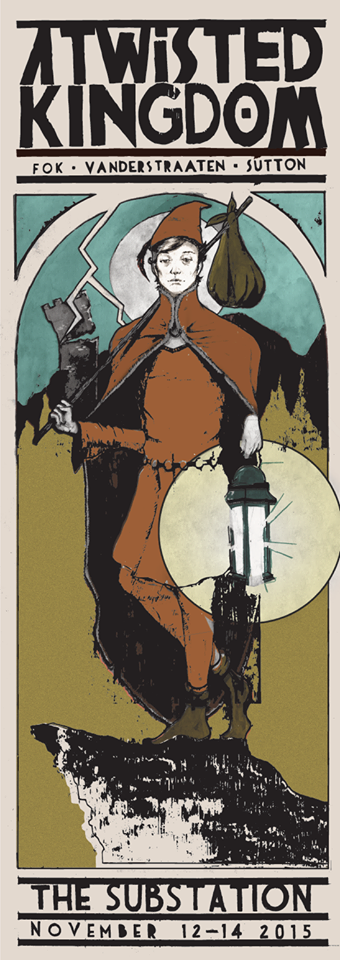
Despite the financial constraints of the production, the designers must be applauded for generously lending their talents. Marc Gabriel Loh’s illustration for the poster and the programme is the best I have seen in a while.

The programme informs us that this production marks Isa Ong’s first foray into music composition for theatre. This makes him one of those annoyingly talented individuals as his music does not indicate a beginner’s attempt. Chew Wei Shan’s haunting vocals towards the end of the show enhances the pathos.

Hakeem Kasban’s lighting design is simple yet effective. Faith Sim’s costume design may appear odd at first but it is wonderfully appropriate in the context of the show. Olivia Vong’s set design makes good use of the space and every item is significant to the story.

Indeed, “The Fool is welcomed everywhere he goes” as one cannot help but stop and listen to his story.

Other Reviews

“Twisted Tales” by Walter Chan, Centre 42 Citizens’ Reviews

[Dance Review] The Fleeting Moment — Capturing the Ephemeral

raw moves the fleeting moment

The Fleeting Moment
Teresa Ranieri & Raw Moves
5 November 2015
Goodman Arts Centre Black Box
5–7 November 2015

Choreographer Teresa Ranieri and I face a similar challenge in our respective endeavours. How do we capture an ephemeral experience and convey its impact in a way that others can experience it for themselves?

The first fleeting moment we see is dancer Kenneth Tan walking into a darkened room and behind a screen as a pastiche of images is projected onto it. A soundscape with repeated motifs fills the room as five other female dancers (Chiew Peishan, Neo Hong Chin, Melyn Chow, Liu Wen-Chun, Sherry Tay) emerge and observe Tan. Observation and mirroring dominate this piece as Tan navigates this mental and emotional landscape.

The ephemeral is suggested through the melding and separating of the dancers and media artist Bruno Perosa’s projection of the dancers’ images splintering. The amorphicity of memory is evoked through a repeated sequence of a dancer adopting a pose of another dancer while a third observes and reacts to it. Apart from the ephemeral, are there intimations of—as Ranieri puts it—instances that define our existence?

Throughout the course of the show, we see snatches of what could possibly be interpreted as death, rebirth, freedom, and struggle. Such vague terms, along with my qualification of providing possible interpretations, do not satisfy the reader and there lies the flaw of the show.

While there is a clear synergy in the way the dancers react to each other, they fail to achieve the “wild carousel of feelings and emotions” that Ranieri is gunning for. At times, this may be due to the guarded approach of the dancers. At others, the beautiful movement work simply fails to capture anything.

Ranieri also misses out on a couple of moments to develop on an interesting premise. At one point, the dancers suddenly split up as four square plots of light are thrown onto the space. I initially thought it is trying to evoke how we tend to compartmentalise our memory or emotions. However, no elaboration is provided apart from a couple of movement sequences and the dancers sliding into the square plots. This leaves me questioning my initial interpretation.

Fortunately, the show gains momentum in the second half which is signalled by a dancer tossing the paper cranes as the ensemble go on to evoke a sense of struggle. Perhaps, the most affecting moment appears towards the end as we see Kenneth Tan trying to gather the pieces of confetti while preventing another dancer from messing it up. He evokes a sense of pathos in salvaging the pieces of memory and emotions as he tries to make sense of it all.

While the choreography is sometimes conceptually hazy, The Fleeting Moment does offer glimpses of beauty that are worth waiting for.

Other Reviews

“Raw moves: Immerse in the moment” by Lisabel Ting, AsiaOne (originally published in The Straits Times Life!)

[Dance Review] Torobaka — A Parley of Traditions

torobaka

Photo: Jean -Louis Fernandez

Torobaka
Akram Khan & Israel Galván
16 October 2015
Esplanade Theatre
16–17 October 2015
Part of da:ns Festival 2015

There is something uncomfortable about Torobaka. How is it possible for two dancers to collaborate on a show with the bull as its main metaphor when one of them comes from a culture which reveres the animal, while the other slays it?

“Anarchy” says the programme notes. The only solution is to go against tradition and come together as two dancing bodies.

The result: Two phenomenal dancers in a bullring that duel, complement, and play with each other.

One of the main impetuses of this performance is a response to a problem in most intercultural collaborations. Rather than digging deep by investigating the vocabularies and limits of both traditions, most performances are often a sophisticated version of dance school recitals. Both traditions are placed alongside each other and the audience is asked to draw up a list of similarities and differences between them.

Torobaka is definitely not one of them. In this work, we see Khan and Galván rolling up their sleeves, giving all that their traditions offer, and summarily tossing them out as well. In many ways, the dances are respecting their traditions in their truthful assessment of what they can offer.

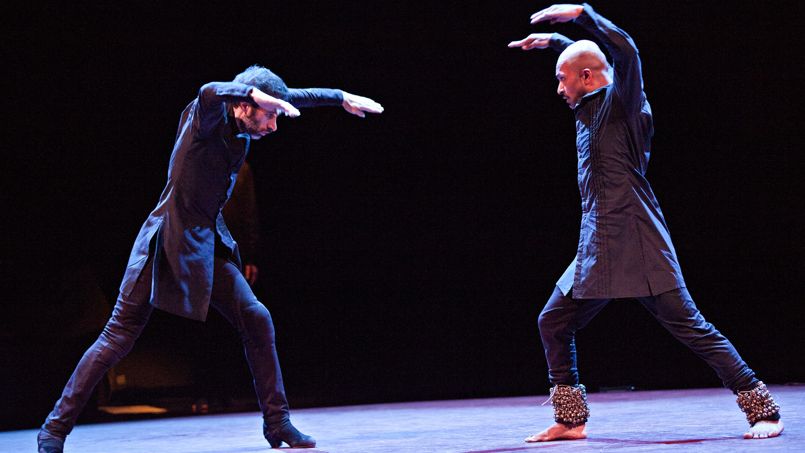
The show starts off with both dancers performing moves inspired by both traditions but expressed in their own way. While Galván’s angular flamenco lines and Khan’s fluid lines are still somewhat discernible, the audience will be hard-pressed to tease out which moves belong to which tradition. And that is the point.

The performance then progresses to a series of solos where both dancers openly defy both traditions. If “purists” were seething at both dancers before, they will go into cardiac arrest this time.

Think Khan dancing with hands in flamenco boots or silencing the jaleos (shouts of encouragement) by the Spanish palmero (rhythm clapper), Bobote.

Aside from his usual fare of breaking the lines expected of a flamenco dancer, Galván’s ferocious and primal solos were ornamented with playful squawks and gestures. At one point, I gasped as he stomps on Khan’s ghungaroos (ankle bells) and performs a series of footwork. However, with the jingling of the bells to accompany his footwork, it feels as if he is performing a duet with Khan.

In other solos, it is clear that both men are going back to the roots as if to remind the audience of where they came from. The show ends with the dancers coming full circle by locking horns and combating each other in the only way that they know how.

If the choreography is complex, the music that accompanies it tops that. It is a wondrous amalgamation of classical kathak and flamenco rhythms that are lyrically guided by songs from western classical and folk traditions.

Percussion enthusiasts would revel in B. C. Manjunath alternating between vocalising kathak rhythms and counting in Spanish while playing the pakhawaj (percussive drum comprising two kettle drums tied together) or duffali (hand drum).

Vocal and choral lovers will enjoy the interweaving of David Azurza’s counter-tenor vocals with Christine Leboutte’s lower range. Add Bobote’s clapping into the mix and we get music that is profoundly meditative, dramatic, and playful at various times.

Torobaka puts creativity, energy, and passion back into dance as it excavates the dynamics of human interaction as well as forming new movement vocabularies. In essence, Khan and Galván show us how anarchy and tradition can co-exist within the realm of human expression.

Other Reviews

“da:ns Fest 2015: Akram Khan, Israel Galvan go mano a mano” by Mayo Martin, Today

“Duality in Harmony” by Germaine Cheng, The Straits Times Life! 

“Torobaka Review” by Ezekiel Oliveria, Five Lines

[Dance Review] An Evening of Five Works — A Dazzling Constellation of Bodies

NDT2

An Evening of Five Works
Nederlands Dans Theater 2
9 October 2015
Esplanade Theatre
9–10 October 2015
Part of da:ns Festival 2015

The youth wing of Nederlands Dans Theater (NDT) graces the Esplanade stage again with five fresh works which premiered within the last five years.

The programme opens with “Schubert and Some Other Time” by Sol León and Paul Lightfoot. In Schubert, the choreographic duo mirrors the motifs of the music by creating motifs of angular and flowing actions that extend throughout the pas de deux. While it is an exploration of love, it refuses to fall into extremities. What unfolds is a meditative rumination of love that is enhanced by the beautiful lines and perfect control of the dancers.

Despite the monochromatic set design of “Some Other Time”, León and Lightfoot colour their dance with various movement vocabularies such as mime, contemporary, and ballet. The dancers are tasked to embody the feelings of oppression and breaking free set against screens being pushed around the stage which adds another layer of movement. The dancers showed superb versatility and flexibility as they coalesce into a constellation of bodies. At times, it is hard to pick out which represents oppression and which freedom because—apart from being too transfixed by the dancers—what constitutes either sometimes depend on one’s perspective.

Sharon Eyal’s and Gai Behar’s “Sara” opened the second segment as several dancers appear in nude tights while pulsating to trippy music. The set up consists of one girl mouthing the words of a song while the others forming a series of pseudo-tableaus but each dancer repeats a particular action like a cog in a machine. This is interspersed with synchronised movement sequences.  It is surprisingly wonderful that Eyal mentions that “[i]t springs from the subconscious, but is very humane at the same time” because there is a primal quality that emanates from the piece. Sara eludes any intellectual interpretation but there is a sense of it coming from a deep place in oneself that is seldom the focus of introspection.

To be able to seek and achieve mutual comfort requires a great deal of interaction. Edward Clug’s “Mutual Comfort” is like a physics experiment of how one body reacts when it comes into contact with another. The dancers handle the technical demands with aplomb and the crispness of their lines is something to behold. This piece presents the facets of human interaction at its most beautiful.

NDT 2 pulled out all the stops to ensure that the show ends with a bang. Cue dazzling lights, sixteen dancers, synchronised movement sequences, and baroque music at its most dramatic. These elements come together to form an extravagant presentation of…

“Cacti”.

An earlier review of this piece says that Alexander Ekman’s ability to be genuinely funny through the medium of dance is an achievement. Unfortunately, that sentiment is myopic. Ekman’s genius lies in the ability to satirise one’s art form and yet the audience will still takes what he is doing seriously after having a good laugh. Cacti is a riot of fun which showcases not only the physical abilities of the dancers, but their creativity as well. The voiceovers which include a monologue expounding on a supposedly profound fact and the running commentary of the silliness of the dance moves show how the production elements can really enhance the dance. More importantly, it also boasts of the dancers’ non-kinetic talents.

Rather than just being a showcase of five recent works, NDT 2 offers an exposition of the potentials of contemporary dance and the human body. One can only hope they formulate their next exposition as soon as possible.

Other Reviews

“Nederlands Dans Theater 2’s Five Works closes with a work that is profound and humorous” by Germaine Cheng, The Straits Times Life!