[Quick Theatre Review] Six Characters in Search of an Author — Six Characters Questioning the Premise of Theatre

Six characters

Six Characters In Search of an Author
Théâtre de la Ville
10 September 2015
Victoria Theatre
10–12 September 2015
Part of Singapore International Festival of Arts 2015

In response to naturalistic theatre, Valerii Briusov writes:

“There is no fixed boundary between the real world and the imaginary world, between ‘dreaming’ and ‘waking,’ ‘life’ and ‘fantasy.’ What we commonly consider imaginary may be the highest reality of the world, and the reality acknowledged by all may be the most frightful delirium.”

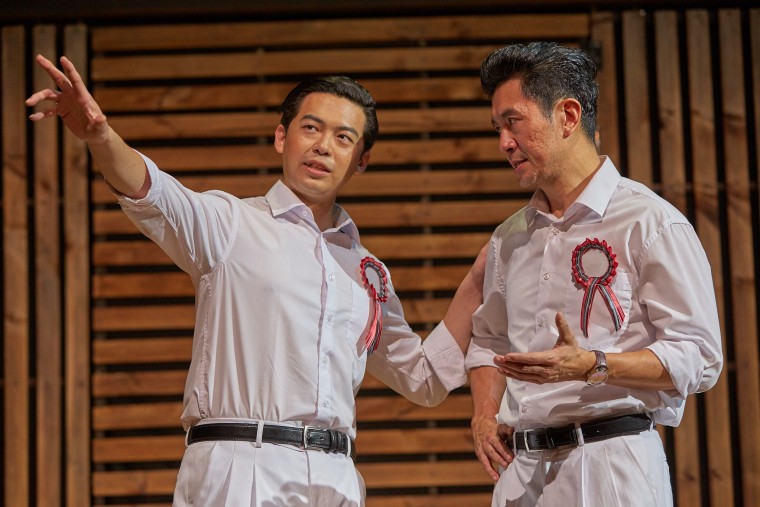
While Pirandello may not be considered a symbolist, his play is Briusov’s comments made flesh. In the midst of rehearsing “The Rules of the Game,” six characters belonging to an unfinished story appear in the rehearsal room and the director is asked to stage their tragedy. What unfolds is an overwhelming, frustrating, yet utterly intriguing piece which challenges the premises of what theatre purports to do.

Pirandello hits the sweet spot between developing the philosophical dialectic without drowning the audience as there is enough action to keep us in our seats. Despite the seeming chaos on stage, there is definitely a method to the madness as director Emmanuel Demarcy-Mota manages to encapsulate it within a minimal landscape of a rehearsal room.

The audience was treated to a wonderful performance by the cast with the actors playing the actors (it’s confusing, I know) being mere walk-on players and yet having enough of a presence to justify them being in the play. The actors playing the characters

Throughout the course of our writing careers, us critics would often pronounce what is considered good theatre and what it is not. If I were asked to do so now, I would – like the character of the “The Father-” unleash a slew of pseudo-philosophical gibberish. My only recourse is to rely on my intuitions which says that this production is definitely one of them.

Other Reviews

Six Characters In Search of an Author by Ng Yi-Sheng, SIFA.sg

“The Elusive Reality of Theatre” by Tung Kai Wai, The Practice Journal

“Six Characters In Search Of An Author: A Bizarre French Madhouse Play” by Abigail Tee, Reuel Writes

[Flash Dance Review] Lord of the Dance: Dangerous Games — Lord of the Looks

n.b. There are times when I am quite busy and would not be able to write a full review of the shows that I have watched. Quick reviews are meant to file my main impressions of a certain show.  

Lord of the Dance

Lord of the Dance: Dangerous Games
Michael Flatley
4 September 2015
Grand Theatre, Marina Bay Sands
3–6 September 2015

It should be called Lord of the Looks. Dancers are wonderful but there’s something odd with everyone being absolutely good looking. It’s exactly the same format as Flatley’s Feet of Flames and Lord of the Dance. Only minor tweaks were made to the choreography and new songs were added.

Those familiar with Flatley’s work will be absolutely disappointed as the way he markets the show is as if it’s a completely new show. What a horrible way to end a glittering career.

Surely he can look to various stories from America (where he was born) or Ireland (where his family comes from) to come up with something wonderful. What a waste of his talents.

Go if you are completely unfamiliar with Flatley’s work or are willing to blow your cash just to look at eye candies for a bit.

[Dance Review] Returning — Stunning Life Cycles

Photo: Ng Yuan Jie

Returning
Goh Lay Kuan
14 August 2015
Drama Centre Theatre
13–15 August 2015

Ostensibly, Returning shows the life cycle of a school of salmon and the trials and tribulations they face. Artistically, I see a life cycle of a tree—drawing nutrients from the roots of tradition before bearing fruits that are expressive and confident.

The dance piece is divided into five segments with the first three segments portraying the salmon developing from an embryo to a smolt and the final two showing the salmon returning to the streams to lay eggs.

Choreographers Meenakshy Bhaskar, Jenny Neo, and Osman Abdul Hamid drew on the movement vocabulary of the Indian (Bharatanatyam), Chinese, and Malay dance traditions to chart the developmental stages of the salmon’s life cycle.

As the embryos become alevins, their movements are limited and they struggle to make sense of the environment. The structured and grounded Bharatanatyam movements , conceived by Bhaskar, lends a firm but quiet energy to the piece. The striking facial expressions and footwork of the dancers exudes the eagerness of the alevins that are full of potential.

Neo’s light and youthful Chinese dance choreography captures the energetic fry as they zip around, avoid predators, and pick up the necessarily survival skills. Despite the perilous situation, the dancers punctuate their quick movements with a momentary pose and let out a playful kiss—the fry call out to one another to ensure that they stay together.

The fry become fingerlings and the process of smoltification soon occurs. After this transition, the smolts emerge with a silvery coating. This appears to be a rite of passage and the Malay dance choreography by Osman Abdul Hamid celebrates the fulfilment of the rite. A sense of joy fills the air as the dancers sway gently and gracefully to the lush tones of the accordion.

Reaching maturation and confident of survival, the smolts navigates and overcome all sorts of obstacles with aplomb. This is mirrored by the dancers as they—gaining all the needed technique and strength through their traditional dance training—come together and showcase their versatility in Osman Abduls Hamid’s contemporary choreography. All of them are consummate dancers as the audience is treated to a sequence that is engaging and dramatic. The swirling blue rays of the intelligent lights, designed by Dorothy Png, evoke the tumultuous depths of the ocean which heightens the tension.

The final choreography by Low Ee Chiang continues the drama that culminates in all the dancers taking to the stage. Their synergy is palpable for the renewal of the next generation of salmon depends on them. In one striking moment, they all fall to the floor as the lights goes out. The meditative sound of the flute creeps in slowly as the dancers emerge from their foetal position. The process is consummated and life begins again.

Despite its structure, Returning does not feel segmented and kudos to Mdm Goh Lay Kuan (artistic director) for ensuring that all the choreographies coalesced into a cohesive whole.

The same commendation must go to Julian Wong (music director) for the same achievement with the music. In fact, the structure of the music complements the dance as well. In the first three segments, music from the Indian, Chinese, and Malay traditions take their respective centre stage and instruments that do not typically belong to the tradition serve as accompaniment. However, in the final two segments, composer Ho Wen Yang really brings out the best in all the instruments as they chorus as a wondrous whole.

For us—the younger generation—whatever is known of Mdm Goh’s legacy is probably through interviews and books. With this latest offering, she beckons us to relook at the artistic roots and the possibilities of dance with fresh eyes.

We cannot help but follow her on this journey of return.

Other Reviews

“‘Returning’ Delivers Visual Delights” by Sonia Kolesnikov-Jessop, Blouinartinfo

“Goh Lay Kuan’s ‘Returning’ is a Flawed Return to Traditional Dance Forms” by Nirmala Seshadari, Straits Times Life!

[Theatre Review] Dementia — Not As Memorable As It Should Be

Photo: Marcell Rev

Dementia
Proton Theatre
13 August 2015
Victoria Theatre
13–15 August 2015
Part of Singapore International Festival of Arts 2015

“Actors on stage. Static sounds. Smell of electrical appliance overheating. Occasional flashing light. Cramped hospital ward—four beds. Various personal items of the patients are seen; well lived-in. Christmas tree. Patient sits in the auditorium as the nurse coaxes her back to the stage.”

These scattershot impressions that Dementia creates as one enters the theatre is unsettling. As the audience takes their seat, a plump man in a sweater—who we later find out to be the doctor—starts getting restless and exuberantly informs us that this is a hospital ward for dementia patients. His uncontrollable laughter underscores his introduction and one wonders whether he is actually a patient himself.

This sense of puzzlement is emblematic of the show.

Is Dementia literally about a rich man buying over the whole building, hurling what is left of a psychiatric ward into the streets, and converting it into a Hungarian equivalent of Babestation? Or is it a metaphor for the state of Hungarian society?

I could not make up my mind throughout the show but I later found out that it is meant to be both as indicated in the progamme booklet.

The ghostly remnant of the hospital ward is inspired by the closure of the National Institute of Psychiatry and Neurology in Budapest (formerly known as Lipótmezei Psychiatric Hospital) in 2007. The government incurred the ire of critics as there was no consultation with healthcare professionals which made the restructuring programme appear as a blatant political move. An unjust move at the expense of the psychiatric patients who were left to fend for themselves as the extant hospitals could not accommodate all of them.

The deafening silence from the authorities as the building stands abandoned compelled director Kornél Mundruczó to stage Dementia and excavate the alternative voices in society that often go unheard.

Aside from the injustices, we ourselves are like the dementia patients—trapped in our own obsessions as we slowly forget about everything else. With the show being part of the Singapore International Festival of the Arts and its theme being Post-Empires, Dementia is a cautionary message not to fall into a state of post-remembrance.

With a heady mix of live music (played by the patients) and film projection of what goes on in the ward when the curtain falls, Dementia has elements of melodrama and dark comedy that is poised to leave a deep impression. It rarely lets you settle but keeps you on your toes.

Unfortunately, it does not.

While the social message is relevant to any society, the language barrier seems to blunt the immediacy of what the production is trying to evoke. As it is impossible to completely synchronise the English surtitles with the delivery of the Hungarian text, there seems to be an added distance between the audience and the performance.

Safe for the extraordinarily squeamish, the violence, blood, and nudity hardly adds to the shock value. More importantly, there is an uncomfortable asymmetry in the violence done to the women as most of them are sexually humiliated while only two of the male characters experience physical harm. This unnecessarily distracts one from the message of the play.

Despite certain dramaturgical flaws, the play rewards those who are willing to reach out some food for thought and perhaps a moment of clarity. A gift much needed in a demented society which even calculates whether the able-bodied is deserving of state support.  

Other Reviews

“Proton Theatre’s Dementia is a Little Ward of Horrors” by Corrie Tan, Straits Times Life!

“SIFA 2015: Proton Theatre’s Dementia is an emotional rollercoaster ride” by Yane Usagi, Today

“Dementia” by Ng Yi-Sheng, SIFA.sg 

“Dementia: Taking One Hard Look at our Senility and Mortality” by Reuel Eugene, Reuel Writes

[Book Review] Almost English by Charlotte Mendelson

Almost English

Charlotte Mendelson

Pan MacMillan (2013)/ 400 pp.

To purchase the book, click here

[Transcript]

Hello and welcome to Isaac Encounters! Today, I’ll be encountering Almost English by Charlotte Mendelson. The story revolves around a mother, Laura, and her daughter, Marina. When the father abandons the family and disappears without a trace, Laura— with daughter in tow—has to stay with her rambunctious Hungarian in-laws due to financial constraints.

Marina is put into a traditional English boarding school, Combe Abbey but struggles to fit in due to her mixed heritage. Meanwhile, Laura tries to make a living but continuously makes a mess of her life such as having an affair with her boss.

As if things cannot get more complicated, Laura’s husband, Peter, reappears and she is at a loss. On top of the many years of hurt and resentment, she has to figure out the best way to tell the family.

As for Marina, she bumps into a fellow student, Guy Viney, at a bus-stop and eventually starts dating him. To her surprise, she finds out that his father is Alexander Viney, a celebrated TV historian. The elder Viney encourages her to change her major to history and as he gets closer to her, things take a dark turn.

I have no idea why this book is long-listed for the Man Booker Prize. While it is not downright awful, it is hardly inspiring or exciting. Apart from the colourful descriptions of the Hungarian family and culture, most of the book consists of Laura’s constant self-loathing and Marina feeling like an outsider. The plot is predictable and occasionally melodramatic.

Worse still, there are quite a few clichés that go with the melodrama: Laura is nervous to meet her husband as she bites her lip till it starts bleeding, Marina is nervous to the point of having a stomach ache,  Laura hates her husband for abandoning them but capitulates to his bad boy charm. These clichés are in the same category as peeing in your pants to represent fear—it should be avoided at all costs unless it significantly adds to the story.

To top it off, there are too many complications in the book and Mendelson has left most of them undeveloped and cold. A narrower focus would make for a shorter and more enjoyable read.

Amidst all the mess, there is one moment where Mendelson’s gift as a writer peeks through. The family suspects that Marina has been in constant contact with Alexander Viney and asks Laura to investigate. She talks to Marina despite not knowing why the relatives are worried.

Marina pushes Laura away despite wanting her to stay. Laura tries her best to comfort her daughter despite having her own problems gnawing at her. The scene is short and the words are few but the way it conveys the mother-daughter bond and the unspeakable hurt is absolutely beautiful.

Unfortunately, one beautiful moment is hardly enough to save a messy book.

[Theatre Review] The LKY Musical — A Decent and Modest Epic

Photo: Metropolitan Productions

The LKY Musical
Metropolitan Productions
30 July 2015
Sands Theatre, Marina Bay Sands
21 July – 16 August 2015

To call The LKY Musical a biopic about Singapore’s first Prime Minister, Lee Kuan Yew, is a misnomer. It is a portmanteau consisting of biography and motion picture. However, if we were to exercise some poetic license and see it as a biographical epic, it is somewhat apt.

I say somewhat because it spans an epic sweep of historical events but its staging does not match up to it. For starters, the Sands Theatre is badly designed. With its small stage, grey interiors, and bad acoustics, it feels like someone decided to convert a warehouse into a “theatre” on a whim. It is clearly designed for cheap entertainment and artistry is a mere afterthought—like belching after drinking too much beer from a plastic cup.

To deal with space constraints, set designer takis makes use of every inch with a three-level structure that has six rooms. Toss in sliding screens with projections and the audience is whizzed from a shelter where rickshaw pullers reside to Lee’s residence in Cambridge.

Yet, ingenuity can only go so far.

The actors are visibly hemmed in by whatever remains of downstage and the size of each room. To make matters worse, the major events from Lee at Raffles leading up to his time in Cambridge zipped past at breakneck speed. The ensemble could hardly settle into their roles and it is merely a notch above someone walking across the stage with a flashcard saying “Japanese Occupation” and sounds of bombs going off in the background.

Despite these flaws, this musical scores enough brownie points to warrant more than two hours of your time if you have some to spare.

Adrian Pang’s versatility truly knows no bounds. While he does not adopt every single behavioural tick of Lee Kuan Yew, he exudes Lee’s unmistakable presence when delivering a political speech. With his body tilted at an angle and chest puffed up, he marshals voters to the polling station as he goes head on against his former comrade turned opponent, Lim Chin Siong.

Benjamin Chow’s Lim Chin Siong certainly matches up to Pang’s Lee. Rather than play the radical hothead as described in history textbooks, Chow’s Lim possesses political cunning and daring which makes him a formidable opponent of Lee Kuan Yew. Chow must also be commended for his ability to maintain his Chinese accented English when singing without compromising on his diction.

Radhi Khalid’s Tunku Abdul Rahman, Malaya’s Prime Minister, is a nice counterpoint to Lee Kuan Yew. Khalid’s gentle cadences as he glides effortlessly through his lines is contrasted with Pang’s pointed attack—an indication of Lee’s no-nonsense approach to politics. While Tunku’s insistence on playing poker rather than discussing politics may be superficially read as insouciance, it is a gentle insistence on the incompatibility of Lee’s egalitarian ideals and Tunku’s racial politics. To discuss it further would unnecessarily sour the already tenuous relationship.

Other notable performers are Sebestian Tan as Teong Koo the optimistic rickshaw puller and Vester Ng as Ng Kai, the naïve and eager union leader of the rickshaw pullers. While Edward Choy (Goh Keng Swee), Dayal Gian Singh (Rajaratnam), and Tan Shou Chen (Toh Chin Chye) gave credible performances in their supporting roles, it is a waste that their characters are not developed further which is an injustice to the legacies of these giants in Singapore history.

Sharon Au as Lee’s wife, Kwa Geok Choo, is clearly doing her best. Unfortunately, her best is not enough as her studied approach and weak singing makes it look as if the decision to cast her is to boost ticket sales by luring her fans to the theatre.

While Dick Lee’s music heightens the atmosphere at important points, the styles are too varied for one to discern a particular motif that defines the musical. Stephen Clark offers witty lyrics such as Lee describing one of the reason he loves his wife is that she is supportive and often makes her ideas seemed like his. However, due to the dismal acoustics of the venue or incompatible levels on the sound console, one will miss it unless an effort is taken to listen intently.

With Lee Kuan Yew’s recent demise and the excitement of the upcoming election, the musical is inextricably tangled over concerns of its historical accuracy and intent. My colleagues seem to adopt either an apologist stance or deem that the musical as an unsuitable genre.

The LKY Musical depicts events as it happened generally and is careful not to over-valourise the man—it neither beats the drum of the official narrative nor poses a distinct challenge to it. Additionally, it has no pretentions of showing “The Singapore Story” which is made abundantly clear through its uninspiring title. As an art work, it generally entertains and I have detailed where it is lacking.

The performing arts cannot replace the work of the historians which is where you should go for nuances and interpretations of events. At the very least, one hopes that it sparks an interest in those whose only acquaintance with the narrative is through the stilted words of a heavily regulated history textbook.

Other Reviews

“Theatre review: Adrian Pang turns in a stirring performance in The LKY Musical by Corrie Tan, The Straits Times Life! 

“Theatre review: The LKY Musical by Naeem Kapadia, Today

“Review: The LKY Musical by Gwen Pew, Time Out Singapore

“A Missed Opportunity” by Andre Theng, Centre 42 Citizens’ Reviews

“Defying detractors, LKY Musical gets standing ovation” by Lisa Twang, The New Paper

“Does the LKY Musical live up to the Man?” by Crystal Nanavati, Sassy Mama

“{Review} The LKY Musical – A Night to Stand Proud and be Inspired” by Audrey, Says! Happy Mums

The LKY Musical by Mummybean, Life is in the Small Things

“Theatre Review (Singapore): ‘The LKY Musical’” by Sharmila Melissa Yogalingam, BlogCritics

The LKY Musical – Review” by Campus Magazine

“Sylvia Toh Reviews The LKY Musical by Sylvia Toh, superadrianme

The LKY Musical — A Musical We’re Proud to Call Our Own” by David Sim, Life’s Tiny Miracles

The LKY Musical: The history of Chinese men’s Singapore” by Kirsten Han, The Online Citizen

The LKY Musical: A Bold Account of Singapore’s Founding Father” by Reuel Eugene, Reuel Writes

[Theatre Review] Vision — The Magic of an Expensive Production

GPS_3018

Vision
Lawrence Khong & Priscilla Khong
5 July 2015
Esplanade Theatre
3–12 July 2015

A defining moment in the history of magic is the arrival of Val Valentino as the The Masked Magician. His audacity to reveal all the tricks of the trade has set a ridiculously high standard for magicians of this generation.

Sceptical audiences, including myself, are no longer satisfied with saying, “Wow! How did they do that?”  To impress us, we have to go, “This is utterly impossible. No sleight of hand can achieve this.” In sum, we demand acts that are impossible, not difficult.

Vision, unfortunately, offers acts that are rather difficult but far from impossible. In fact, a great deal of their illusions are sophisticated versions of those Valentino revealed in the late 1990s. Only two illusions manage to enthral me for they seem impossible despite all the lighting and stage effects that Esplanade provides.

The audience must bear in mind that the stage of Esplanade is cavernous. What is seen is merely half the size of the actual stage space. This allows for endless possibilities for their conceal-and-reveal routines. The intricate lighting and stage machinery also enhance the possibilities to distract the audience.

In an attempt to stand apart from other acts, Lawrence and Priscilla Khong—a father-daughter duo— decides to add in a narrative of a troubled father and daughter relationship that is written and directed by Samantha Scott-Blackhall. This seems to be a desperate device to facilitate the transition from one illusion to the next.

Worse still, both magicians are rather uninspiring actors. The inclusion of the skit only serves to unnecessarily prolong the show. Blackhall should have added an additional item in her invoice to the producer; acting lessons for the Khongs.

The only redemptive aspect of the production, apart from the two illusions which impressed me, is the troupe of wonderful and energetic dancers. They exude a strong stage presence and flexibility in tackling different dance styles as they appear larger-than-life on stage.

Readers may accuse me of being unfairly demanding on the production. However, one needs to look no further than some of the magicians from America’s Got Talent. At almost no cost at all, they are able to put a creative spin on old card tricks or sawing a lady into halfThe trick to ensuring the future of magic is to come up with something new, however small the change is, rather than focusing on performing an old trick more efficiently.

Far from evoking a sense of wonder, Vision is only a testament to the technical possibilities a theatre can achieve. The real magicians of the show are Priscil Poh (set designer) and Nick Ho (lighting designer).

[Theatre Review] Another Country — A Celebration of Two Countries

Photo: Wong Horng Yih, Courtesy of W!ld Rice

Photo: Wong Horng Yih, Courtesy of W!ld Rice

Another Country
W!ld Rice
27 June 2015
Drama Centre Theatre
25 June–11 July 2015

”If only at one point our hands could clasp,

What rich variety and gesture could be ours.”

~ Dance by Fadzilah Amin

Like any love-hate relationship, Singapore and Malaysia have often come to fisticuffs. But in Another Country, we waved at our cousins, raced across the room, pulled them up, and danced with them.

We danced to the melodies and sentiments excavated from the texts of both countries that span five centuries. Drawing from literature, interviews, and even legal documents, Alfian Sa’at intricately weaves together the text for Sayang Singapura while Leow Puay Tin does the same for Tikam-Tikam: Malaysia@Random 2.

The Malaysian ensemble (Ghafir Akabar, Sharifah Amani, Anne James, Alfred Loh, Iedil Putra) interprets the Singaporean texts and the Singaporean ensemble (Sharida Harrison, Lim Yu-Beng, Gani Karim, Janice Koh, Siti Khalijah Zainal) performs the Malaysian texts.

What emerges is a beautiful testament to the rich cultural resources we share that present a socio-historical account of the concerns that the writers had. This compels the audience to re-look at their own stories from a fresh perspective while listening and learning more about the other side.

The curators must be applauded for picking texts which not only cover events running up to the merger or just after the separation, but also broach uncomfortable topics.

Notable selections from the Malaysian corpus include Tunku Abdul Rahman dreaming of a bad omen which preceded the race riots in Malaysia, Amir Muhammed’s 120 Malay Movies which discusses Singapore marking the start of the national narrative at 1965 and parallels that with the Malaysians not acknowledging their cultural roots from the Hindu empires of old, and the self-reflexive The Myths that Cloak Our Theatre by Krishen Jit which criticises the industry for the lack of community theatre projects and turning theatre into a polished product meant for the middle classes to consume.

The Singapore selection explores political censure, among other topics, by choosing The Campaign to Confer the Public Service Star on JBJ by Eleanor Wong, Fear of Writing by Tan Tarn How, and Gemuk Girls by Haresh Sharma. The most interesting choice of them all is Elangovan’s Talaq which portrays how some Indian-Muslim husbands intentionally misinterpret Islamic principles to justify their infidelity and subjugation of their brides from India. I was surprised that the Media Development Authority allowed this to pass given that they banned the original performance of the English script.  I hope that the audience would be compelled to read the play in full and judge it for themselves.

The possible dialogues sparked off by this production would not have been possible without the brilliant performances by both ensembles. Their talent and versatility are clear for all to see as they are able to smoothly transit between texts that have very different demands and characters. The actors are also able to command the stage during their individual scenes and immediately reintegrate back as an organic whole once that is over. I would not be surprised if this production gets a nomination for best ensemble at the Life! Theatre Awards and it will be such a lovely gift to the Malaysian actors as well.

This project needs to be revisited every decade and updated with new and exciting writing. Apart from the texts we have, future iterations should boldly experiment with performance practices and forms. Who knows? Perhaps we could develop a performance vocabulary unique to both sides of the causeway—our own artistic secret handshake.

Other Reviews

“Theatre Review: Wild Rice’s ‘Another Country'” by Mayo Martin, Malay Mail

“Review: Another Country” by Gwen Pew, Time Out Singapore

“It’s a small world after all” by Andre Theng, Centre 42 Citizens’ Reviews

“REVIEW: ‘ANOTHER COUNTRY’ – NO PASSPORT NEEDED, ART TRANSFORMATIVE!” by Ann Lee, The Daily Seni

“Another Country by W!ld Rice Review – Proving the Singapore-Malaysia Causeway Isn’t Too Much Of A Divide” by Scott Lur, The Smart Local

[Book Review] Singapore in the 60s by James Suresh and Syed Ismail

Singapore in the 60s

Singapore in the 60s

James Suresh (author) & Syed Ismail (illustrator)

Training Plus Int’l Pte Ltd (2015)/ 217 pp.

“If there is a subgenre of writing Singapore is becoming alarmingly good in, it is the literature of nostalgia.”

While that comment by Dr Gwee Li Sui was referring to Last Train from Tanjong Pagar,  it is arguably an accurate description of James Suresh’s latest book.

From the sights and sounds of his childhood in Queenstown to descriptions of trades and public amenities available, Singapore in the 60s serves as a comprehensive introduction to what life was like back then. The choice of adopting a conversational style of writing makes the book accessible and engaging—it feels as if one is brought around the neighbourhood by a jolly uncle.

The combination of general facts and personal anecdotes shows why such personal recollections complement official history. It reveals how certain events affected people involved who, at that point in time, do not have complete knowledge of what was happening.

While I may be able to rattle off a couple of reasons why Singapore merged with Malaya, to learn that children were provided with a book to familiarise themselves with the flora and fauna of Malaysia is incredibly illuminating. It makes the historical event much more vivid and I am pleased that this book will be used as a teaching resource in schools.

That said, this book would have benefited from tighter editing. A couple of the sentences are too long and should broken up into shorter sentences. In other cases, the use of punctuation will make it a smoother read.

Illustration

Illustration: Syed Ismail (2015)

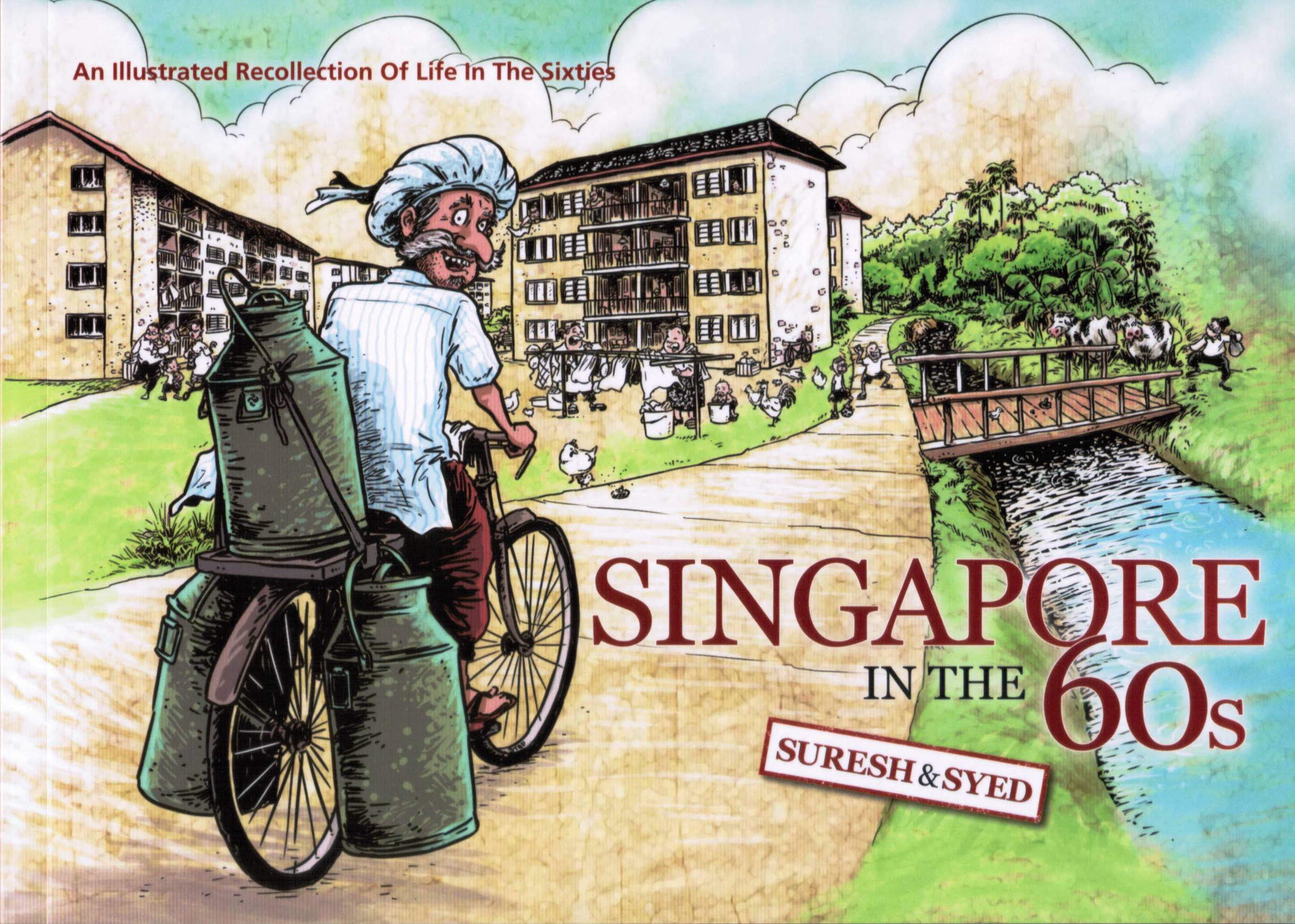
Given that this is an illustrated book, the contributions of Syed Ismail must not be overlooked. While his humorous depictions undoubtedly enhances the reader’s enjoyment, his ability to capture the architectural features (see the cover of the book) and a sense of space must be commended.

Additionally, it is clear that Ismail also took the pains to tell his own story with his pictures. Rather than offer a general depiction of Suresh’s descriptions, all his figures are given a unique personality as they react to a certain situation quite differently (see image above). This creates visual interest and readers, especially the older ones, will be rewarded if they took the time to appreciate the illustrations.

Regardless of whether there is a future in nostalgia, Singapore in the 60s promises to be an enjoyable read for the old timers and an educational one for younger readers aged nine and up.

Further Reading

From the Blue Windows by Dr Tan Kok Yang

  • A memoir focusing specifically on Queenstown

Growing Up in Geylang by Lai Tuck Chong

  • A blog which details a childhood in Geylang

[Book Review] A Single Man by Christopher Isherwood

A Single Man

Christopher Isherwood

University of Minnesota Press (2001) / 186 pp.

To purchase the book, click here

[Transcript]

Hello and welcome to Isaac Encounters! Today, I’ll be encountering A Single Man by Christopher Isherwood. I have to admit that I picked up the book after watching the beautiful film version by Tom Ford starring Colin Firth as George. However, as there was quite a gap between watching the film and reading the book, I will only be reviewing the book today.

A Single Man follows a day in the life of George, an English professor, after he found out that his partner, Jim, was killed in an accident. I hesitate to say “a day in the life of” because rather than giving it a full-blown naturalist treatment, Isherwood presents us with a portrait of grief in three facets. George has to deal with everyday happenings, his friend, and his student with memories of Jim looming in the background.

From the first paragraph, one understands why Ford would be compelled to make a film based on the book. Isherwood’s ability to describe a mundane activity—such as George waking up—in such a refreshing way and at a micro level is akin to a camera close-up on a part of the actor’s body. Isherwood’s dexterity in language treats us to writing that is humorous, poignant, and enlightening.

This is complemented by telling it through a third-person perspective which allows us to see the juxtaposition between his inner and outer reality. This mind-body dualism indicates the profound disconnect George has with his life and he copes by merely performing what is expected of him. The thing about grief or depression is that the most difficult thing to handle is not the surge of feelings but the mundane.

The zipping in and out between George’s thoughts and how others react to him sheds light on his sardonic interpretation of things. From feeling that he might as well be a talking head on a tray while lecturing to observing a quarrelsome couple who would die in their “beer-stained bed,” he keeps the happenings of the world at arm’s length. If they are distant, he does not need to deal with them.

This sense of melancholy is amplified by his tendency to indulge in fantasy fuelled by his misanthropy. He imagines punishing everyone in various ways for being part of the hetero-normative culture or being straight-out homophobic. In his anger for what happened, he blames them for causing Jim’s death. And the times that he is alive—the sexual or human longing that he experiences—makes him painfully aware of Jim’s absence which makes it incredibly heart-wrenching.

Of all the interactions George has, the one with his student, Kenny has to be the most interesting. The relationship is of a teacher-student, father-son, and two men in a bar all rolled into one. Kenny represents what George has just lost and a vicarious second chance in life. Isherwood balances ambiguity with tenderness and beautifully explores love, lost and everything in between.

It is easy to sum up this novel as a man grieving about the lost of a loved one. However, it is important that we see it as a gay man grieving for his partner. The openness in the treatment of George’s sexuality has led many critics to tout this novel as laying the foundations for gay liberation in literature.

However, critics like Octavio Gonzalez disagree and argue that there is an ascetic element of self-abnegation in George. By doing so, he offers an alternative to the identity politics of being a synecdoche for gay liberation. I am sympathetic to this view as there is more evidence in the text to support this stand.

Yet, one should also be careful not to read too much into it because the detachment of George could very well be part of a private grieving process. If you’re interested in reading about the debate, I’ve left a citation in the description below.

Thank you for joining me on this encounter. If you’ve read the book or have watched the movie, tell me what you thought about it. If you like what I’m doing, please subscribe and tell your friends. With that, till the next book.

References

Gonzalez, Octavio R. “Isherwood’s Impersonality: Ascetic Self-Divestiture and Queer Relationality in A Single Man.” MFS Modern Fiction Studies 59.4 (Winter 2013): 758-89. Print.