[Listing] Rent by Pangdemonium!

Rent_Title_DetailsSquare

This October, Pangdemonium is proud to celebrate the 20th Anniversary of revolutionary rock musical, RENT. Winner of the Tony Award for Best Musical and the Pulitzer Prize for Drama, this unforgettable and timeless story of a group of friends, who despite poverty and illness, learn to fall in love and find their voices, will anchor Pangdemonium’s 2016 Season of Love.

Under the shadow of HIV/AIDS, the group’s dreams and losses weave through the musical’s narration to paint a stunningly raw and emotional portrait of the gritty bohemian world of New York City in the 1990s. A story that resonates with all ages, RENT will be brought to life by a cast of rising performers including:

Benjamin Chow (Best Supporting Actor, The LKY Musical, 2016 Straits Times Life! Theatre Awards)as Mark,a struggling film-maker;

Cameron MacDonald as Roger, a doomed musician;

Juan Jackson as Collins,a disillusioned vagabond anarchist tech wizard;

Aaron Khaled as Angel, a drag queen with a heart of gold;

Tabitha Nauser as Mimi, a troubled club dancer;

Mina Kaye (Best Actress, The Rise and Fall of Little Voice, 2015 Straits Times Life! Theatre Awards)as Maureen, a wild-child performance artist;

Frances Lee as Joanne, a hot-shot human rights lawyer; and

Mitchell Lagos as Benny, the one who sold his soul

“RENT is one of those very rare modern musicals that resonates profoundly with people across ages, and across generations. Full of heart, honesty, and passion, RENT still has the ability to move and inspire people with the power of its music and timeless message of community, life-affirmation, and most of all, love. We are very thrilled to be celebrating the 20th anniversary of this wonderful musical”, say artistic directors Adrian and Tracie Pang.

Directed by Tracie Pang, RENT also features Cheryl Tan,  Andrew Marko, Siti Maznah, Seong Hui Xuan, Venytha Yashiantini, Erwin Shah Ismail, Crenshaw Yeo, and Oliver Pang. With memorable characters, an inspirational story, and music that will make your heart sing, RENT is theatre at its best- exuberant, passionate, and joyous.

Tickets go on sale from 5 August 2016 on SISTIC.

RENT runs from 7 to 23 October 2016 at the Drama Centre Theatre.

[Theatre Review] My Mother Buys Condoms — The Reviewer Reviewed

Photo: 36frames/ Courtesy of W!ld Rice

Photo: 36frames/ Courtesy of W!ld Rice

n.b. I would like to inform my readers that I am currently a project-based intern with Checkpoint Theatre for their upcoming production, The Last Bull: A Life in Flamenco. However, I strongly believe that this does not affect the integrity of my critique. Views expressed are my own.

My Mother Buys Condoms
W!ld Rice, Singapore Theatre Festival 2016
24 July 2016, 3 p.m.
Creative Cube, Lasalle College of the Arts
14 — 24 July 2016

Prior to watching My Mother Buys Condoms, I face a common problem that is familiar to any critic. Having accumulated a sleep debt, I was afraid of not being able to give it my full attention, and assess the best that I could. Playwright Helmi Yusof, who is also an established arts journalist and critic for The Business Times, makes my job easy by peppering his debut play with witty punch lines; puns on swear words; and hilarious comedy of errors sequences.

Unfortunately he offers little else, especially when it comes to exploring the sexuality of an older woman.

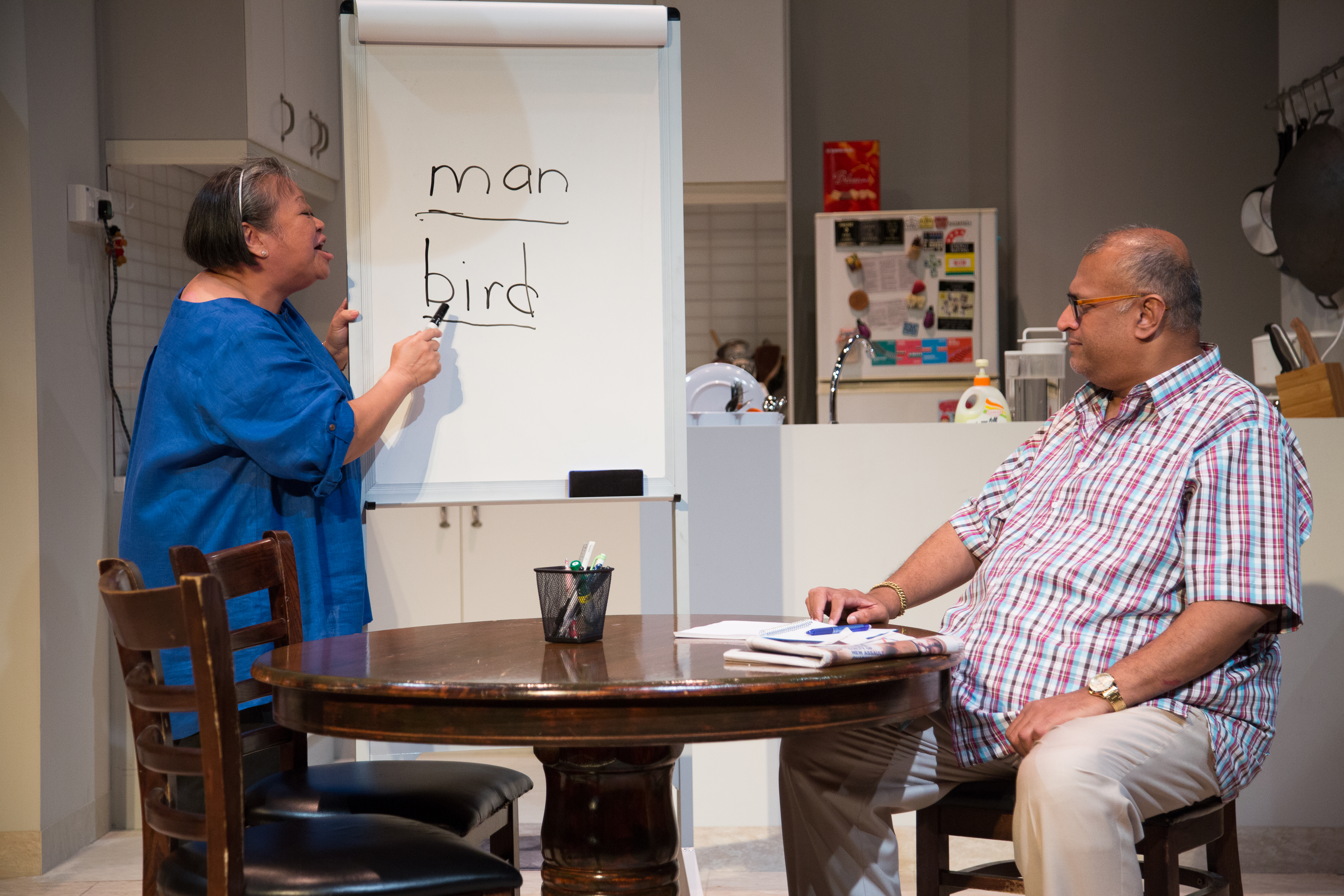
The set-up of Raju (Ramesh Panicker), an air-conditioner repairman, taking English classes from retired literature teacher Maggie (Lok Meng Chue) because he wants to read crime reports in the newspaper is improbable. Additionally, the acceleration of events to the point when both of them fall in love makes it seem as if Maggie loves Raju simply because he expresses an interest.

Such a shallow plot could be forgiven if Helmi intends for it to be a convenient device to give more space for Maggie to deal with the conflict between her desires and the social mores of society. Yet, when it comes to it, all Maggie does is to ask, “Why not?” She does not offer an argument, or try to show the flawed logic of her detractors. Instead, she is like a petulant child who asks why regardless of what is said to her.

Coupled with Wong Chee Wai’s intimate set and Julian Wong’s mawkish musical interludes, the feel of the whole show is reminiscent of a popular local ‘90s television sitcom, Under One Roof.

That said, one must not downplay the craft and skill of comedy. Helmi does have a neck for comedy, and this is enhanced by the actors’ (apart from leads, Elnie S. Mashari, Joshua Lim, and Seong Hui Xuan also deserve commendation) ability to keep the comical scenes snappy and energetic.

While My Mother Buys Condoms indicates an encouraging prospect of critics being able to traverse both sides of the footlights, it should not pretend to aspire more than what it is—a light diversion better suited for a variety show.

Other Reviews

“My Mother Buys Condoms: Let’s talk about sex and seniors” by Akshita Nanda, The Straits Times Life! 

“Grey Pride: A Review of ‘My Mother Buys Condoms’, by W!ld Rice” by Ng Yi-Sheng, The Online Citizen

“Theatre Review (Singapore): ‘My Mother Buys Condoms’ by Helmi Yusof” by Sharmila Melissa Yogalingam, Blog Critics

“My Mother Buys Condoms: Love, Sex And Senior Citizens?” by Reuel Eugene, Reuel Writes

“Sex, ageing, and the courage to be happy” by Alisa Maya Ravindran, Centre 42 Citizens’ Reviews

“My Mother Buys Condoms” by Dawn Teo, Centre 42 Citizens’ Reviews

[Theatre Review] Geng Rebut Cabinet — Turning Up The Heat on Politics

STF2016 GRC by Teater Ekamatra pic 2

Courtesy of Teater Ekamatra

n.b. I would like to inform my readers that I am currently a project-based intern with Checkpoint Theatre for their upcoming production, The Last Bull: A Life in Flamenco. However, I strongly believe that this does not affect the integrity of my critique. Views expressed are my own.

Geng Rebut Cabinet
Teater Ekamatra
Commissioned by W!ld Rice for Singapore Theatre Festival 2016
14 July 2016
Flexible Performance Space, Lasalle College of the Arts
14 — 24 July 2016

Neither our theatre scene nor playwright Alfian Sa’at is a stranger to political plays. But what the avid theatre-goer would have been used to is a play that focuses on a particular issue, and offers a barrage of criticisms; some vociferous, while others are comical.

In Geng Rebut Cabinet (GRC), we see Alfian Sa’at unfurling his list of criticisms of government policies, especially those which affect different racial groups, and frame all of them within the boundaries of a political farce. From the lack of Malays in major military roles; to the lack of Malay representation in local popular culture; to the media releasing negative statistics according racial lines, nothing escapes this playwright.

Despite packing in so many issues and criticisms, he achieves the incredible feat of not allowing it to be overbearing, didactic, or a tiresome lament. His creation of a hypothetical Singapore with Malays being the majority, and the Chinese being the minority, is a defamiliarising element that throws the justifications the government gives for their policies into sharper relief.

It is within this sophisticated structure that the plot of five candidates from the ruling party contesting to win a group representational constituency in an election progresses. As Catherine Seah (Serene Chen), the minority Chinese candidate, deviates from the party line by campaigning for improving the Chinese community, the play poses questions that transcends beyond race issues: Who should a politician represent? What constitutes the people? Should one campaign for what one believes in despite in displeasing one’s constituents?

These questions are raised as Catherine comes into conflict with her colleagues: grassroots activist Zainab Halim (Dhalifah Shahril), Minister of Human Resources Roslan Jantan (Khairudin Samsudin), retired Brigadier-General Bukhari Ghazali (Fir Rahman), and Maisarah Hamdan (Farah Ong); a lawyer who neither harps on her homosexuality nor identifies herself to be part of the LGBT community.

While characters in a farce are not meant to be complex, the cast should be lauded for their robust performances. The comical moments are buoyant and entertaining as the actors pick up on each other cues quickly, while the tense moments are played with emotional truth as each character knows what they want out of the exchange.

All said and done, the successful staging of the show, with merely an advisory that says the show is suited for 16 years and above, raises another political issue. Why did the powers that be let such a show pass?

Of course, I can only offer speculations.

While I would love to think that the authorities have become enlightened to allow the airing of such issues, they could be acting based on yet another old argument. Plays have very limited reach, and theatre-goers are usually more “sophisticated” than the lay person. Furthermore, the “problematic” character is Chinese and not Malay. As such, the Malay audience members would not identify with her too strongly. If that were the case, then the very existence of GRC as a staged play is a manifestation of the problems that the playwright is trying to raise.

Other Reviews

“The Party Don’t Stop: A Review of GRC by Teater Ekamatra” by Ng Yi-Sheng, The Online Citizen

“Review: GRC by Teater Ekamatra” by Bak Chor Mee Boy

“Chasing our dreams… together?” by Jocelyn Chng, Centre 42 Citizens’ Reviews

““少数与多数之间的互换与碰撞” by Zekson Tan (陈迦笙), Centre 42 Citizens’ Reviews

[Theatre Review] Jacques Brel Revisited

13041455_10154183496559275_8269308797582857315_o

n.b. I would like to inform my readers that I am currently a project-based intern with Checkpoint Theatre for their upcoming production, The Last Bull: A Life in Flamenco. However, I strongly believe that this does not affect the integrity of my critique. Views expressed are my own.

Jacques Brel is Alive and Well & Living in Paris
Sing’Theatre
28 May 2016, 4pm
SOTA Drama Theatre
26 May—4 June 2016

In the programme notes, director George Chan thanked his team “for being so brave to stage a show that is not necessarily commercially viable.” This anticipates the question: “Why would I want to watch some European thing which is just a series of songs?”

On the surface, the show seems quite foreign. But what exactly is Jacques Brel is Alive and Well & Living in Paris? It is a revue of songs by a Belgian singer which were written mostly in French, and translated into English by Americans. The songs touch on life, love, war, peace, death, age, class among many others.

In short, it is a little of everything brilliantly performed by a group of actors who are not afraid of putting their individual stamp on Brel’s classic songs.

In Frances Lee, we have sassiness coupled with a devilishly good voice which culminates in “Funeral Tango”. As her persona sardonically observes how people behave at her funeral, she makes the song her own by choosing to adopt a Singaporean accent to mock her “friends.” This zinger of a song is completed with her cast mates decked in sunglasses, while enacting a pantomime of lavish sympathy.

Stephanie Van Driesen provides a beautiful counterpoint to Lee by taking on songs that require a demure persona. From “Timid Freida to the heart-wrenching “Ne Me Quitte Pas”, one relishes every single second she is on stage. The clarity of her voice and depth of expression attest to her virtuosity as a performer.

Not to be outdone, the men are keen to showcase their range and versatility. Apart from being impressed by Matt Jasper’s vocals, notice his range as he transits from being crass in “Middle Class”, to being earnest in “Song for Old Lovers”, to being camp in “Next”. My favourite performance of his has to be his gritty rendition of “Amsterdam”.

The same goes for George Chan as he delights the audience by being “cute in a stupid ass way” in “Jackie” as his persona prances around with youthful vigour while aspiring to be famous. His soulful rendition of “Marieke” goes in an opposite direction as his persona reflects on lost love. His choice of paring it down—as compared to having this intoxicating drive which is present in Brel’s performance—makes the song heartfelt and painful. In this vein, music director Joel Nah must be congratulated for his gorgeous arrangements of the music.

Speaking of choices, Chan must also be praised for his directorial choice of including Genevieve Peck’s projections as a subtle way to impress upon the audience the relevance of Brel’s message. He also exercised some poetic licence by replacing the places of conflicts in the last line of “The Bulls” to current ones; a sobering reminder of the slaughter that is still happening.

Together, the quartet showcases its range by keenly executing comical sequences—choreographed by Chan—in “Madeleine” as Jasper pines for her, while taking us for a dizzying ride in “Carousel”, before closing the show with a rousing anthem of peace, “If We Only Have Love”. This stellar cast works so well together that one hopes they will reunite to do something on a much larger scale.

That said, the latter half of the ignorant question posed at the beginning of this review contains a kernel of truth. While having a continuous performance of 28 songs—without any plot or explanation— is meant to showcase the poetry of Brel’s music, the constant barrage of song, choreography, and hard-hitting messages can be overwhelming. This results in having some of the numbers pass by in a blur. Unfortunately, this is out of Sing’Theatre’s control. We can only look at the original creators of the show (Mort Schuman and Eric Blau), and wag our fingers.

As the cast took their curtain call, I thought to myself, “If only the title of the revue were true.” If only Brel were still around to witness his legacy and how it sparked such a great deal of creativity that is evident in Sing’Theatre’s latest success.

Other Reviews

“Jacques Brel is Alive and Well & Living in Paris – SingTheatre – Review” by Jennifer, Angloinfo

“Simplicity is Bliss” by Jeremiah Choy, Centre 42 Citizens’ Reviews

“Review: Sing’Theatre’s Jacques Brel is Alive and Well & Living in Paris” by Steven, The Mad Scene

[Theatre Review] Ready! Set! Zo! — Imaginative Retelling of the Zodiac Race

13235240_10153775259879087_3725217420809300733_o

n.b. I would like to inform my readers that I am currently a project-based intern with Checkpoint Theatre for their upcoming production, The Last Bull: A Life in Flamenco. However, I strongly believe that this does not affect the integrity of my critique. Views expressed are my own.

Ready! Set! Zo!
I Theatre Creative Edge
28 May 2016, 10 a.m.
The Substation
25–29 May 2016

It is unavoidable. When Chinese New Year comes around, many adults will develop a voracious reading habit. They will consume every single word on information panels placed outside shopping malls, which inform them whether the coming year will be kind to those who are born in a particular year of a particular animal.

If only they bothered to read the folk tale of how the zodiac cycle came to be to their children which, judging from Creative Edge’s imaginative re-telling, has the potential to be entertaining.

Playwright and lyricist Dwayne Lau expands on the folk tale by giving the animals distinct personalities, and showed why the animals finish the race in the order that they did. His script is structured based on the snake acting as a commentator of the race. The plot is not only engaging, but the adults will be entertained by his clever puns, and references to white rabbit sweets, and how the fortune cat came to be.

However, in the course of giving life to his characters, he inadvertently faces problems when it comes to delivering the right message. Rat is scheming, manipulative, and devilishly intelligent—which is why she came in first. Yet, she is not punished and gets to retain her position. In order to circumvent the problem of sending the wrong message to children, Lau has a line saying that the positions do not matter as they each animal has a year to itself, and the years go in cycles. But the fact that Rat still came in first in a race, and that still says something. Additionally, she may have apologised towards the end of the show, but it appears that it was out of fear of Tiger rather than earnestly admitting her mistake.

In terms of the performance, director Alecia Kim Chua is keen to showcase the main aspects that the young actors of the Creative Edge programme go through. The physical work of embodying the various animals, mask work, and shadow puppetry expose children to various modes of story-telling, and they complement each other in the context of the show.

Unfortunately, most of the actors are not consistent in the way they embody the animals as the identity of some of the animals are not clear when they first appear on stage.  Also, they sometimes forget that the face of their characters is the mask that they put on their heads, and not their actual faces. There are several occasions when they portray their characters through their own facial expressions rather than moving the mask in such a way that brings the character to life. The only exception is Abby Lai as the Rat.

Despite the raw performances, Ready! Set! Zo! is an entertaining piece of children’s theatre. With some minor tweaks and more emphasis on physical theatre, it has the potential to be part of I Theatre’s repertoire which can be restaged, especially in the midst of Chinese New Year celebrations.

[Theatre Review] Emily the Musical — Dollar Store Emily

Emily The Musical

n.b. I would like to inform my readers that I am currently a project-based intern with Checkpoint Theatre for their upcoming production, The Last Bull: A Life in Flamenco. However, I strongly believe that this does not affect the integrity of my critique. Views expressed are my own.

Emily the Musical
Musical Theatre Ltd
21 May 2016, 3pm
SOTA Studio Theatre
20–22 May 2016

Being an iconic play, Emily of Emerald Hill has gone through many guises. The titular character, Mrs Emily Gan, has poured her heart out to thousands of people in theatres big and small. Thus, it comes as no surprise that the next progression would be a musical adaptation of the play.

Taking on the task of writing the book and lyrics, Stella Kon reworks her original play into more of a retrospective. Emily’s grandson, Bin Seong (Mark Nicodemus Tan), visits her on his break from studying in Vancouver. He brings his girlfriend, Mei Choon (Jasmine Blundell), along who asks Emily about her past to learn more about the family. Throughout the course of the show, Emily recounts various moments of her life.

Despite it being a monodrama, the story of Emily starting out as a young wife in an arranged marriage, and gaining the worldly-wise to manoeuvre the ins and outs of household politics contains endless possibilities for a musical. Unfortunately, Musical Theatre Ltd seems preoccupied with the form of a musical, rather than the content.

Kon ruins the show with her stilted and banal dialogue. The lines seem to be mere fillers before another character bursts out into song. Most of the characters lack clear motivation to do anything. To get to the scene in which Emily talks about her eldest son, Richard, who—spoilers ahead!—eventually commits suicide, Mei Choon asks Bin Seong if he knows anything about his uncle. He replies no and suddenly says “let’s go” so that both characters can exit the scene.

While we see a slightly different side of Emily in different moments of her life, the lack of plot details and build-up paints a schizophrenic rather than a complex image of her.

As for the music, Desmond Moey’s songs are pleasant, but very forgettable. Additionally, there are too many songs and it feels as if they are there to fulfil some quota of songs so that the show can be considered a musical. The only stand-out song is Manis-Manis (sweet-sweet) as the melody is reminiscent of songs from the 1950s, and not some generic ballad.

While it is understandable that the musical has to be staged in a black box due to budget constraints, director Sonny Lim does the show a further injustice with his relatively static blocking. The actors seem hemmed in by the space, and Emerald Hill—which is described as a “rambling mansion”—feels like a matchbox apartment.

That said, set designer Chris Chua must be praised for making do with the space by creating three tiers of tiled flooring against a triptych, which forms the walls of the mansion. The uppermost tier is the main entrance, the middle represents the main hall, while the last tier becomes the other quarters in the mansion or the street outside.

In the programme notes, director Sonny Lim insists that Emily the Musical is not Emily of Emerald Hill set to music. He is right.

Emily the Musical is a dollar store adaptation of the original.

Other Reviews 

“Theatre review: Emily The Musical presents a diminished matriarch” by Boon Chan, The Straits Times Life!

“Emily Goes Broadway” by Jocelyn Chng, Centre 42 Citizens’ Reviews

“Emily the Musical” by Jorah Yu, Centre 42 Citizens’ Reviews

[Theatre Review] Dark Room Sheds (More) Light on Prison Life

Photo: Crispian Chan

Photo: Crispian Chan

n.b. I would like to inform my readers that I am currently a project-based intern with Checkpoint Theatre for their upcoming production, The Last Bull: A Life in Flamenco. However, I strongly believe that this does not affect the integrity of my critique. Views expressed are my own.

Dark Room
Edith Podesta
28 April 2016
Esplanade Theatre Studio
28 April–1 May 2016

Two years ago, I was profoundly affected and had my pre-conceptions about ex-prisoners challenged by Dark Room x8.

The memory of its impact makes me apprehensive about watching this iteration. What should one expect of this second staging? More importantly, having been made aware of my prejudices, will Dark Room still have an impact?

I am happy to report that most of my impressions of the first iteration apply to this one as well.

In the midst of my apprehension, I forgot a simple truth. Regardless of what one knows, there is a sort of power in having someone stand in front of you and tell you a story. And the stories told in Dark Room—that of the prison system, and how it affects the individuals—need to be retold again and again.

While there are some changes in the main ensemble (Nelson Chia, Timothy Nga, Erwin Shah Ismail, Ian Tan, Mohd Fared Jainal, Noor Effendy Ibrahim, Oliver Chong, and Pavan J Singh), the performances by this batch of actors are equally stellar. The complexities of script are deftly handled as the show organically shifts from poignancy, to hilarity, to the downright painful.

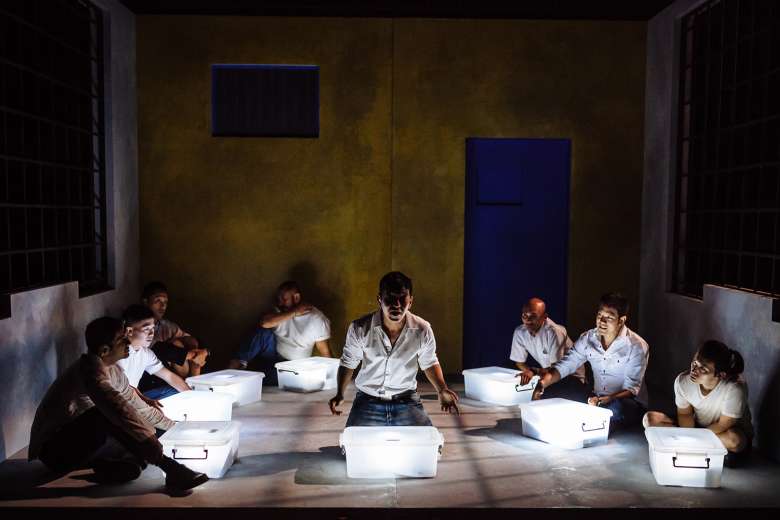
Chris Chua’s set, which consists of three structures that can be cleverly configured into the prison cells and walls, is a much welcomed addition. It vividly impresses on the audience the small space that the prisoners inhabit, and its possible psychological impact.

That said, this fuller rendering also has its excesses.

Director and writer Edith Podesta took on the audiences’ earlier feedback by introducing the perspectives of a female inmate (Shafiqhah Efandi) and the parents (Lim Kay Siu and Neo Swee Lin) of the prisoners. However, they are tokenistic at best.

Apart from learning two new facts,—female inmates man the call centre, and yard time is not a regular occurrence—the female inmate does not add anything to the show. Podesta also does the character an injustice by not giving her an identifiable personality which is present in the male characters.

Similarly, the parents’ perspective only focuses on their sadness, and the difficulties of visiting their child in prison. All these are not really new insights and could be easily imagined by the audience.

Additionally, certain sound effects by Darren Ng—such as the banging of the judge’s gravel— are too literal and gimmicky. This takes away the gravity of the text which can be competently conveyed by the actors.

Finally, the ending which has the characters repeatedly imploring the audience not to judge too quickly risks being overbearingly didactic.

Despite all that, the beauty of Dark Room is that the issues raised in the piece will always be pertinent. This gives Podesta countless opportunities to re-stage it, and find the right balance for the show.  What remains is for her to trust her artistic instinct and be very selective of which suggestions to bring on board.

Resources on Dark Room

Dark Room in residence @ Basement Workshop, Centre 42

Other Reviews

“Edith Podesta and The Studios’ Dark Room is an immersive and intimate retelling of life in Changi Prison Complex” by Karin Lai, Today

“Prison Tales Retold” by Akshita Nanda, The Straits Times Life!

“Struggling with the Outside from the Inside” by Alisa Maya Ravindran, Centre 42 Citizens’ Review

“Chained and Connected” by Beverly Yuen, Centre 42 Citizens’ Review

“Dark Room by Edith Podesta at The Studios” by Corrie Tan

“Architecture of Empathy” by Dumbriyani

[Listing] Singapore Theatre Festival 2016

STF

Wild Rice brings back the  Singapore Theatre Festival (STF) for the 5th time  with 8 of the most exhilarating, ambitious, and thought-provoking new plays.  Featuring 9 playwrights, 8 directors, and 4 theatre companies, the plays touch on a diverse range of issues that would speak to people from all walks of life in contemporary Singapore.

With LASALLE College of the Arts being the  festival’s hub  from 30 June to 24 July, STF will feature re-worked productions of recently staged plays,— Rodney Oliveiro’s Geylang, Johnny Jon Jon’s Hawa, Kenneth Chia and Mark Ng’s Let’s Get Back Together and Alfian Saat’s Geng Rebut Cabinet (GRC)—and shine the spotlight on the works of first-time playwrights:  Helmi Yusof’s My Mother Buys Condoms, Nessa Anwar’s Riders Know When It’s Gonna Rain, and Thomas Lim’s Grandmother Tongue.

Recently awarded the Best Production of the Year at ST Life! Theatre Awards, HOTEL, directed by Wild Rice’s very own Ivan Heng and Glen Goei and written by Alfian Sa’at and Marcia Vanderstraaten, will be the mainstay production of the festival.

There will also be a programme of FEST!VITIES held at LASALLE’s Lowercase Café comprising a series of lively forums; drag, music and stand-up comedy  performances; and a Playwriting Workshop by the festival’s Dramaturg and Wild Rice’s Resident Playwright Alfian Sa’at.

For more information about the Singapore Theatre Festival, please visit its official website.

[Theatre Review] Intrusions — “A World Beyond Common Sense”

Intrusions

Photo: Vasco Emidio

n.b.  I would like to inform my readers that I am currently helping Checkpoint Theatre to archive one of their upcoming productions. However, I strongly believe that this does not affect the integrity of my critique.

Intrusions
Jean Ng & Joavien Ng
31 March 2016
Esplanade Theatre Studio

31 March–2 April 2016

(After Tynan, 2 November 1958)

A studio filled with ephemera. It is scattered all over the place as it is evident it has been in a toss-up of trial and error. Towards the back, a banner reads “Our Dream Show.” Two performers are in the midst of the devising process.

Performer 1 (henceforth P1) is at the mirror making a series of weird faces. Performer 2 (henceforth P2) reacts by laughing. P1 occasionally checks the sound levels of P2, writes in a notebook, takes photos of some of her faces, and continues experimenting in the mirror.

P1: (while writing in her notebook) Ok, so that’s two motifs done.

P2:  (laughs a little) I really admire you man. Not only do you have a strong physicality, you have a rubber face; the variety of expressions you can do ah. (P1 takes pictures of some of her own expressions) Eh, you trust me that much?

P1:  Yea. But we still have to try them out on others… just to be safe (continues with her experimentation).

P2: Yea, play safe better.

P1: But not too safe, if not our show will be boring. (She writes up her notes and takes a break. She’s clearly exhausted). Oh yea–

P2: What?

P1: What is a good way of linking the motifs together?

P2: Hm… I’m not sure…

P1: Damn. We still need to create more sections…

P2: Well–

P1: Yup?

P2: If the motifs are good then maybe we don’t have to worry too much. We just use the usual link. (P1 is puzzled) Since our work has a post-modern flavour, we link it up by the usual movement as if we are being electrocuted or possessed.

P1: What?

P2: Don’t worry. As long as the motifs of the facial expressions and our subsequent material are amusing enough, I think the audience won’t mind too much about that.

P1: (looks at the decibel meter) I guess so. Ok let’s KIV this issue.

P2: Orh. What about our other materials ah?

P1: Let’s look at our journals. (Goes to a table and takes two dream journals and peruses them with P2).

P2: Eh see here… We both talk about mirrors!

P1:  Mirrors… Maybe we mirror each other in something…

P2: But don’t make it exactly alike.

P1: Same same but different… Perhaps like we are in a parallel existence or something. Then we do actions within in a similar theme but we are clearly in different spaces.

P2: Yea! Maybe different climate or we suggest that we exist in different era or culture. Not bad…

P1: Good, good. At the same time we can also confound expectations. Since we are both women right, maybe we randomly do some construction stuff and cook really badly in some parts.

P2: (laughs) Can. But do you think there’s something is missing for this part?

P1: Yea… but I don’t know how to say it.

P2: That’s right!

P1: Huh?

P2: We can’t communicate what it is… lost communication… (tries to come up with related concepts for a bit) Since we can’t just keep doing stuff willy-nilly, we should try to establish communication with each other.

P1: But we fail to do that! That’s great… At least the audience has something to follow. We also can throw in something for fun (looks around and sees a red telephone) like that one! (Both agree and write in their notebooks) Speaking of audience following us ah, maybe we should come up with something on top of us just moving all the time?

P2: Like what? Monologues ah?

P1: Yea… You can do that since you are the literary one.

P2: Eh but you must also help me to think.

P1: If you want audience to follow us… then throw in something about mothers or childhood. Make that one funny ah. Don’t just make it a trip down memory lane. The theatre shouldn’t add to the nostalgia fest.

P2: Ok… But I think we need to mix it up a bit. Not everything should be funny.

P1: Funny is good what. If the audience—and especially the critics—are happier, they might be more forgiving… But you’re also right… If we want serious, then have something that suggests violence but we don’t actually act it out.

P2: Haha… like in a Greek play… Something serious… You ok with rape?

P1: What?

P2: I mean of course no one is ok with rape. I’m talking about adding something about rape inside the show… it could be quite violent. Just checking because some people might be sensitive.

P1: But we don’t act it out right?… Then it’s fine.

P2: Ok cool. Oh yea, how should we frame this whole thing? I mean we have a bit of this and that, but how do we string them together?

P1: We ask questions.

P2: Huh? Why suddenly so profound?

P1: No, we are talking about dreams and fantasy right? We ask questions about it.

P2: Oh like those seemingly paradoxical ones?

P1: Yea. With that we can also use the lights to highlight certain things. That way, we have some sort of structure but we are free to explore.

P2: Dreams are such wonderful sandboxes. You can do anything.

Other Reviews

“Madly beautiful dreamscapes” by Akshita Nanda, The Straits Times Life!

“Intrusions by Jean Ng and Joavien Ng – Review” by Five Lines Asia

“Dreams, and what to do?” by Kei Franklin, Centre 42 Citizens’ Reviews

“不是痴人说梦” by Neo Hai Bin, Centre 42 Citizens’ Reviews

[Theatre Review] The Effect — Not Totally Effective

The Effect

n.b. Out of professional courtesy, I would like to inform my readers that I am currently helping Checkpoint Theatre to archive one of their upcoming productions. However, I strongly believe that this does not affect the integrity of my critique. None of the actors in The Effect are involved in the project I am working on.

The Effect
Pangdemonium!
13 March 2016, 3pm
Victoria Theatre
25 February–13 March 2016

Audiences and colleagues who have watched The Effect before me rightly pointed out that one of the themes of the play is about the nature and reality of love. However, if we were to look at the bigger picture, the play poses a more fundamental philosophical question: Can the self be reduced to the workings of the brain?

Prebble expounds on this question through two parallel relationships. On one hand, we have Tristan Frey (Linden Furnell) and Connie Hall (Nikki Muller) who are test subjects of the antidepressant drug, RLU37. When they fall in love, questions are raised over whether it is real or is it an effect of the drug.

On the other hand, we have Dr Lorna James (Tan Kheng Hua) and Dr Toby Sealey (Adrian Pang), researchers administering this drug trail. Apart from their professional relationship, this duo once had a turbulent romance.  James suffers from depression and Sealey wants to her to take the drug. James is reluctant as, apart from her doubts about its efficacy, she believes that medication does not solve everything.

And it is in the interactions of the couples that lie the greatest merit and demerit of any play that poses philosophical questions.  The former is seen in the Frey-Hall romance as the questions arise through the plot and conflicts the couple has.

The latter is seen in the doctors’ relationship as Prebble stages a flat-out debate with both characters expressing opposing arguments. Granted that Prebble does attempt to flesh out a past history between the doctors, the argument could still take place even if they were madly in love with each other. As if the main philosophical question is not complex enough, the doctors also debate about the ethics of marketing drugs.

As for the effect of the acting, the actors are competent but not impressive. Furnell and Muller wonderfully feed off each other’s energy and are completely at ease on stage. However, Muller adopts an accent that, while believable, restricts how she expresses herself. She sounds perpetually excited and there is hardly a modulation in tone. While Tristan Frey is Irish, Furnell makes the wise decision of adopting a very light Irish lilt to play his character. This gives him more space to work with the demands of the scene.

Oddly enough, Tan Kheng Hua and Adrian Pang decided not to adopt an English accent which makes it rather odd given that both actors are more than capable to do so. More importantly, they mar an otherwise good performance by not being able to sustain the energy in the quieter moments.  Even when Dr Lorna James unravels, Tan’s portrayal is too inward that I found it difficult to sympathise with her. Instead, it feels like I am observing a curiosity from afar.

While many productions do create multiple physical and psychological spaces within the confines of the same set, the division is not clear enough in this production. For some reason, it feels rather crowded when all four actors are on stage. Furthermore, even when the set is altered to suggest a different space,—such as when the doors of the lab are tilted diagonally outwards to suggest the open windows of an abandoned asylum—Furnell and Muller do not make the effort to create the sense of a new space.

That said, set designer Wai Yin Kwok must be praised for the futuristic and clinical set. This is complemented by Guo Ningru’s sound design of static noises or the humming of the machinery which create an unsettling atmosphere.

If my review were akin to the results of a drug trail, it would be what Dr Lorna James had expected: Some positive effects but these are ultimately inconclusive.

Other Reviews

“This is your brain on love: Pangdemonium’s The Effect by Akshita Nanda, The Straits Times Life! 

“Theatre Review: The Effect by Adibah Isa, Buro 24/7

“Is It Love, Or Is It The Dopamine: The Effect by Adelyn Tan, Word of Mouth – Raffles Press

“Theatre review: Romantic prescription in Pangdemonium’s The Effect by Naeem Kapadia, Today

“The Effect of love — in 4D” by Jeremiah Choy, Centre 42 Citizens’ Reviews

“The Effect of Love and Other Drugs” by Seewah Ho, What’s Next