[Theatre Review] The Emperor’s New Clothes — Joy of Playing Dress-up

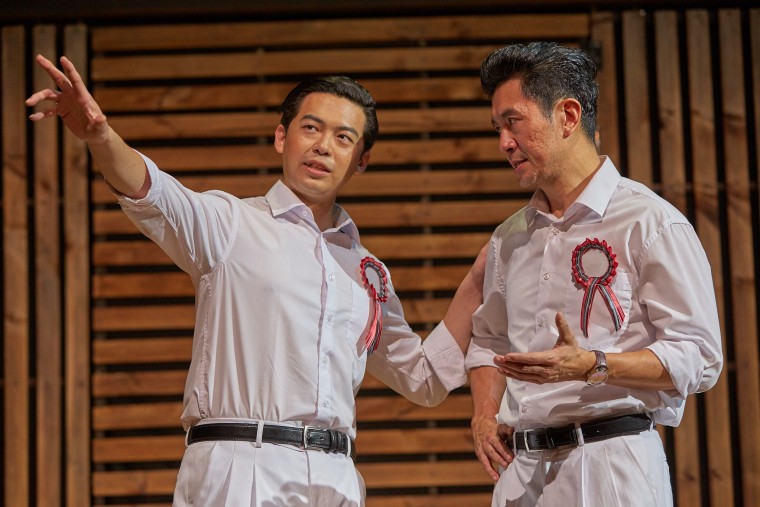
The_Emperor_39_s_New_Clothes_by_W_LD_RICE_pic_3

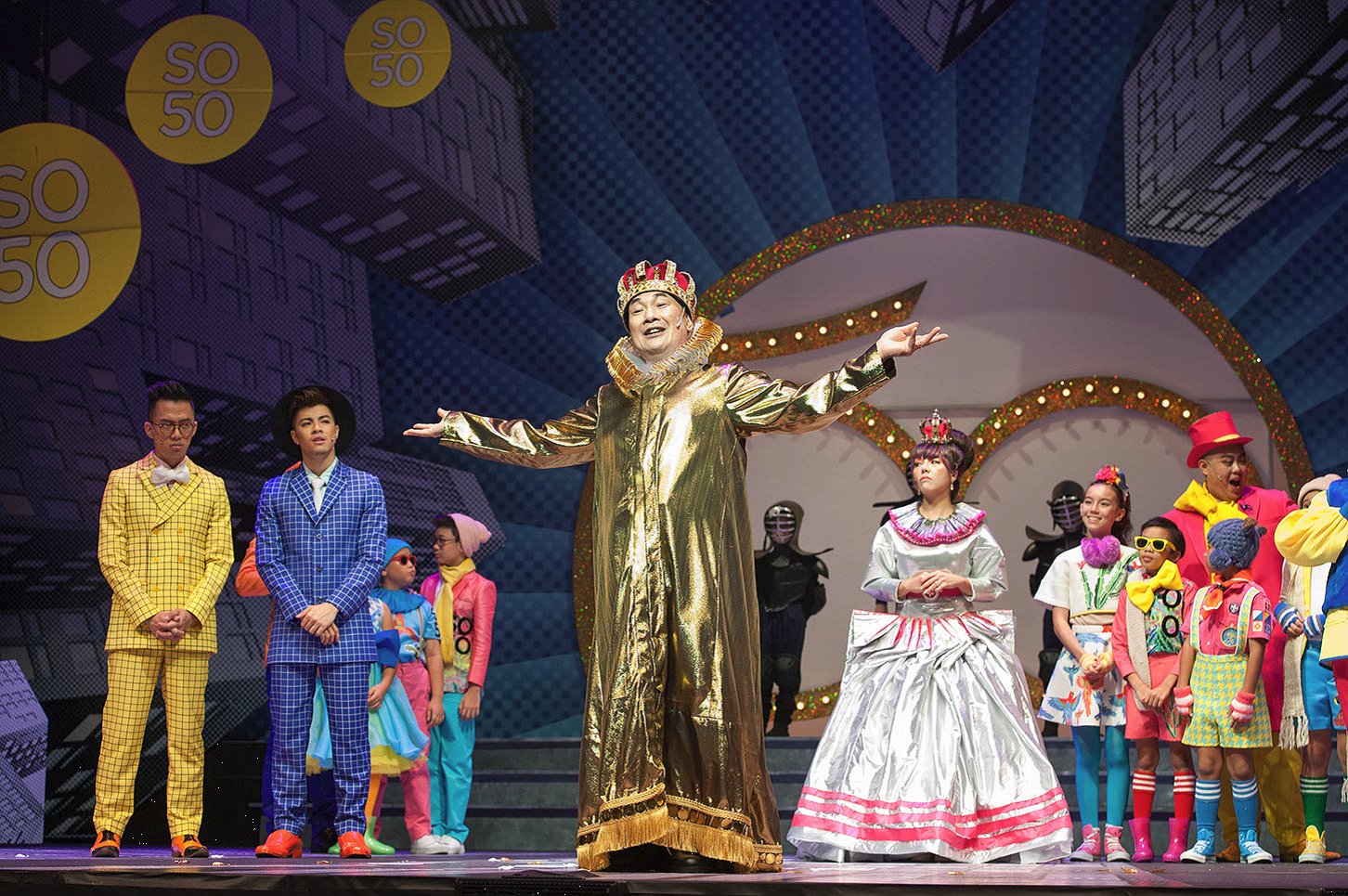
Photo: Albert Lim KS / Courtesy of W!ld Rice

The Emperor’s New Clothes
W!ld Rice
21 November 2015
Drama Centre Theatre
10 November–12 December 2015

There is a difficulty in adapting the popular tale by Hans Christian Andersen as a pantomime. It needs to have wonderful costumes, it has to be fun, and—most importantly—it must not be pretentious as the main point of the story is to mock the pretentions of society.

W!ld Rice excels on all counts.

Nathan No Surname (Benjamin Kheng) and Khairul No Surname (Sezairi) are orphans who become tailors. They are commissioned by the  ministers in the hopes of getting them to create a wonderful outfit for the vainglorious Emperor Henry Lim Bay Kun (Lim Kay Siu) for free. Khairul eventually convinces Nathan that they should take it as it is a good exposure for their business. They later find out that the Emperor arrests all who take the attention away from his outfit during the National Dress Parade (NDP) and decide to teach the Emperor a lesson with his “new outfit” for the 50th NDP.

Nothing is safe from satire as Joel Tan’s witty script references Lee Kuan Yew, lawsuits against foreign media, incompetency of the ministers, ISA, banning  musical instruments during Thaipusam, mediocrity of Mediacorp dramas, SG 50, and absurdity of national day parades.

With Tan’s clever employment of puns, acronyms, and Singlish, the audience experiences a bellyache of laughs throughout the two hours. The greatest merit of this sparkling script is that it does not belabour the various criticisms that it puts across. This makes the play snappy while packing in quite a lot at the same time.

Additionally, its injection of self-deprecating jokes such as mentioning Ivana Heng, the crazy theatre director who designed a rainbow outfit for the Emperor, or the Emperor asking his Minister of Retribution (Andrew Lua) to keep tabs on Sam Willows (a band that Kheng is part of) makes it all the more delicious.

Director Pam Oei pulls out all the stops and makes her cast showcase whatever talent they have or even acquiring new ones just for the show. Most of them sing, dance, and play instruments live on stage.

Benjamin Kheng’s anxious Nathan is a nice contrast to Sezairi’s laidback Khairul. Aside from their singing which they are known for, their dancing is tight and there is a wonderful synergy between them as we can easily believe that they are “brothers from another mother.”

Lim Kay Siu (Emperor Henry Lim) brings out his youthful and vain side as he preens and poses throughout the show. Audrey Luo (Empress Jeanette How) plays the melodramatic caricature of local actress Jeanette Aw to the hilt. This could not come at a worse time as Aw is currently facing criticisms about her inability to sing in Beauty World.

Other notable performances include Siti Khalijah Zainal (Nafisa bte Jasmani, Minister of Finance), Andrew Lua’s  (Wong Bok Siu, Minister of Retribution), Benjamin Wong and his counter-tenor vocal range as the aptly named Aplhonsus Kan Sing Low, Andrew Marko as the Thai fashion reviewer, and Candice de Rozario as Arppeggio Chong.

Julian Wong keeps our toes tapping with his catchy tunes that range from joget music to the moving, ballad-like “Open Up” when the tailors and the Empress confront the Emperor. Set designer Eucien Chia adopts the comic book aesthetic by having skyscrapers pointing inwards. The monochromatic set allows costume designers Phisit and Saxit from Tube Gallery to unleash a largely neon palette onto the stage.

All these elements make for a fun, energetic, zany, and hilarious musical that calls on the powers that be to reflect on their style of governance and perhaps renew their commitment to serving the people.

With Singapore celebrating her Jubilee and witnessing a heated election, I could not think of a more befitting production to end the year. If only we could nudge our ministers into the theatre.

Other Reviews

“The Emperor’s New Clothes pantomime has audience in stitches” by Akshita Nanda, The Straits Times Life!

“Time Out Singapore: ‘The Emperor’s New Clothes’ Review” by Gwen Pew, Gwen Pew (originally published in Time Out Singapore

“The Emperor’s New Clothes: Revisiting SG50 Through the Wittiest Musical” by Sheryl Teo, Popspoken

“Theatre Review (Singapore): ‘The Emperor’s New Clothes’ at Wild Rice” by Sharmila Melissa Yogalingam, BlogCritics

“The Emperor’s New Clothes: A Treat For All Ages” by Reuel Eugene, Reuel Writes

“The emperor’s new clothes” by Jes, Jesme

“Review: The Emperor’s New Clothes” by Jordan Chia, Youth.sg

[Theatre Review] Battlefield — Brook Makes Audience Battle Boredom

Battlefield

Battlefield
Peter Brook & Singapore Repertory Theatre
21 November 2015, 3 pm
Capitol Theatre
17–21 November 2015

I do not need to offer a synopsis of Battlefield for the story from Mahabharata should be somewhat familiar to most people. More importantly, the tales and parables are intimated so subtly that it could have been any other generic story.

Brook returns to story-telling traditions as the action—or lack thereof—takes place on a largely bare stage. Characters are indicated by the cloth they wear around their necks and the story is told through words, symbolic actions and manoeuvring of various cloths. However, the thousands of deaths and the struggles of the king are neither indicated by the expressions of the actors (Carole Karemera, Jared Mcneill, Ery Nazaramba, and Sean O’Callaghan) or the timbre of their voices.

Rather than bore you with details of this lacklustre performance, allow me to entertain you with a description of the drama that unfolded around me.

A bout of snoring from the left flank of the theatre marks the thirty-fifth minute of the show. I look to the left and about six to ten seats away from me, there is a man fast asleep as he reclines in his seat. Every few minutes, there is an intermittent pause in the snoring as he tries to find a more comfortable position to snooze in.

On four or five occasions, I hear the rustling of a plastic bag directly behind me. I am inclined to turn around to see what is in the plastic bag but I do not want to embarrass the person. While I am usually irritated by such nuisance, I only have the deepest of sympathies for my fellow audience member.

At the forty-five minute mark, a young man four seats to my left starts to get restless. Yielding to temptation, he rips open his bag that is fastened by Velcro and risks incurring the wrath of his fellow audience members. Nobody bats an eyelid. He takes out the programme, places it on his lap and starts flipping it in search of enlightenment or anything that would kill time.

Stepping out of the theatre, an Indian woman complains to the front-of-house about not being able to hear the actors. As I walk out of the lobby, a voice trails behind.

“Excuse me!” I turn around and it is the same Indian lady. “Did you just watch the Mahabharata?”

“Yes.”

“Were you sitting in the circle?”

“No… I was seated towards the back of the stalls.”

“Cannot hear the actors right?” I nodded in agreement.

“I mean sometimes they never pronounce their words clearly… but when they do, you could hardly hear it… very bad.”

“Yah.” I watch her walk off. She shakes her head in disappointment and points her finger forward either to emphasise her frustration to herself or perhaps to admonish an imaginary Peter Brook.

Unlike my colleague from The Straits Times, I shall not make excuses for the show as I can only report my experience. One may write all the books in the world but if the production does not reach out to the audience, it is a colossal failure.

Rather than get caught up with the glimmer of Brook’s halo, we should demand more from this experienced artist.

Other Reviews

“Art of story-telling at its finest in Peter Brook’s Battlefield” by Akshita Nanda, The Straits Times Life!

“Theatre Review: Battlefield by Mayo Martin, Today

“Theatre Review: Peter Brook’s Battlefield” by Alex Tham, Buro 24/7

“Singapore Repertory Theatre Presents: Battlefield by Peter Brook” by Nithia Devan, City Nomads

“Theatre Review (Singapore): ‘Battlefield’ by Peter Brook” by Sharmila Melissa Yogalingam, Blog Critics

Battlefield—An Indulgence of Ideas [Review]” by Seewah Ho, What’s Next

“The Final Scene from the Mahabharata by Imp (alias), Faerie Tales 

[Theatre Review] A Twisted Kingdom — Definitely Not Fool’s Gold

twisted kingdom

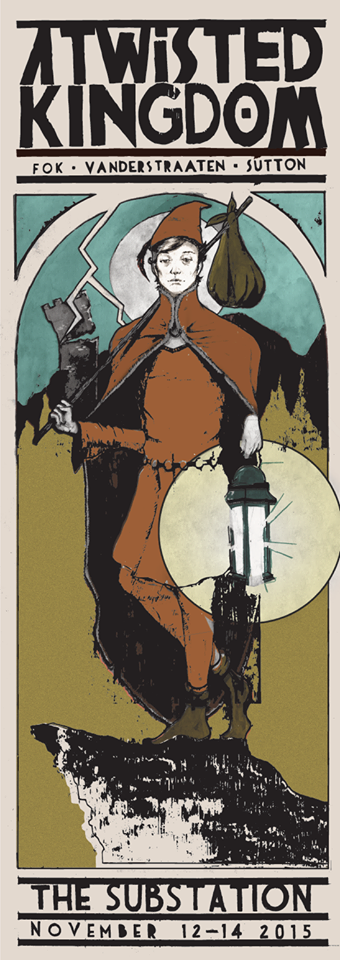
Illustration: Marc Gabriel Loh

A Twisted Kingdom
Dark Matter Theatrics
12 November 2015
The Substation
12–14 November 2015

Just like the Tarot cards, The Fool (Lian Sutton) in A Twisted Kingdom goes on a journey through life’s mysteries and, in the process of doing so, drudge up his own personal memories and history. He embodies the everyman while telling a very personal story.

Playwright Christopher Fok showcases his mastery of the medium by seamlessly weaving the overarching story of the Fool in search of the prince, references to fairy tales, and the Fool’s painful past into one intriguing tapestry.

While the arrangement of the scenes may appear complicated, there is an indescribable logic to it. Fok achieves the sweet spot of preventing the audience from falling into a passive lull but not pitch it at such an esoteric level that one is unable to get a grip on what is going on.

How does one play the Fool and reopen old wounds at the same time? Sutton has part of the answer. One should not be fooled that a small stage space would make his job any easier. From jumping on the chair and turning it into a horse to donning a doctor’s coat and embodying different sorts of doctors, Sutton is a sensitive story-teller.

The ability to transit into the next scene which is of a very different nature from the previous speaks of an intense rehearsal process. Sutton may be overstretched at times, but the audience is always couple of paces behind the Fool as we eagerly follow him on his journey.

Despite the financial constraints of the production, the designers must be applauded for generously lending their talents. Marc Gabriel Loh’s illustration for the poster and the programme is the best I have seen in a while.

The programme informs us that this production marks Isa Ong’s first foray into music composition for theatre. This makes him one of those annoyingly talented individuals as his music does not indicate a beginner’s attempt. Chew Wei Shan’s haunting vocals towards the end of the show enhances the pathos.

Hakeem Kasban’s lighting design is simple yet effective. Faith Sim’s costume design may appear odd at first but it is wonderfully appropriate in the context of the show. Olivia Vong’s set design makes good use of the space and every item is significant to the story.

Indeed, “The Fool is welcomed everywhere he goes” as one cannot help but stop and listen to his story.

Other Reviews

“Twisted Tales” by Walter Chan, Centre 42 Citizens’ Reviews

[Listing] Beauty World

beauty world 2015 NO TEXT

This November, legendary duo Dick Lee and Michael Chiang reunite once again for Singapore’s number one musical, the iconic Beauty World!

This much-beloved musical, which has seen multiple stagings since its debut at the Singapore Arts Festival in 1988, traces the adventures of a small-town girl from Batu Pahat who sets out on a quest to find her father in Singapore With a mysterious jade pendant as her only clue, she winds up in a dubious cabaret, where she learns some heartbreaking truths about love and life.

This revival, which features Michael Chiang’s revised script from 2008, will be directed for the first time by co-creator and composer Dick Lee. The production will bring an exciting ensemble of formidable talents from theatre and television.

TV star Jeanette Aw sizzles as Lulu, the beautiful but vindictive cabaret queen, while Malaysian talent Cheryl Tan brings wide-eyed charm to the role of Ivy Chan, our innocent protagonist. Adding her touch of class to the mix is seasoned actress Janice Koh, appearing in her first musical as the wise and winsome Mummy.

Other theatre talents include Timothy Wan (Ah Hock the bouncer), Joshua Lim (Frankie the boyfriend), and Frances Lee (Rosemary the penpal).

While the plot remains unchanged, and the comedy is as enjoyable as ever, this new version promises to unveil a darker, more dangerous Beauty World.

Beauty World runs from 13 November to 12 December at Victoria Theatre. Tickets from Sistic.

[Listing] The Emperor’s New Clothes by W!ld Rice

Emperor's New Clothes

Once upon a time, in a kingdom not so far away, ruled a vain and pompous Emperor, who was crazy about his clothes, himself and little else. So obsessed with fashion was he that he decreed that the 50th anniversary of his reign be celebrated with the most extravagant National Dress Parade of all time. But, as he primped and preened, he neglected his citizens, who could only get his attention by complimenting him on his appearance.

One day, two cheeky tailors decide to teach him a lesson. Presenting the Emperor with an eye-popping ensemble literally woven out of thin air, they convince him that only the smartest and most competent people in the land can see it.

What can be done to stop the nation’s biggest wardrobe malfunction? Why won’t the Emperor’s courtiers and the aristocracy speak up? Is there anyone who’s brave enough to tell the naked truth?

This holiday season, W!ld Rice puts a Singaporean spin on Hans Christian Andersen’s timeless tale about the ultimate fashion victim. Directed by Pam Oei, The Emperor’s New Clothes is a brand new musical with a razor-sharp script by Joel Tan and a sparkling score by Julian Wong. Its stellar cast includes Lim Kay Siu as the Emperor, Benjamin Kheng of The Sam Willows, Singapore Idol’s Sezairi Sazali and Siti Khalijah Zainal—all playing musical instruments live on stage!

Fun and laughter never go out of fashion. Don’t miss the most hilarious, heartwarming musical of the holiday season!

Catch The Emperor’s New Clothes from 20 November – 12 December at the Drama Centre Theatre. For ticketing information, please visit Sistic.

[Quick Theatre Review] Six Characters in Search of an Author — Six Characters Questioning the Premise of Theatre

Six characters

Six Characters In Search of an Author
Théâtre de la Ville
10 September 2015
Victoria Theatre
10–12 September 2015
Part of Singapore International Festival of Arts 2015

In response to naturalistic theatre, Valerii Briusov writes:

“There is no fixed boundary between the real world and the imaginary world, between ‘dreaming’ and ‘waking,’ ‘life’ and ‘fantasy.’ What we commonly consider imaginary may be the highest reality of the world, and the reality acknowledged by all may be the most frightful delirium.”

While Pirandello may not be considered a symbolist, his play is Briusov’s comments made flesh. In the midst of rehearsing “The Rules of the Game,” six characters belonging to an unfinished story appear in the rehearsal room and the director is asked to stage their tragedy. What unfolds is an overwhelming, frustrating, yet utterly intriguing piece which challenges the premises of what theatre purports to do.

Pirandello hits the sweet spot between developing the philosophical dialectic without drowning the audience as there is enough action to keep us in our seats. Despite the seeming chaos on stage, there is definitely a method to the madness as director Emmanuel Demarcy-Mota manages to encapsulate it within a minimal landscape of a rehearsal room.

The audience was treated to a wonderful performance by the cast with the actors playing the actors (it’s confusing, I know) being mere walk-on players and yet having enough of a presence to justify them being in the play. The actors playing the characters

Throughout the course of our writing careers, us critics would often pronounce what is considered good theatre and what it is not. If I were asked to do so now, I would – like the character of the “The Father-” unleash a slew of pseudo-philosophical gibberish. My only recourse is to rely on my intuitions which says that this production is definitely one of them.

Other Reviews

Six Characters In Search of an Author by Ng Yi-Sheng, SIFA.sg

“The Elusive Reality of Theatre” by Tung Kai Wai, The Practice Journal

“Six Characters In Search Of An Author: A Bizarre French Madhouse Play” by Abigail Tee, Reuel Writes

[Theatre Review] Dementia — Not As Memorable As It Should Be

Photo: Marcell Rev

Dementia
Proton Theatre
13 August 2015
Victoria Theatre
13–15 August 2015
Part of Singapore International Festival of Arts 2015

“Actors on stage. Static sounds. Smell of electrical appliance overheating. Occasional flashing light. Cramped hospital ward—four beds. Various personal items of the patients are seen; well lived-in. Christmas tree. Patient sits in the auditorium as the nurse coaxes her back to the stage.”

These scattershot impressions that Dementia creates as one enters the theatre is unsettling. As the audience takes their seat, a plump man in a sweater—who we later find out to be the doctor—starts getting restless and exuberantly informs us that this is a hospital ward for dementia patients. His uncontrollable laughter underscores his introduction and one wonders whether he is actually a patient himself.

This sense of puzzlement is emblematic of the show.

Is Dementia literally about a rich man buying over the whole building, hurling what is left of a psychiatric ward into the streets, and converting it into a Hungarian equivalent of Babestation? Or is it a metaphor for the state of Hungarian society?

I could not make up my mind throughout the show but I later found out that it is meant to be both as indicated in the progamme booklet.

The ghostly remnant of the hospital ward is inspired by the closure of the National Institute of Psychiatry and Neurology in Budapest (formerly known as Lipótmezei Psychiatric Hospital) in 2007. The government incurred the ire of critics as there was no consultation with healthcare professionals which made the restructuring programme appear as a blatant political move. An unjust move at the expense of the psychiatric patients who were left to fend for themselves as the extant hospitals could not accommodate all of them.

The deafening silence from the authorities as the building stands abandoned compelled director Kornél Mundruczó to stage Dementia and excavate the alternative voices in society that often go unheard.

Aside from the injustices, we ourselves are like the dementia patients—trapped in our own obsessions as we slowly forget about everything else. With the show being part of the Singapore International Festival of the Arts and its theme being Post-Empires, Dementia is a cautionary message not to fall into a state of post-remembrance.

With a heady mix of live music (played by the patients) and film projection of what goes on in the ward when the curtain falls, Dementia has elements of melodrama and dark comedy that is poised to leave a deep impression. It rarely lets you settle but keeps you on your toes.

Unfortunately, it does not.

While the social message is relevant to any society, the language barrier seems to blunt the immediacy of what the production is trying to evoke. As it is impossible to completely synchronise the English surtitles with the delivery of the Hungarian text, there seems to be an added distance between the audience and the performance.

Safe for the extraordinarily squeamish, the violence, blood, and nudity hardly adds to the shock value. More importantly, there is an uncomfortable asymmetry in the violence done to the women as most of them are sexually humiliated while only two of the male characters experience physical harm. This unnecessarily distracts one from the message of the play.

Despite certain dramaturgical flaws, the play rewards those who are willing to reach out some food for thought and perhaps a moment of clarity. A gift much needed in a demented society which even calculates whether the able-bodied is deserving of state support.  

Other Reviews

“Proton Theatre’s Dementia is a Little Ward of Horrors” by Corrie Tan, Straits Times Life!

“SIFA 2015: Proton Theatre’s Dementia is an emotional rollercoaster ride” by Yane Usagi, Today

“Dementia” by Ng Yi-Sheng, SIFA.sg 

“Dementia: Taking One Hard Look at our Senility and Mortality” by Reuel Eugene, Reuel Writes

[Theatre Review] The LKY Musical — A Decent and Modest Epic

Photo: Metropolitan Productions

The LKY Musical
Metropolitan Productions
30 July 2015
Sands Theatre, Marina Bay Sands
21 July – 16 August 2015

To call The LKY Musical a biopic about Singapore’s first Prime Minister, Lee Kuan Yew, is a misnomer. It is a portmanteau consisting of biography and motion picture. However, if we were to exercise some poetic license and see it as a biographical epic, it is somewhat apt.

I say somewhat because it spans an epic sweep of historical events but its staging does not match up to it. For starters, the Sands Theatre is badly designed. With its small stage, grey interiors, and bad acoustics, it feels like someone decided to convert a warehouse into a “theatre” on a whim. It is clearly designed for cheap entertainment and artistry is a mere afterthought—like belching after drinking too much beer from a plastic cup.

To deal with space constraints, set designer takis makes use of every inch with a three-level structure that has six rooms. Toss in sliding screens with projections and the audience is whizzed from a shelter where rickshaw pullers reside to Lee’s residence in Cambridge.

Yet, ingenuity can only go so far.

The actors are visibly hemmed in by whatever remains of downstage and the size of each room. To make matters worse, the major events from Lee at Raffles leading up to his time in Cambridge zipped past at breakneck speed. The ensemble could hardly settle into their roles and it is merely a notch above someone walking across the stage with a flashcard saying “Japanese Occupation” and sounds of bombs going off in the background.

Despite these flaws, this musical scores enough brownie points to warrant more than two hours of your time if you have some to spare.

Adrian Pang’s versatility truly knows no bounds. While he does not adopt every single behavioural tick of Lee Kuan Yew, he exudes Lee’s unmistakable presence when delivering a political speech. With his body tilted at an angle and chest puffed up, he marshals voters to the polling station as he goes head on against his former comrade turned opponent, Lim Chin Siong.

Benjamin Chow’s Lim Chin Siong certainly matches up to Pang’s Lee. Rather than play the radical hothead as described in history textbooks, Chow’s Lim possesses political cunning and daring which makes him a formidable opponent of Lee Kuan Yew. Chow must also be commended for his ability to maintain his Chinese accented English when singing without compromising on his diction.

Radhi Khalid’s Tunku Abdul Rahman, Malaya’s Prime Minister, is a nice counterpoint to Lee Kuan Yew. Khalid’s gentle cadences as he glides effortlessly through his lines is contrasted with Pang’s pointed attack—an indication of Lee’s no-nonsense approach to politics. While Tunku’s insistence on playing poker rather than discussing politics may be superficially read as insouciance, it is a gentle insistence on the incompatibility of Lee’s egalitarian ideals and Tunku’s racial politics. To discuss it further would unnecessarily sour the already tenuous relationship.

Other notable performers are Sebestian Tan as Teong Koo the optimistic rickshaw puller and Vester Ng as Ng Kai, the naïve and eager union leader of the rickshaw pullers. While Edward Choy (Goh Keng Swee), Dayal Gian Singh (Rajaratnam), and Tan Shou Chen (Toh Chin Chye) gave credible performances in their supporting roles, it is a waste that their characters are not developed further which is an injustice to the legacies of these giants in Singapore history.

Sharon Au as Lee’s wife, Kwa Geok Choo, is clearly doing her best. Unfortunately, her best is not enough as her studied approach and weak singing makes it look as if the decision to cast her is to boost ticket sales by luring her fans to the theatre.

While Dick Lee’s music heightens the atmosphere at important points, the styles are too varied for one to discern a particular motif that defines the musical. Stephen Clark offers witty lyrics such as Lee describing one of the reason he loves his wife is that she is supportive and often makes her ideas seemed like his. However, due to the dismal acoustics of the venue or incompatible levels on the sound console, one will miss it unless an effort is taken to listen intently.

With Lee Kuan Yew’s recent demise and the excitement of the upcoming election, the musical is inextricably tangled over concerns of its historical accuracy and intent. My colleagues seem to adopt either an apologist stance or deem that the musical as an unsuitable genre.

The LKY Musical depicts events as it happened generally and is careful not to over-valourise the man—it neither beats the drum of the official narrative nor poses a distinct challenge to it. Additionally, it has no pretentions of showing “The Singapore Story” which is made abundantly clear through its uninspiring title. As an art work, it generally entertains and I have detailed where it is lacking.

The performing arts cannot replace the work of the historians which is where you should go for nuances and interpretations of events. At the very least, one hopes that it sparks an interest in those whose only acquaintance with the narrative is through the stilted words of a heavily regulated history textbook.

Other Reviews

“Theatre review: Adrian Pang turns in a stirring performance in The LKY Musical by Corrie Tan, The Straits Times Life! 

“Theatre review: The LKY Musical by Naeem Kapadia, Today

“Review: The LKY Musical by Gwen Pew, Time Out Singapore

“A Missed Opportunity” by Andre Theng, Centre 42 Citizens’ Reviews

“Defying detractors, LKY Musical gets standing ovation” by Lisa Twang, The New Paper

“Does the LKY Musical live up to the Man?” by Crystal Nanavati, Sassy Mama

“{Review} The LKY Musical – A Night to Stand Proud and be Inspired” by Audrey, Says! Happy Mums

The LKY Musical by Mummybean, Life is in the Small Things

“Theatre Review (Singapore): ‘The LKY Musical’” by Sharmila Melissa Yogalingam, BlogCritics

The LKY Musical – Review” by Campus Magazine

“Sylvia Toh Reviews The LKY Musical by Sylvia Toh, superadrianme

The LKY Musical — A Musical We’re Proud to Call Our Own” by David Sim, Life’s Tiny Miracles

The LKY Musical: The history of Chinese men’s Singapore” by Kirsten Han, The Online Citizen

The LKY Musical: A Bold Account of Singapore’s Founding Father” by Reuel Eugene, Reuel Writes

[Theatre Review] Another Country — A Celebration of Two Countries

Photo: Wong Horng Yih, Courtesy of W!ld Rice

Photo: Wong Horng Yih, Courtesy of W!ld Rice

Another Country
W!ld Rice
27 June 2015
Drama Centre Theatre
25 June–11 July 2015

”If only at one point our hands could clasp,

What rich variety and gesture could be ours.”

~ Dance by Fadzilah Amin

Like any love-hate relationship, Singapore and Malaysia have often come to fisticuffs. But in Another Country, we waved at our cousins, raced across the room, pulled them up, and danced with them.

We danced to the melodies and sentiments excavated from the texts of both countries that span five centuries. Drawing from literature, interviews, and even legal documents, Alfian Sa’at intricately weaves together the text for Sayang Singapura while Leow Puay Tin does the same for Tikam-Tikam: Malaysia@Random 2.

The Malaysian ensemble (Ghafir Akabar, Sharifah Amani, Anne James, Alfred Loh, Iedil Putra) interprets the Singaporean texts and the Singaporean ensemble (Sharida Harrison, Lim Yu-Beng, Gani Karim, Janice Koh, Siti Khalijah Zainal) performs the Malaysian texts.

What emerges is a beautiful testament to the rich cultural resources we share that present a socio-historical account of the concerns that the writers had. This compels the audience to re-look at their own stories from a fresh perspective while listening and learning more about the other side.

The curators must be applauded for picking texts which not only cover events running up to the merger or just after the separation, but also broach uncomfortable topics.

Notable selections from the Malaysian corpus include Tunku Abdul Rahman dreaming of a bad omen which preceded the race riots in Malaysia, Amir Muhammed’s 120 Malay Movies which discusses Singapore marking the start of the national narrative at 1965 and parallels that with the Malaysians not acknowledging their cultural roots from the Hindu empires of old, and the self-reflexive The Myths that Cloak Our Theatre by Krishen Jit which criticises the industry for the lack of community theatre projects and turning theatre into a polished product meant for the middle classes to consume.

The Singapore selection explores political censure, among other topics, by choosing The Campaign to Confer the Public Service Star on JBJ by Eleanor Wong, Fear of Writing by Tan Tarn How, and Gemuk Girls by Haresh Sharma. The most interesting choice of them all is Elangovan’s Talaq which portrays how some Indian-Muslim husbands intentionally misinterpret Islamic principles to justify their infidelity and subjugation of their brides from India. I was surprised that the Media Development Authority allowed this to pass given that they banned the original performance of the English script.  I hope that the audience would be compelled to read the play in full and judge it for themselves.

The possible dialogues sparked off by this production would not have been possible without the brilliant performances by both ensembles. Their talent and versatility are clear for all to see as they are able to smoothly transit between texts that have very different demands and characters. The actors are also able to command the stage during their individual scenes and immediately reintegrate back as an organic whole once that is over. I would not be surprised if this production gets a nomination for best ensemble at the Life! Theatre Awards and it will be such a lovely gift to the Malaysian actors as well.

This project needs to be revisited every decade and updated with new and exciting writing. Apart from the texts we have, future iterations should boldly experiment with performance practices and forms. Who knows? Perhaps we could develop a performance vocabulary unique to both sides of the causeway—our own artistic secret handshake.

Other Reviews

“Theatre Review: Wild Rice’s ‘Another Country'” by Mayo Martin, Malay Mail

“Review: Another Country” by Gwen Pew, Time Out Singapore

“It’s a small world after all” by Andre Theng, Centre 42 Citizens’ Reviews

“REVIEW: ‘ANOTHER COUNTRY’ – NO PASSPORT NEEDED, ART TRANSFORMATIVE!” by Ann Lee, The Daily Seni

“Another Country by W!ld Rice Review – Proving the Singapore-Malaysia Causeway Isn’t Too Much Of A Divide” by Scott Lur, The Smart Local

Adieu Flying Inkpot: What Now?

Inkpot screengrab

And just like that, one of our cultural institutions in its own right has decided to call it a day.

The theatre and dance arm of The Flying Inkpot has been consistently reviewing and assessing a large section of the arts scene for the past 19 years. In its own quiet way, it amassed a decent following and stands as an alternative source to our newspaper critics and a whole crop of glossy lifestyle websites of more recent vintage. The most unfortunate thing is that only those invested in the arts scene will understand the gravity of this loss.

While Corrie Tan (The Straits Times, Life!), Mayo Martin (Today), and Helmi Yusof (Business Times) will undoubtedly continue their wonderful work, their professional commitments mean that they will not be at the forefront of theatre criticism. One must understand that they are journalist-critics—journalists first, critics second. The focus of the newspapers probably require them to prioritise industry stories over the reviews. To compound the problem, they have to shoulder the lion’s share of the arts beat as they have few colleagues working with them.

As such, their role in criticism is limited to being active writers and providing occasional feedback during industry consultations conducted by the National Arts Council (NAC). They neither have the time nor energy to promote the standing of critics, spark thoughtful discussions about the arts scene (beyond the allotted column inches), and improve the quality of writing (apart from their own).

That is where The Flying Inkpot comes in and its departure has left a gaping hole in the ecosystem.

I have been reading Inkpot‘s reviews on and off for years. It started out as getting a second opinion on whether a particular show is good or not. However, having developed a strong interest in theatre criticism over the past two years (hence this blog), The Flying Inkpot has become a benchmark for me. My reviews have to be as good, if not better than what Inkpot puts out. Additionally, it has been an interesting experience to see if the writers there agree with my opinions of a particular show that I have reviewed. Behind the computer screen, I have occasionally let out exclamations of, “Hear! Hear! What’s with all the hype by people on Facebook?” or “Are you serious!? Did you even watch the show?” Indeed, I feel an odd sense of camaraderie just by yelling at my computer screen after reading the reviews.

As the performing arts scene show gratitude for services rendered, a pressing question looms: What is next for theatre criticism? Here are some initial ideas.

Taking Stock

For starters, before we decide our next step, we have to lay the groundwork for current and future critics. In acknowledging the value of the reviews for researchers, practitioners, and aficionados, the editors of Inkpot—Kenneth Kwok and Matthew Lyon—have decided to make the archive available to all even after the website has shut down.  The mainstream media should do the same.

Rather than subject interested individuals to squinting as they scroll through microfilms or settle for heavily watermarked copies online, the NAC should partner with Singapore Press Holdings (SPH) and Esplanade Library to start an online portal which contain all the reviews by our newspaper critics past and present.

NAC should also commission a book which will be a general survey of the history of theatre criticism in Singapore. Drawing from the newspapers and The Flying Inkpot, it will feature some key reviews of various productions over the years. Perhaps it can include an introduction at the start of each section which analyses writing styles of reviewers or interesting insights about theatre history that can be gleaned from these reviews.

If there is enough academic and artistic interest, an academic book can be published which contains various essays about theatre criticism. They can range from in-depth analyses of particular critics to how theatre criticism fits in our local arts ecosystem. Practitioners could contribute essays about their views on critics or how they made use of past reviews to inform their research while creating a new production.

Looking Ahead

In the best of all possible worlds, we should work towards having full-fledged critics or at least actor/dancer-critics (some feel that there will be a conflict of interest but I disagree—another post for another day) a reality. Criticism is not just about watching something and voicing one’s opinion. A critic should be as knowledgeable about the performing arts as possible. Ideally, he or she should be reading up on latest trends and research in the day before rushing off to review a show at night. It is a proper career and not something you do when you have some time to spare in the evenings.  

However, even if all relevant parties were to work together on this (and that is a big if), it would take at least 10–15 years to achieve this. What can we do now?

Well, a critic is nothing without readers. Apart from The Art of Review talk organised by the Esplanade Library this year, there was no forum on theatre criticism in recent memory at all. I would like to see discussions comprising both practitioners and critics on the same panel and get views from both sides of the curtain. A public talk will give the audience a chance to weigh in on what they think the role of criticism. It would also benefit the critics as, speaking from my own experience, they hardly get any feedback from their readers and the conversation borders on being insular.

Of course, one might point out that it is a lovely exercise of preaching to the choir. This might be true in some respects but a realistic goal of such public outreach is to encourage those who might be willing to engage at a deeper level rather than “convert” the uninterested. Besides, even within the arts scene—and I will be really pleased if I am wrong—the engagement seems to be between the reviewer and the reviewed; the choir needs some encouragement to expand its repertoire and sing louder.

As for more “concrete” measures, the easiest route to take is to ask all the writers to start their own blogs or, for those who are interested in journalism as well, join The Muse (a rather good arts website). Alternatively, they could join the glossy lifestyle websites and improve the quality of criticism there (I shall not bore you with a list of their inadequacies).

While that is all well and good, a central website is still necessary. If everyone does their own thing, who does a theatre company choose to offer press tickets to? Will they shun critics whose tastes and proclivities do not incline towards the genre or dramaturgy that the company is known for? We cannot all flood The Muse and there is something to Inkpot resolutely standing as an alternative—not necessarily against—to the soundbites galore offered by glossy websites that seem to be spawning exponentially.  

Matthew Lyon is on to something when he mentioned that if Inkpot were to be revived in any way, shape, or form, it will have to expand its scope to include videos, podcasts, and feature articles. However, it would take a generous funding model to sustain this. On top of that, it would require a full-time team which would not be possible for him and fellow editor, Kenneth Kwok, to be in charge of. He does not think corporate sponsorship or advertising might be a good idea as the site should not be beholden to commercial interests and that most companies do not want to be associated with an activity that is generally (and most erroneously) seen as being nasty to people.

I sympathise and somewhat agree with Lyon. But there are a lot of things going on here. In the beginning, this website will still have to be on a voluntary basis for a while but it can steadily progress to a model in which contributors are paid a nominal fee.

While it might probably be true that big corporate sponsors do not want to be associated with the website due to the negative perceptions of what critics do, it might not be true for smaller establishments. Perhaps one should woo restaurants and bars that are near performing venues for advertisements. Why would it matter to them if it is a eulogistic or slamming review as long as the readers—who form a reasonable section of the theatre-going public—glance at their advertisements and learn about their promotions? The only clash of interests here are companies who serve as official caterers or are involved with certain promotional tie-ups with a particular theatre company. Even with them off the list, there are still many companies available.

Aside from that, why do we have to limit ourselves to direct funding/ advertising/ sponsorship? Online advertising revenue has progressed quite a bit. There are “indirect” advertising revenue streams such as Google Adsense in which the website can earn some revenue based on the number of unique views or clicks on the advertisements displayed. If the website starts a YouTube channel, the videos can also be monetised. Hopefully, after a few years, the revenues will be substantial enough to remunerate the contributors.

Speaking of YouTube, the sky is the limit in terms of content. It could be a panel talk-show setting (see Theatre Talk) in which various critics (including those from the newspapers) come together and talk about the shows they have seen, predictions for the Life! Theatre Awards, or just argue with each other over what they have written. It could also be two enthusiastic presenters just bantering away and occasionally inviting artists in for a chat. The setting of the latter format could be in a cafe and perhaps the management could give some advertising dollars too.

Finally, there is absolutely no shame in asking people for donations. In fact, theatre companies could sponsor a couple of tickets and donors who donate a certain amount will be entered into a lucky draw to win them.

Whatever it is, considered and insightful criticism must be kept alive and we are poorer for it if it dies. Adieu Inkpot, it has been a good run and—fingers crossed—we will meet again someday.