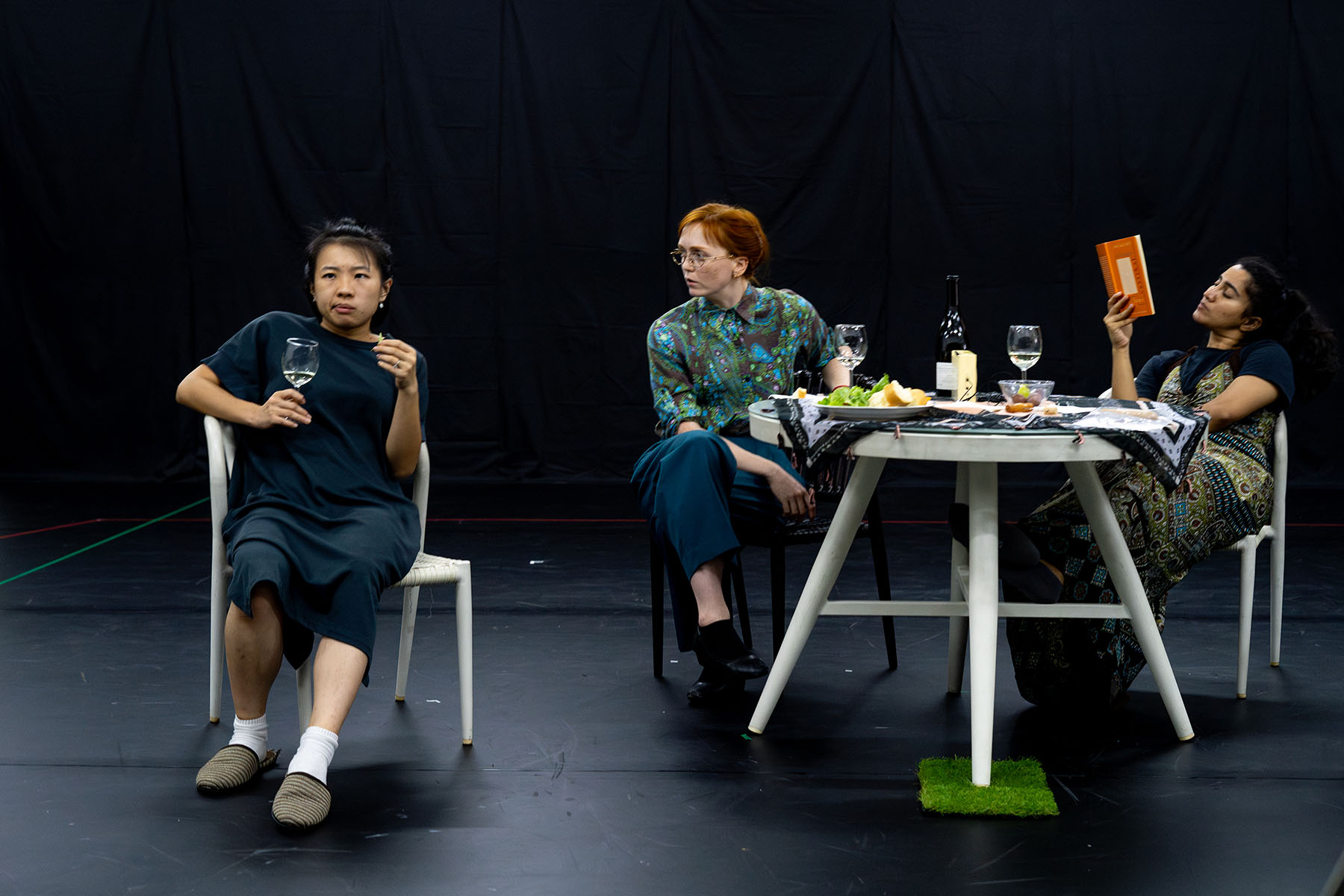
The second production by the graduating cohort of the Intercultural Theatre Institute (ITI) features a double bill: “Fall” by James Saunders and “The Music Lovers” by Georges Feydeau, adapted by Reggie Oliver.
“Fall” explores the theme of loss within a family dealing with an impending tragedy while “The Music Lovers” is a lighthearted tale of mistaken identities.
To find out more about the double bill, I interviewed director Aarne Neeme and a few of the cast members of the show.
Why was the format of a double bill chosen and why “Fall” and “The Music Lovers” in particular?
Aarne Neeme (director): It is always a priority to offer graduating students equal opportunities to show their talents in their final presentation. Given the composition of the class (four women, one man), this presented a difficult choice, which was made easier by choosing two plays. Thus those with smaller roles in one, could be compensated in the other. The other benefit was the choice of two contrasting styles, to fully utilise and display their acting range.
Both plays in this production have distinct styles and demands. How did you ensure that the actors could effectively switch between the introspective nature of “Fall” and the physicality of “The Music Lovers”?
Aarne Neeme (director): The whole basis of actor training is to develop their acting resources and skills. At ITI, together with addressing traditional Eastern forms, they are taught the difference of approach working from the inside out, and the outside in; the external and internal modes of acting. This allows for a greater flexibility in finding the appropriate style demanded by the work.
Courtesy of Intercultural Theatre Institute
What are some of the challenges you encountered in portraying characters from two contrasting plays within the same production?
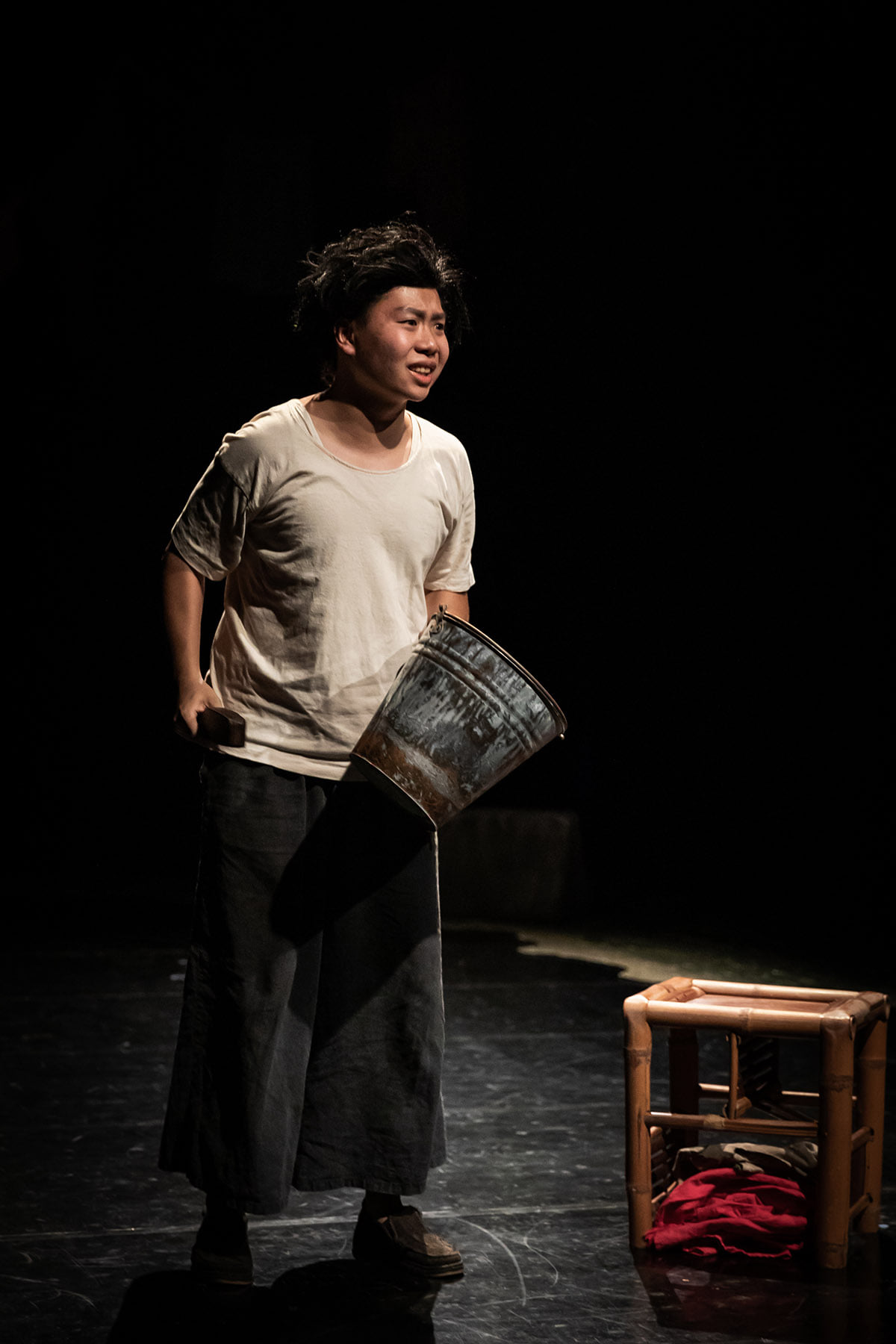
Cheng Kam Yiu (Yolanda): Playing two completely different characters in one production is quite challenging because both of them are of different ages and eras. Lucille is a French young lady in her early twenties from the late 1800s, while Mary is almost sixty in the 1980s. They have distinct physicalities and manners, so one has to transform completely in a split second.
The styles of the plays are also very different: “Fall” is a naturalistic tragedy whereas “The Music Lovers” is a farce in which the characters constantly address the audience and break the fourth wall. Actors have to know the requirements for each genre and adjust accordingly. But it always goes back to the intention and subtext of the plays, which is the most challenging to me.
As a non-native English speaker, the sense of text doesn’t come to me naturally. However, I’m grateful that Aarne is a very patient and helpful director. With his guidance and rich experience, I have a better understanding of the text. I still have a long way to go, but I’m truly thankful for having these two plays mark the end of my ITI journey.
Courtesy of Intercultural Theatre Institute
How do you think your training in the past three years has prepared you for the demands of this double bill?
Choy Chee Yew and Abinaya Jothi: There was a great deal of learning and unlearning simultaneously. Not to be overly fixated on what we have trained in, but to trust our instincts, have fun, and use what we have learned to guide us back when we get carried away. We believe the previous final year production, The Chair, taught us that regardless of genre or style, theatre conveys the stories of human beings, and audiences should see that rather than ensembles of actors “demonstrating” their abilities.
What are some interesting insights you gained in the process of working on this production?
Aarne Neeme (director): This production celebrates the full breath of the theatrical experience both for the actors and their audiences. From the catharsis of Tragedy (evoking fear and compassion), to the comic release of Farce (dealing with obscenity, slapstick and mistaken identities). Thus showing off the full scope of both human and theatrical experience, that we inherited from the Classical Greeks and remains with us to this day.
Swathilakshmi Perumal (actor): “Fall” is a realistic play. We were required to sit down and deliver our lines throughout. Since most of our training is psycho-physical, it is challenging. It leans towards the film logic of experimenting with props. It is interesting to experience this type of performance on stage.
A woman demands justice from the mayor as her husband holds her back / Photo: Bernie Ng
The Chair Intercultural Theatre Institute 1 September 2023 Drama Centre Black Box 31 August–2 September 2023
An original piece by the graduating cohort of the Intercultural Theatre Institute, The Chair revolves around a seemingly nondescript town that is rocked to its core when James, scholarship recipient and pride of the town, kills a few children.
According to the law of the town, the execution must be carried out by the family of the victims.
A woman (Swathilakshmi Perumal) keen on revenge pressures her husband (Choy Chee Yew) to take on a role because he is a butcher. But despite him being adept at slaughtering chickens, he feels uneasy about taking a human life.
The mayor (Mika Oskarson Kindstrand) quickly absolves herself of the responsibility by claiming it is merely a duty for her, but it is healing and an act of justice for the others, including the wider public.
A recluse elderly woman [Cheng Kam Yiu (Yolanda)] has the unenviable position of grieving over the loss of her grandchild, while being the town’s appointed counsellor to the chosen executioner. Things take a strange turn when the butcher and her are chosen as the executioners.
James’s mother (Abinaya Jothi) struggles to make amends with the rest who have always shunned her as she works as a cleaner.
Throughout the course of the show, questions about the nature of justice are raised as the characters grapple with grief, anger, and guilt.
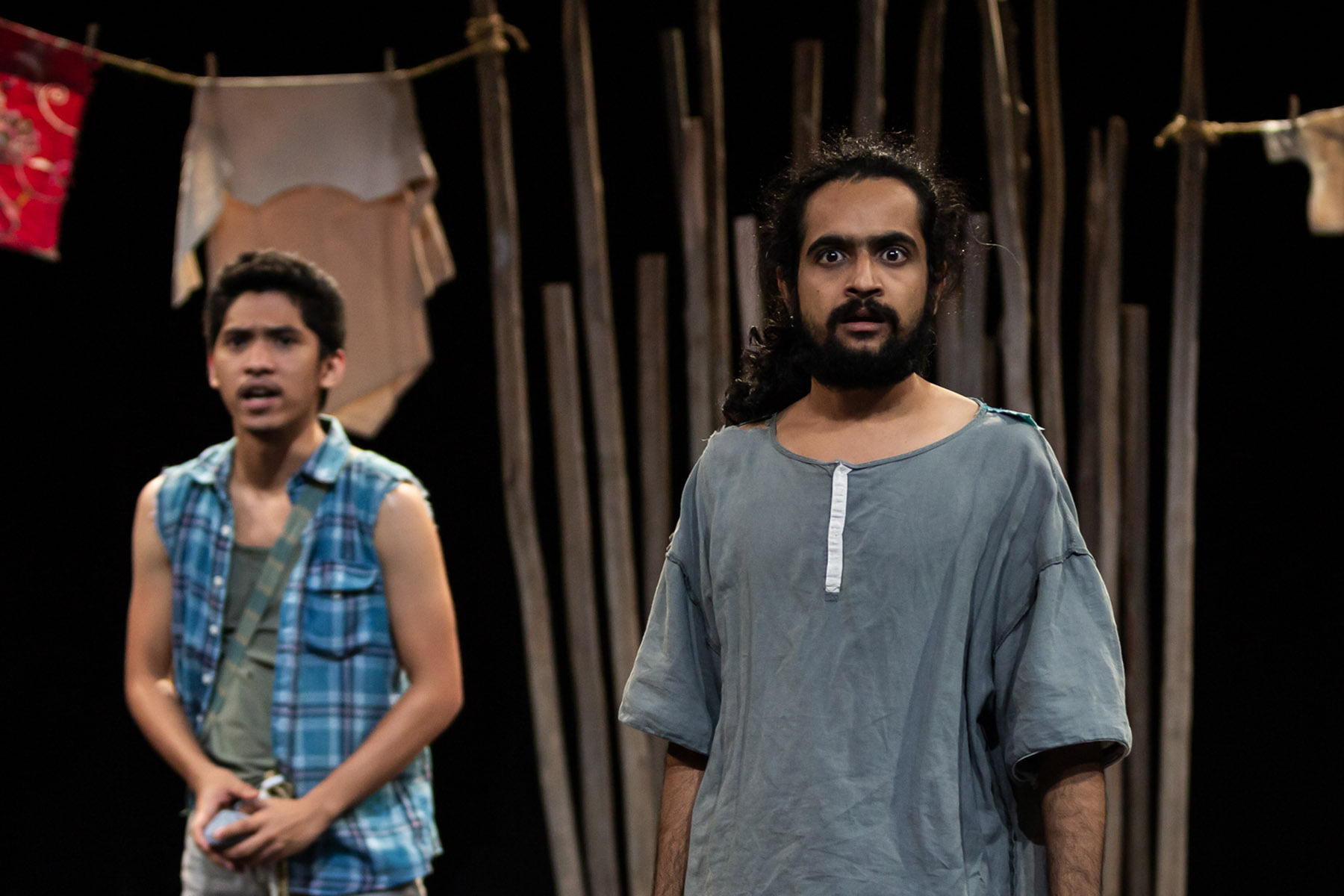
Tensions run high between the mayor and James’s mother / Photo: Bernie Ng
Unfortunately, this proved to be a tall order for the actors. We get enough from them to understand the plot, but not enough to sense that the characters are actually grappling with and trying to keep these emotions under control.
Given that this is an original work, it is puzzling as to why the young actors are given such overly demanding roles.
However, we are compensated with a good synergy in their movement work.
In one scene, the characters are frantically trying to search for the children in the river, depicted by just a black patch on the floor. As they tumble over each other, the characters take turns to raise up the children’s belongings. How the actors manage to hide and retrieve the props is a wonder to this reviewer.
The strong synchronicity between the actors’ movements and the sound (designed by Meng Jiaoyang) and lighting effects (designed by Faith Liu Yong Huay) also contribute to the simmering tensions which leads to a couple of climatic moments, signalled by perhaps an overuse of strobe lights.
The butcher mulls on the grave task ahead / Photo: Bernie Ng
Kudos to director Li Xie for pulling together the seemingly disparate elements of a sparse set (black patches on white floor); striking props by Puny Life Form (think a striking red telephone with cord that doubles as a noose while hanging on sharp hooks); and guiding the actors through the devising process to create a coherent world.
Despite the dungeon-like atmosphere, the consistency of the visual, audio, and performance languages allow us to buy into the idea of the characters being in an odd little town.
While I was not on the edge of my seat, The Chair still intrigues as one considers the nature of justice and how it should be meted out.
The Chair marks the debut of the 2023 graduating cohort of the Intercultural Theatre Institute (ITI). An original work directed by Li Xie, The Chair raises questions on individual and collective responsibility, grief, and the desperate, at times absurd pursuit of justice in an unjust world. Who has the right to decide? When is justice served? What do we owe to each other in the balancing of scales?
I interviewed Li Xie and a few members of the cast to find out more about the show.
What is the devising process like? Was the theme of justice decided beforehand or did it evolve out of the devising process?
Cheng Kam Yiu (Yolanda): It is a collaboration between the director and actors. We first shared our views and interpretations of the script then put the imagination on the floor. From a common understanding of the content, we devised the score using different elements such as movement, sound, space, and object. The score became more detailed and refined throughout the process. There are multiple themes in the script while the actors are exploring their own characters’ journeys of dealing with grief and loss under an extreme circumstance.
As the students have learnt many performance forms and training systems, did you tap into their varied training as you direct the piece?
Li Xie: Yes, the most important aspect is how to bridge their varied training beyond its forms, to discover how all various roads lead to similar core essence in performance.
Meyerhold’s Biomechanics features quite strongly in the rehearsal process. Were there any interesting discoveries you had about the actor training system as you and your cohort worked on The Chair?
Choy Chee Yew: We trained intermittently in Biomechanics over the past three years and the production was an opportunity to put the training into practice. The principles of Biomechanics are actually applicable in all aspects of theatre-making, but as our training wasn’t continuous, it was noticeable that the principles were not as ingrained in some of our bodies as they should.
The rehearsal process made it clear that certain misconceptions of Biomechanics needed to be debunked. As a training system, it adopts certain stylised approaches to impart its principles, especially the etudes. However, this doesn’t mean that an actor trained in Biomechanics has to perform in a stylised manner like an etude. Even in a realistic play, the principles of biomechanics are still as relevant; precision, rhythm, clarity, efficiency, and the conscious use of the whole body in expressing intention.
During the devising process, there were many uncertainties, such as the understanding of the characters’ intentions and how to best use a very bare stage. At times, this resulted in a lack of clarity in what we were trying to express. We were constantly reminded to return to our truthful instincts to approach the character, and then to use the training principles we’ve learnt to deliver in the clearest and most efficient way.
What would an ideally just world look like?
Li Xie: This is a very difficult question which has no clear answers. Everyone’s ideal is different. It’s probably a world one never regrets coming into.
Jemima Dunn as a fairy and Daisy Zhao Xiaoqing as Puck / Photo: Bernie Ng
A Midsummer Night’s Dream Intercultural Theatre Institute 3 November 2022 Esplanade Theatre Studio 3–5 November 2022
I have to admit that when I found out that Beijing Opera, Kutiyattam, and Wayang Wong were incorporated to delineate the characters in A Midsummer’s Night Dream, I had strong reservations.
It could easily derail into an exotic parade. Additionally, with this being the graduation production by the 2022 cohort of the Intercultural Theatre Institute (ITI), it feels like a quick and easy way to showcase what the students learnt, rather than serve the demands of the text.
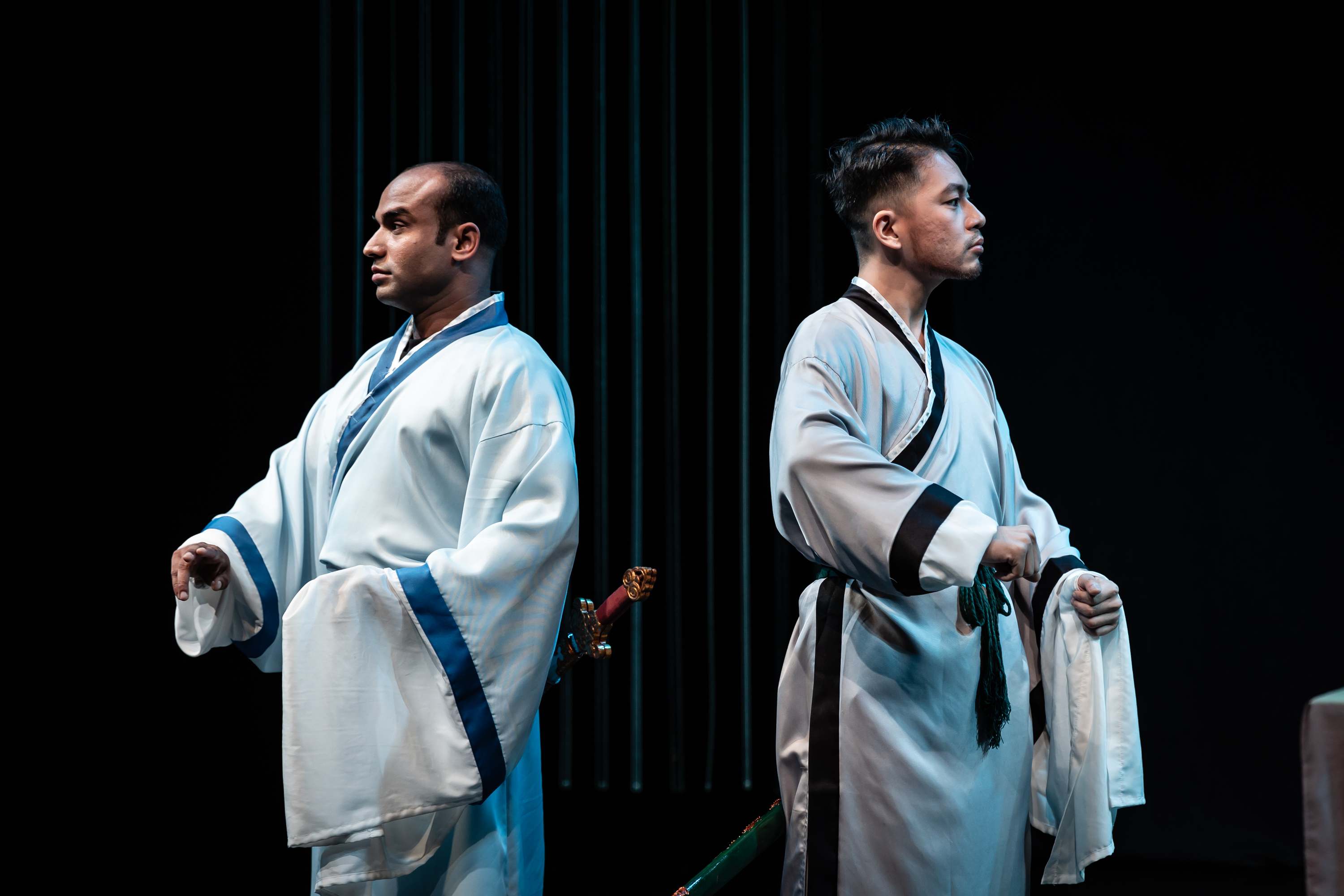
As the Athenians appear in Chinese opera garb in the first scene, which elicits a short burst of laughter, my heart starts sinking. With the inconsistency in make-up and costume,—none of the actors is in opera make-up, and some of them do not have a head covering—it feels like watching kids playing dress-up.
Am I to endure 150 minutes of a rude mechanical play within a crude, mechanical performance?
Thankfully, this is not so.
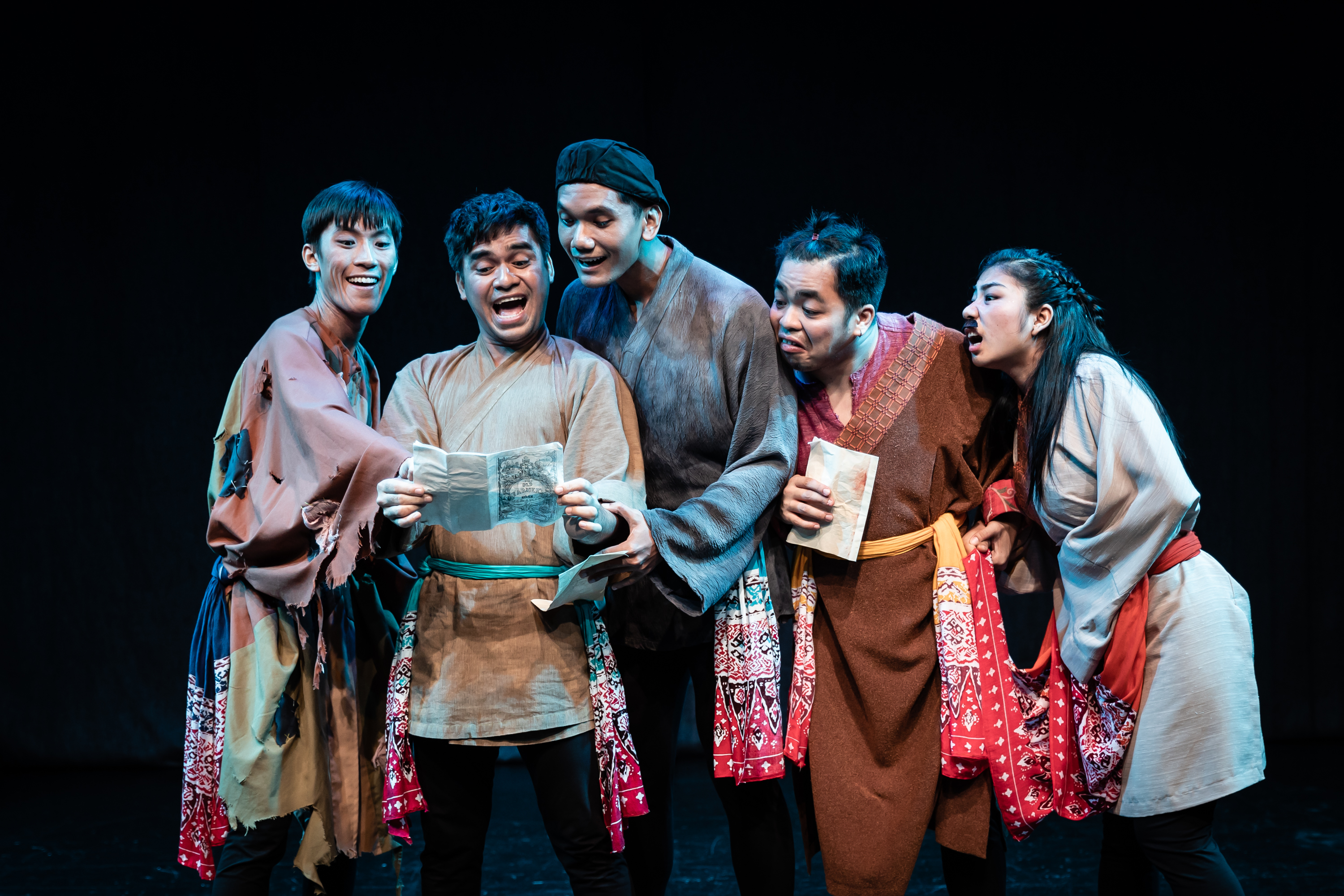
The rude mechanicals / Photo: Bernie Ng
As the performance goes on, the conceit regarding the various performing traditions becomes clearer. The show does not pretend it is faithful to the art form. Rather, certain aspects are borrowed to accentuate a certain quality of the character or to add to the mise-en-scène.
To use a very rough analogy, if we liken each performing tradition to a language, rather than it being multilingual, it is more of borrowing a few expressions that capture something which is difficult to translate in one’s native tongue.
In essence, the focus on incorporating various performing traditions in the publicity materials (mea culpa) is over-egging the pudding.
In that vein, director Aarne Neeme strikes the right balance with the actors when it comes to the fairies and the rude mechanicals.
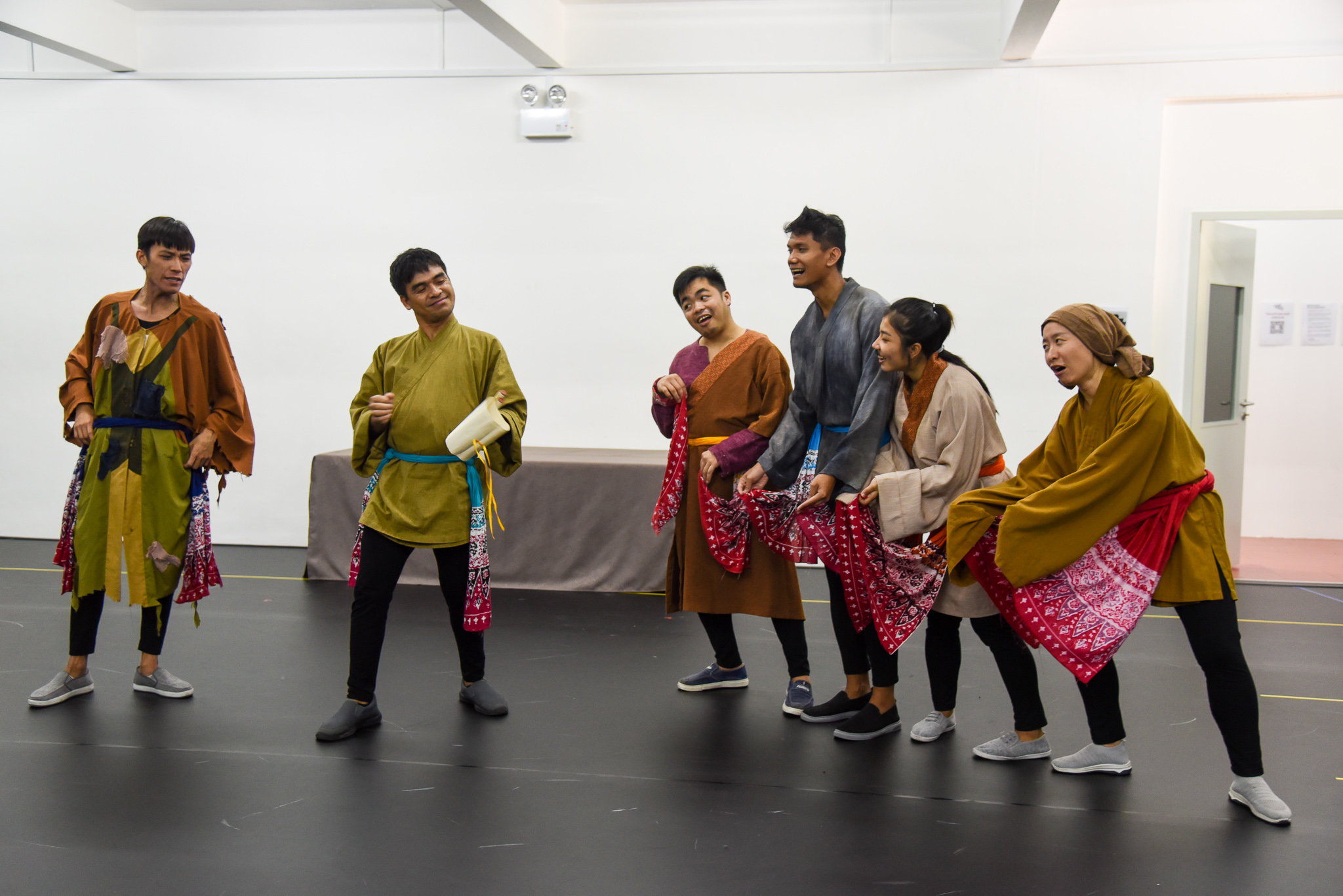
Kuttiyatam influences the wide stance, gestures that look like mudras, and the costumes of the fairies. But the production only seems to take the costumes and the gesture of spreading out the cloth hanging from the sides of the costume from Wayang Wong. This results in a cohesive depiction of the fairies and rude mechanicals.
Unfortunately, there is no consensus on how much the actors should borrow from the Beijing opera convention, resulting in them being slightly stifled by the demands of the form and the presence of the water sleeves.
That said, it should be noted that Ng Yuan Ci (Hermia) is most fluent in the form, as she uses various gestures to portray the besotted or spurned lover to great effect.
Ng Yuan Ci as Hermia and Wong Jin Yi as Helena / Photo: Bernie Ng
But what is truly on display is the versatility of the actors. Of note are Ruthi Lalrinawmi (Titania / Starveling) and Wan Ahmad (Oberon / Snout). Lalrinawmi seems to grow in stature as the graceful Titania while she seems dumpy as Starveling. Being the tallest in the cast, Wan’s height is unmistakable, but the commanding presence of Oberon and the goofy demeanour of Snout is night and day.
While Peh Jun Kai (Bottom) only plays one comedic role, he has full control on the comedic dial throughout the show. He turns it up when he transforms into a donkey, and plays it to the hilt as Thisbe in the play-within-the-play.
Daisy Zhao Xiaoqing’s (Puck / Snug) interpretation of Puck is interesting. Beyond the usual playfulness, she occasionally flashes a sinister side to the prankster, which is seldom seen in most portrayals.
Oliver S.K. Wu (Lysander) and Kaleem Zafar (Demetrius) occasionally struggle with the mountain of mawkish text as they try to woo the ladies, but their physical sequences, which are borrowed from Beijing opera, are entertaining to watch when both characters are at odds with each other.
To my mind, Helena is the most irritating character in the play, but my impression of her has been rehabilitated by Wong Jin Yi’s wry approach to the character. Her deadpan expressions and opportune asides to the audience make us sympathetic to her being subjected to the cold-and-hot treatment (no thanks to Puck’s intervention) by the Athenian men.
Kaleem Zafar as Demetrius and Oliver S.K. Wu as Lysander / Photo: Bernie Ng
As it is a graduation production, it is understandably bare when it comes to the set (curtains of what looks like transparent acrylic strips) and sound (generic Chinese opera or Indian music to signify the entrance of the characters).
The lack of stage effects may result in the show being rather dry, but it is a testament to the overall success of the show that the audience is engaged throughout the whole performance.
And what a fitting end for ITI’s class of 2022! Undergoing three years of actor training during a pandemic must seem like a feverish dream for them.
The final graduation production for the 2022 cohort of the Intercultural Theatre Institute (ITI) is A Midsummer Night’s Dream. True to the ethos of the institute, this production features various performance traditions. I interviewed director Aarne Neeme to find out more about the show.
Why did you choose A Midsummer Night’s Dream as the production for the students to work on?
The choice of the graduation play is a group decision by the teaching staff — relating largely to the student needs and composition. This year we had a relatively large number of talented students, including strong women, which A Midsummer Night’s Dream gave opportunities for, together with the challenges of a Shakespearean play. While I have directed well over a dozen of his creations, this is my first encounter with the Dream, and I am relishing it!
Why did you decide to weave in Beijing opera, Kutiyattam, and Wayang Wong, performing traditions in which students have received some training in, into the show? How did you decide on which characters in the play would take a particular tradition?
One of the aims of ITI is to draw from the rich resources of both traditional Eastern and Western forms. Given the four layers of the play (the Spirit world, Athenian Court, Mechanicals and the “Performance”), it seemed an ideal opportunity to utilise elements of the training to delineate them. While there is no attempt to fully replicate any of the forms, we have simply used aspects to illuminate the differing worlds of the play.
India was the main source of most theatre in Asia, and with its spiritual beliefs, seemed to be the most appropriate for the world of Oberon and Titania. While the formality and morality of Chinese Opera befitted the Athenian aristocracy. This left the largely movement based style of Wayang Wong to the working men, with a touch of Elizabethan theatre for the play-within-the-play.
Courtesy of Intercultural Theatre Institute
What are some of the difficulties in working on the show especially in negotiating across four theatrical traditions?
The greatest challenge is the poetic Elizabeth language (even for native-born English speakers!). Sir Peter Hall puts it as: “The first question that the actor must ask about a Shakespearean speech is not who he is playing or what the character wants, first he must ask WHAT the character says and HOW he says it. The reverse of modern practice.” The delivery requires an understanding of sound and placement to enrich meaning. There was no confusion of traditions in specific characters, as they each belonged to separate forms.
Were there any interesting discoveries in the rehearsal process?
I was struck by the universal similarities of theatre presentation — story-telling through action with the imaginative power of poetry, abetted by music and dance, all on a bare stage lit by the audiences’ imagination. Also our shared human vagaries of being in love confused by infatuation, dream and fantasy, with society’s attempts to control it through reason, rules and the order of marriage. The play presents eight variations of love’s entanglements, leading finally to three marriages, a reconciliation, a meaningless encounter and the ultimate heroic foolishness of dying for love.
Catch It!
A Midsummer Night’sDream runs from 3-5 November 2022 at the Esplanade Theatre Studio.
Photo: Bernie Ng / Courtesy of Intercultural Theatre Institute
Asylum Intercultural Theatre Institute 26 May 2022 SOTA Studio Theatre 26–28 May 2022
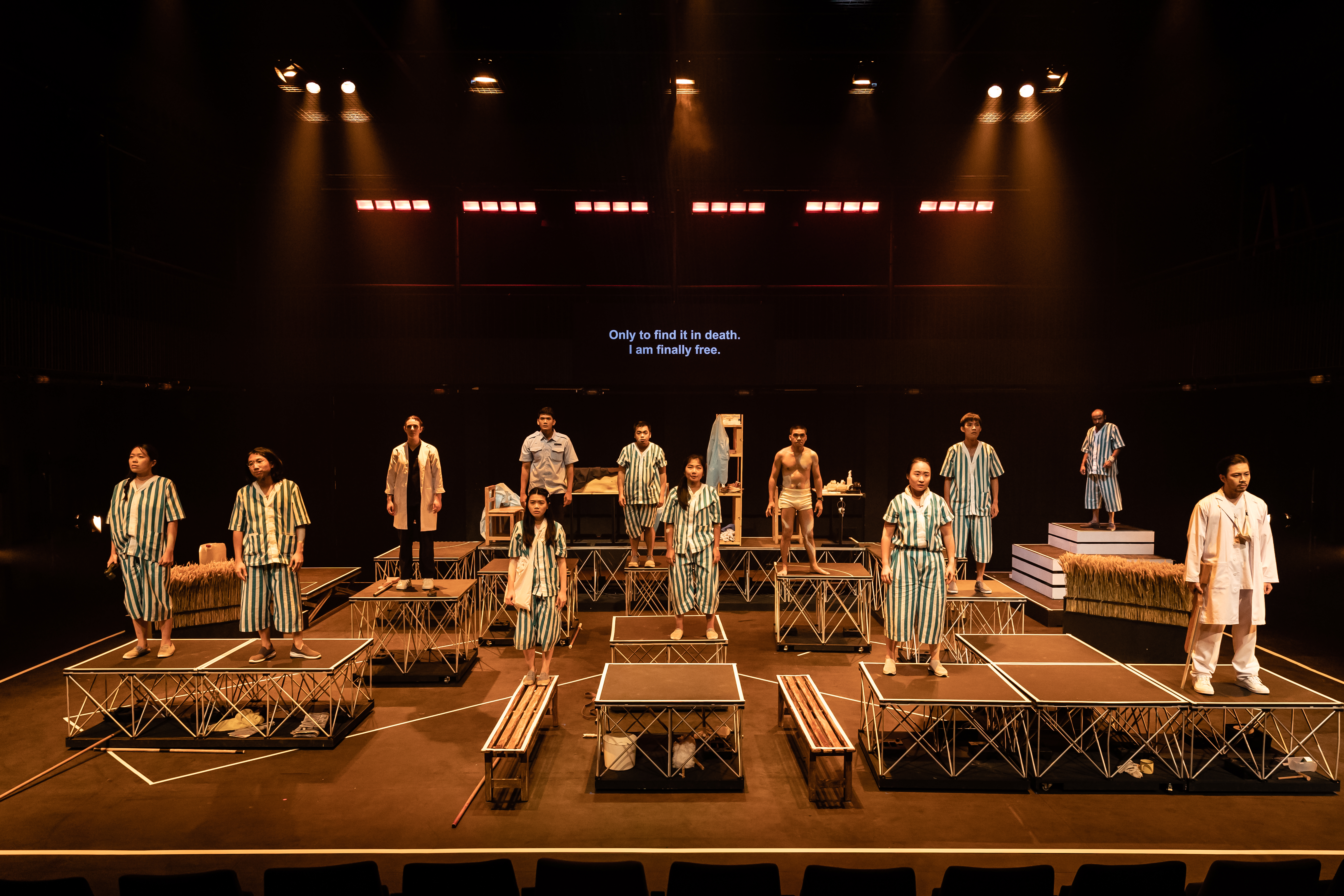
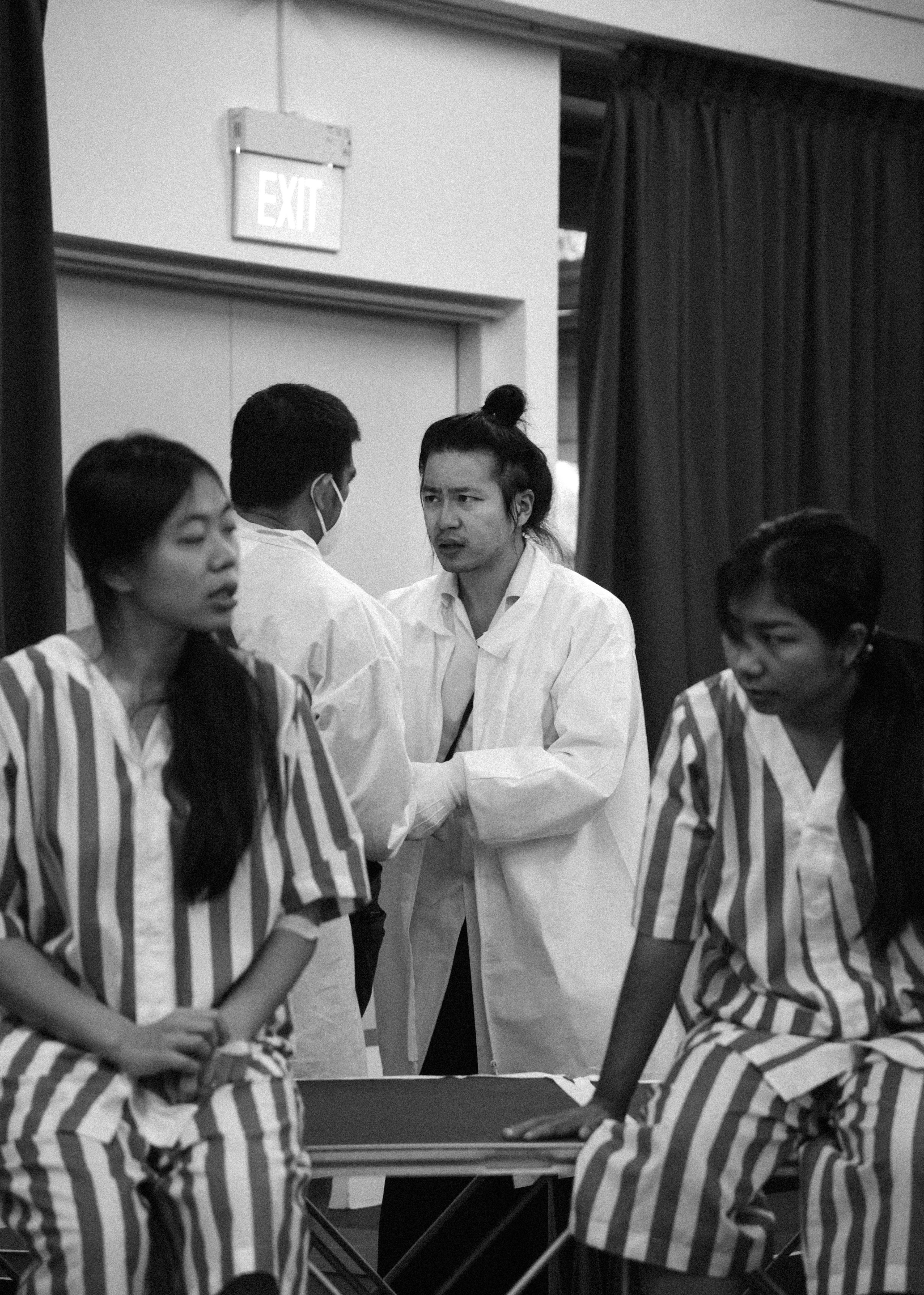
The Asylum is established with actors taping everything to demarcate the lines and boundaries of the set.
Those who are familiar with theatre will be familiar with the slight buzzing sound when the tape is pulled to mark the stage. However, with 12 rolls of tape going at the same time, the buzz grows and is reminiscent of a swarm of pests invading a space.
By all accounts, the opening sequence and its significations of the lines and boundaries that we draw for ourselves, or are imposed on us, are clear-cut and simple. But the visceral impact such a simple device has is a testament to the wondrous alchemy that is Jean Tay’s script with Oliver Chong’s direction.
From there, one witnesses the unravelling of an asylum as a fictional infectious disease rages on in a colonial settlement, and rumours of a tiger roaming the boundaries increases the tensions within the asylum.
The graduating cohort of the Intercultural Theatre Institute (ITI) plays 12 different characters: four female patients (Daisy Zhao Xiaoqing, Ng Yuan Ci, Ruthi Lalrinawmi, Wong Jin Yi), four male patients (Kaleem Zafar, Karlwinn, Peh Jun Kai, Will Wong Keng Ip), two nurses (Ismael Gallaza Pantao, Oliver S.K. Wu), a doctor (Jemima Dunn), and a security guard (Wan Ahmad).
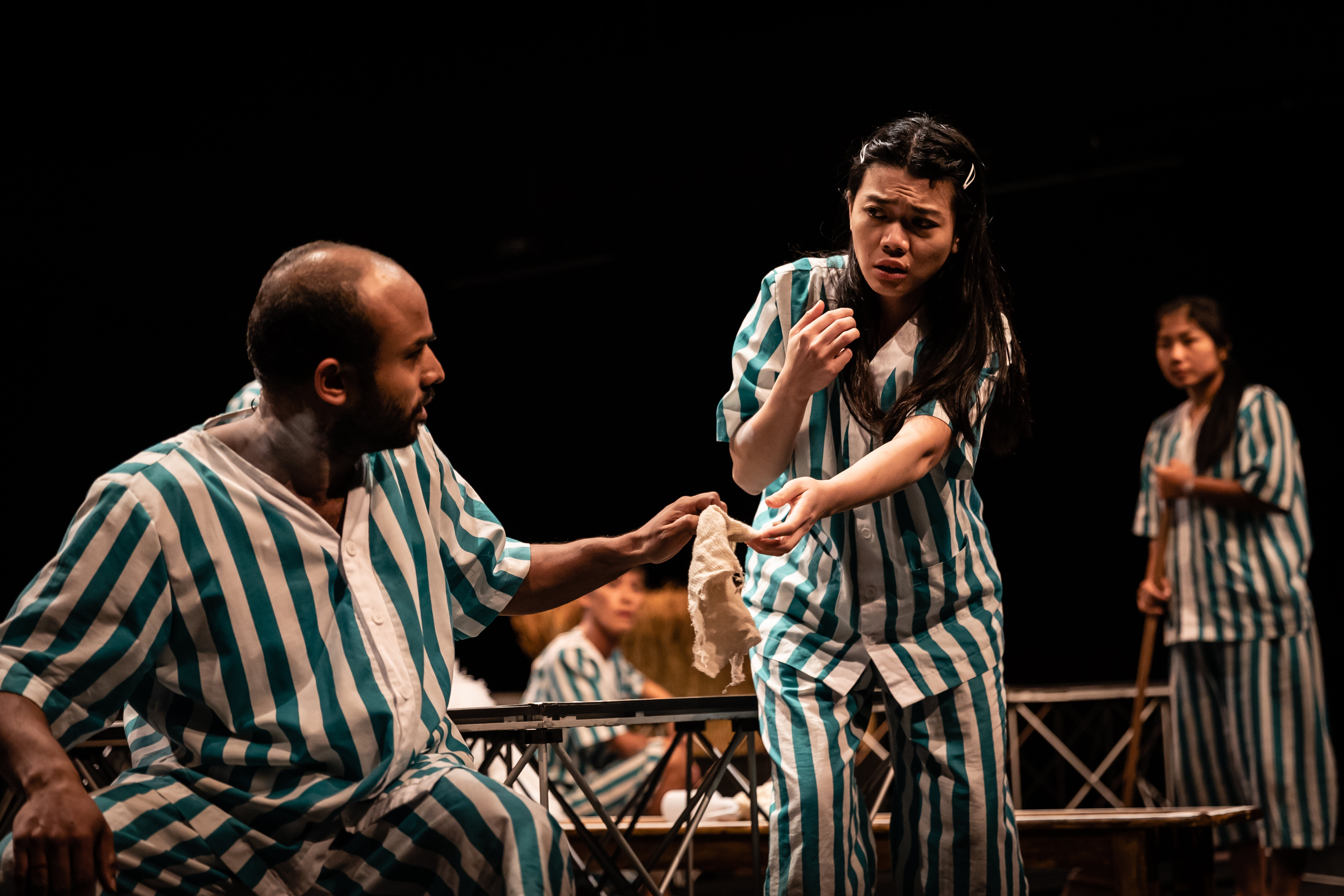
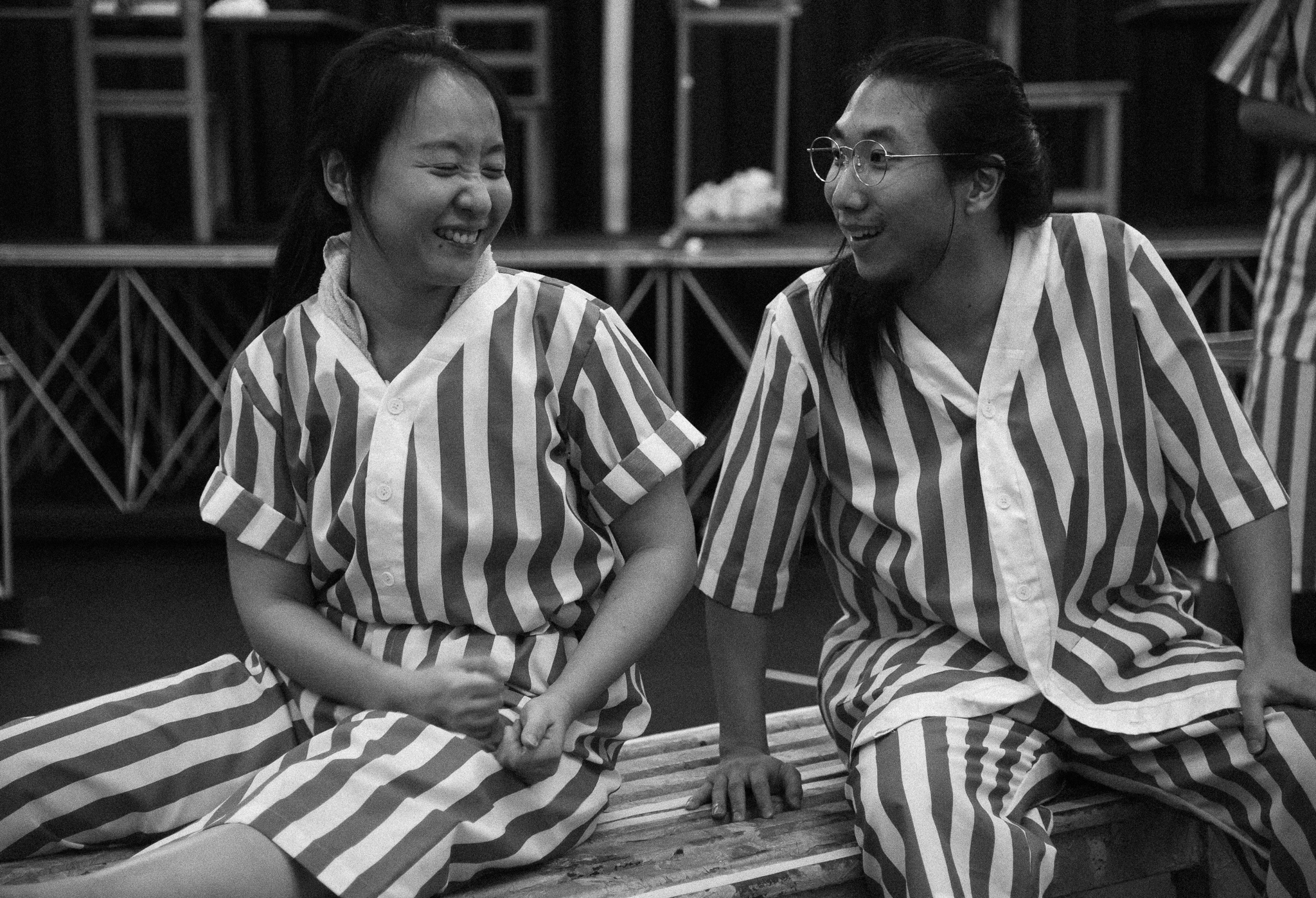
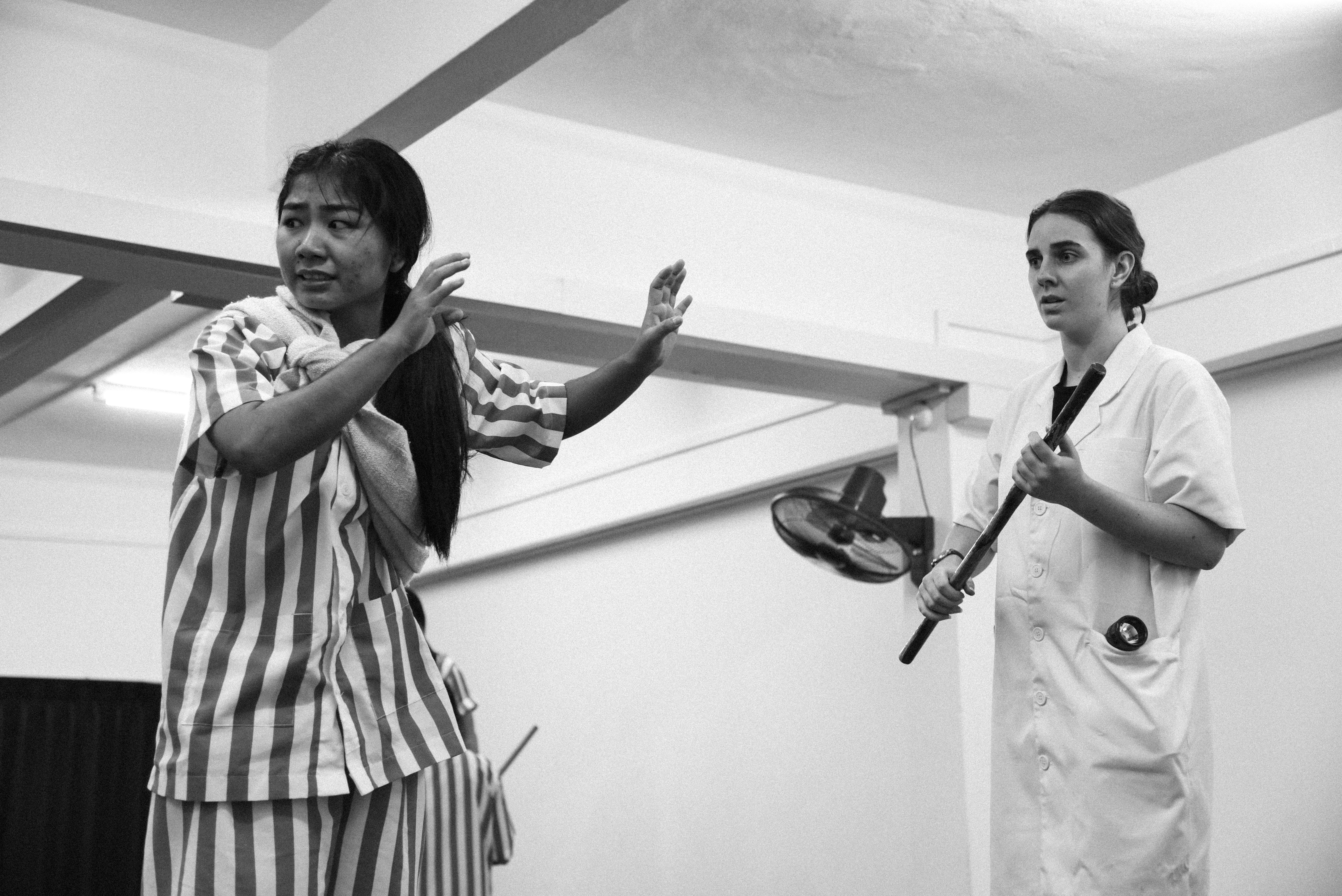
The patients are treated more like inmates, as they are constantly observed by the asylum staff, led by the doctor who carries a big stick. They also fall along a spectrum of coming to terms with the fact that their family and society have abandoned them—from naïveté to being downright jaded.
In this highly charged atmosphere, it is inevitable that the characters would clash with each other due to their conflicting desires. The collisions happen on different levels, and fueled by fear and rumours, result in an implosion. Several patients attempt to escape as the staff tries to hold the fort while looking out for the tiger.
A moment of care between patients / Photo: Bernie Ng
A way to get a grip on the conflict would be to see it as a conflict between safety and humanity. Intuitively, it might seem easy to understand both concepts at first, but one soon realises that it is difficult to articulate precisely what constitutes both.
Separating patients with infectious disease from the community for the sake of safety makes sense on some level. But how far does this entail policing the movements and lives of the patients?
Wanting to live one’s life with a freedom to choose is understandable, but how much freedom should one have without harming the well-being of the wider community?
Jean Tay’s decision to abstract her script away from the peculiarities of old quarantine sites in Singapore not only allows the deeply resonant debate of safety and humanity to come to the fore, it also allows her to touch on the inner fears and hysteria of the unknown, which serves as a foil to the supposed tiger outside the walls of the asylum.
Tay’s ambitions are matched by the deft direction of Oliver Chong. With all the characters being on stage throughout the show, it is tempting to par down the interactions such as letting the characters sleep in their cell when the focus is not on them. However, Chong decides against it, and this results in all sorts of unspoken interactions that entices one to rewatch the show several times.
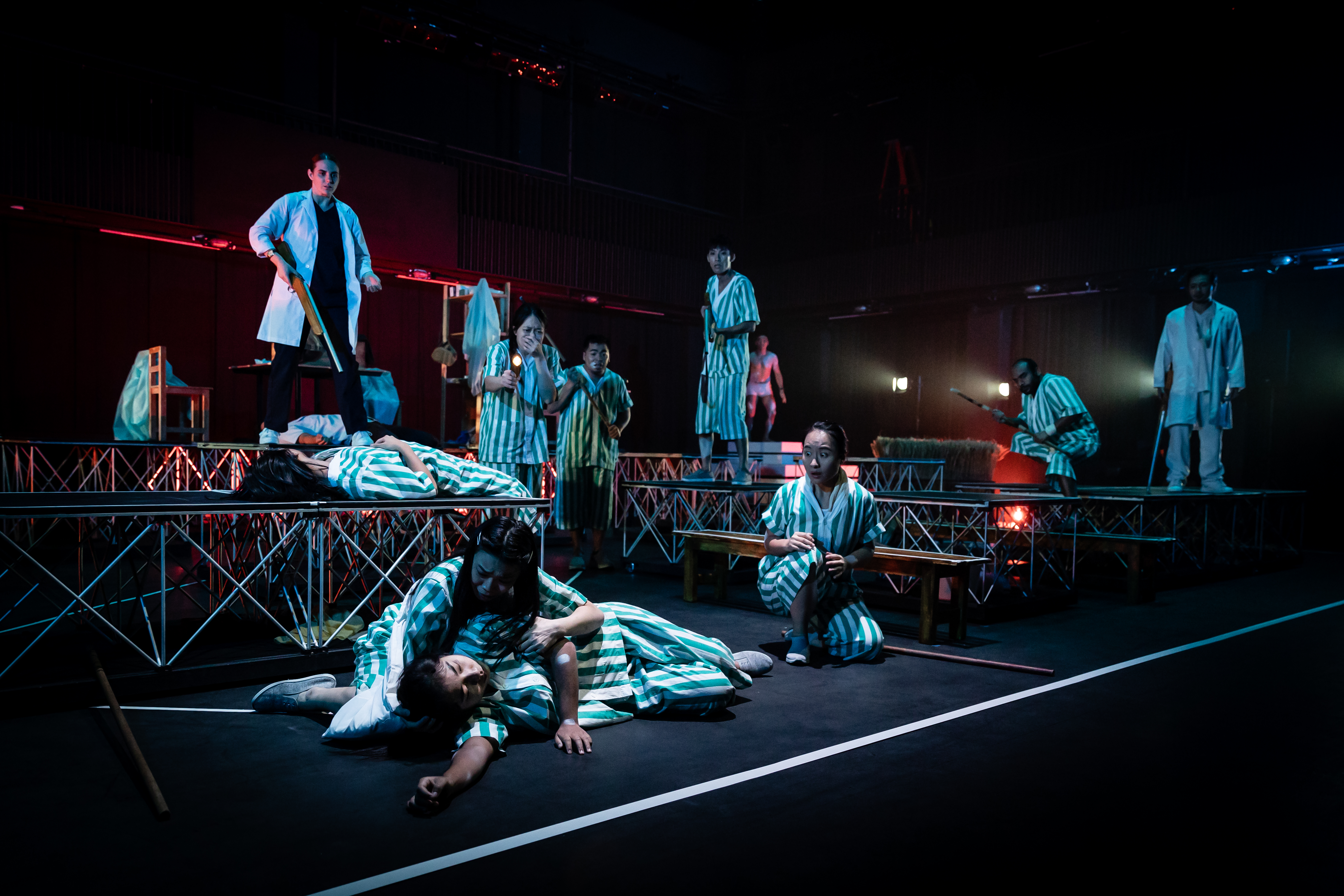
The rigorous training of the actors in various traditional art forms have certainly paid off in terms of their presence and synergy. This is evident during the climatic scene in which the patients stage their getaway. The movement around the set and the stillness when tragedy strikes, creating some beautiful stage pictures.
Tragedy strikes / Photo: Bernie Ng
While there are some mis-timed line deliveries and the buildup was not intense enough to warrant the climax on the opening night, it is a beast of a show. This critic cheers the actors on and hopes the beast is tamed by the third show.
There may be no armed guards or barbed wires, and the act of quarantine during the COVID-19 pandemic in Singapore is seen as a social responsibility, but scratch the surface and we realise that we are still being tracked, traced, categorised, and imposed upon.
Where we draw the line between safety and humanity will forever be contentious, making Asylum a play worth restaging from time to time.
Following the interview with director Oliver Chong and playwright Jean Tay on the process of creating Asylum, I asked the graduating cohort of the Intercultural Theatre Institute to reflect on the process as well as their perspectives on the current COVID-19 pandemic.
What were some of the difficulties in devising this piece?
Daisy Zhao Xiaoqing: The play unfolds slowly to me as we continue rehearsing every day. Every new finding is challenging for me. Whatever the other characters are experiencing, or have experienced, I find part of my character in that. While watching others, I am moved inside, allowing myself to be affected and connected to them. Another difficulty is being onstage for the entire show and having to design every single detail of the simple actions and reactions that come from the character’s core.
Oliver S. K. Wu: All of us are always onstage at the same time, so stage business has to be sustained. Being aware of everything that’s happening onstage and to my character concurrently has been a stimulating challenge.
Peh Jun Kai: Coming together as one piece took awhile because there are 12 different voices, so the giving and taking of space required some trial and error along with patience. Each week is about digging deeper to find the authenticity, energy changes and nuances of the character while being brave and generous in the face of the work.
Wan Ahmad: Crafting the character was simple, but crafting the character’s depth and logical pathway as well as pushing their stakes and vulnerability was tricky and arduous. Every line, every monologue, every moment had to have intention, and trying to achieve the specificity Oliver Chong envisioned in all of us was challenging but fun. I explored many paths for my character’s actions and journey.
Synopsis of Asylum A tiger lurks outside the building, a doctor attempts treatment using unorthodox methods … and within the high walls of the neglected facility, a patient hatches an escape plan.
Were there any interesting discoveries in the rehearsal process?
Ismael Gallaza Pantao: The progress of all of us in this piece. It is amazing to see my peers using what they have learnt from their training in contemporary and traditional theatre over the past two years. The togetherness as an ensemble is also another interesting discovery — how we have come together to elevate each other and our individual crafts.
Karlwinn: The rehearsal process fleshed out the core significance of my character in the play. As an actor, every rehearsal is the opportunity to assess how my character evolves. This includes the character’s personality and behaviour, their relationship with other characters, and the goal of my character by the end of the story. Because of this, the most interesting discovery I found is that as an actor, I am no longer the only one who decides the who, what, where, when, and how, but the character himself can decide that too. When my actor self and character become one.
Ng Yuan Ci: As the rehearsals progressed, I felt everyone starting to immerse themselves into their roles and it slowly felt like we were living in an actual asylum. The immersion helped our creativity in the space and the connections we made with each other come naturally to us. The challenge of ensuring our actions have meaning started to come easy for all of us as well.
Peh Jun Kai: The characters in our play are stuck in a physical place. It is like being in a prison. And likewise, during the pandemic, many of us experienced that feeling of being trapped, physically unable to go out or go overseas to places we want to. There is a sense of collective loss.
And I think what is interesting are the lessons that can be learnt from how these characters try to cope or find solutions in this physical and psychological prison.
Will Wong Keng Ip: We are all onstage at the same time, and I’ve discovered how important it is to support and depend on each other — even when it’s dimmed or dark, or we’re not the focus of that scene. We have come together as an ensemble, to the point where we are not able to work smoothly if someone gets sick or is unable to attend rehearsals. And to me, it is that act of working together as a unit that is an important message in the show as well.
Wong Jin Yi: The importance of creating a full backstory behind each character, and how each character’s backstory grew organically, such as when crafting stakes moment to moment, or giving justification to certain choices the character makes.
Courtesy of Intercultural Theatre Institute
Has the COVID-19 pandemic made you rethink the way you want to practise your craft?
[The pandemic strengthened my faith in theatre, in art. In the magical world, we exist in the same time and space, we breathe together, we stay close to each other, we become a mirror to others, and we become home. I feel more grounded, have more hope, and I become bigger than myself because I know we are more connected than ever. Art is not high in the clouds; art is in the soil. Every individual’s story reflects the collective’s needs and wishes.]
Jemima Dunn: It has definitely made me appreciate the liberties of interacting with performers in the space. Despite the challenges of social distancing and the wearing of masks, it has been a valuable experience learning how to connect with other actors in more subtle forms.
Kaleem Zafar: The COVID-19 pandemic has been a lesson for all of us. Theatre has become such a volatile field, so as an artist, it has become important to have a backup plan. On the bright side, the pandemic has given us the opportunity to work on the self and rethink individual habits.
Peh Jun Kai: I think the changes experienced during the pandemic have made me realise what are some of the non-negotiables in the practice of my craft. This has given me more clarity when I am planning my practice. The personal and professional disruptions caused by the pandemic have made the work harder, and have led me to be more intentional in taking care of myself and the people that I am working for and with. It is important to recognise for myself that the creativity, imagination, and deepening of the character and work happen faster and better when safety and care are present for the actor.
Ruthi Lalrinawmi: I am still looking forward to creating my own works as well as learning and sharing together with like-minded people about theatre. To perform live onstage in front of a large audience. However, the pandemic has also taught me how to survive in this field, and to ponder deeply about my life choices.
Wan Ahmad: In many ways it has. It has pushed me to pick up new skills, such as video editing, music production and graphic design. I had to change the perspective of how audiences could view my work. Especially during the early period of the pandemic, when works were being digitalised and the viewers’ focus points evolved. I began experimenting with images and audibility in my works.
Wong Jin Yi: Definitely. It has thrown into relief how important and essential live performances are. But the pandemic has given birth to certain pieces that really try to make use of technology to augment and improve the audience experience, and there are definitely some exciting developments growing on that end. I have started paying more attention to how digital artists interact with perception with an eye on how I might incorporate such things in my work in future.
Courtesy of Intercultural Theatre Institute
How has working on the piece affected your view on the current COVID-19 pandemic, especially in terms of how your home country is dealing with it?
Ismael Gallaza Pantao: I can relate the different stories of suffering and struggle in our pandemic to this piece. It has taught me that we need to remind ourselves to always be strong, have the courage to fight and have faith.
Jemima Dunn: Working on this piece has given me gratitude to both Singapore and Australia for the methods they have put in place to protect their citizens against this virus. On the other hand, it has shed light on how isolating the past few years have been for so many of us, and how it has challenged our humanity in more ways than one.
Kaleem Zafar: Any kind of pandemic is a kind of suffocation for humanity. It has also caused a lot of anger against the system, that is doing their best to pull humanity out of this situation. In actuality, we are all responsible for how we react to this pandemic, so we should learn how to deal with it together.
Karlwinn: Theatre really is the mirror of life. To me, this piece is a minute representation of what is happening to my country in terms of health facilities, work ethics, and system of government towards pandemics. It’s a reminder that my country is not ready for the pandemic because issues such as the country’s infrastructure and tourism (both eco and cultural) are prioritised. A bill was proposed by a senator once on pandemic preparedness, but it was not prioritised and he passed on before the bill could become a law. Two years later, the pandemic hit the Philippines. It is very disappointing.
Oliver S. K. Wu: Working on this piece has made me understand how fragile humanity is. I have also become very homesick, missing Macau more and more each day.
Ng Yuan Ci: The pandemic has reshaped our personal relationships in drastic ways, connecting people in new ways despite the separation. The difference between our play and the real world is the ability to connect with the rest of the world online. It’s allowed for better communication, less worry and rallying help for the people in need. The pandemic has reminded us to not let fear get in the way of helping each other.
Ruthi Lalrinawmi: It just proves that disease does not discriminate, no matter your background or upbringing. The pandemic has also uncovered the world’s cracks and most importantly, the inequalities in social structures and underdeveloped countries. That the infected continue to be discriminated against or looked down on by their respective societies. We may have developed in most ways, but our hearts will always have that resistance.
Wong Jin Yi: It really drives home the persistent sense of isolation people must be feeling. To be locked away from their families for so long, as well as the sense of alienation of being constantly treated as a second-class citizen, which some migrants still are.
Will Wong Keng Ip: I am more patient and understanding toward others and differing perspectives. I also try to step back and reflect more.
Catch It!
Asylum runs from 26-28 May 2022 at SOTA Studio Theatre.
Asylum marks the first time the Intercultural Theatre Institute (ITI) presents a graduation show in a venue at full capacity in two years. Having come out of the other side of the COVID-19 pandemic, Asylum is inspired by the the long-forgotten histories of Singapore’s old quarantine sites.
To find out more about the show, I interviewed playwright Jean Tay and director Oliver Chong about the creative process and their thoughts about the COVID-19 pandemic.
What inspired you to look into the history of quarantine sites in Singapore?
Jean Tay: I have long been intrigued by old quarantine sites, like the one at St John’s Island. The idea of quarantine always seemed a somewhat distant one, popular in colonial times, but increasingly regarded as a blunt tool given the advances in medicine and technology over the years. As I started to explore further, as part of a research residency with the National Library Board, I came across some incredible hidden stories, from the old leper asylum, Trafalgar Home, in Yio Chu Kang. To me, it was fascinating (and heartbreaking) to see how people dealt with their fear of illness and each other, and how that ended up breaking up families and relationships, but also created new relationships amongst the inmates themselves.
What were some difficulties in creating this show?
Jean Tay: My challenge was having to create a piece that would feature 12 distinct and diverse characters. Fortunately, I was able to work with the final-year students closely to improvise individual characters, loosely based on some of the historical research and different characteristics… we must have come up with over 40 of them! And then from there, I narrowed in on the most compelling characters with the greatest potential and used that as a basis to develop the narrative to see what would happen to these characters when put under pressure. As I did so, the script also moved into a more creative realm, so that it’s not leprosy we’re talking about anymore, but a fictional illness, set in a fictional asylum, in a fictional country.
Oliver Chong: The self-imposed agenda is to give a fair share amount of space to showcase all of the 12 students. This is a challenge I often face when creating graduation shows with a large group of students. There is the pressure of being fair to everyone while knowing that it would be impossible to flesh out all characters, and hence be unfair to all.
As the actors are trained in a myriad of art forms across various cultures, are you tapping into their training to create this show? If so, how?
Oliver Chong: The aim is not about displaying the myriad of art forms that the actors are trained in. Rather, I believe it should be about distillation, that is discovering the core in the different art forms and fusing the training into a melting pot to find meaningful contemporary applications.
Courtesy of Intercultural Theatre Institute
Were there any interesting discoveries during the rehearsal process?
Jean Tay: It is easy to lose track of characters when one is working with such a large cast. Fortunately, my director, Oliver Chong, has come up with the brilliant concept of keeping all the cast onstage at all times, regardless of whether they are featured in the scene. So it means that we get to see what is happening with the other characters, even when they are not actively highlighted in one particular scene, and I love the little discoveries in seeing these “unwritten scenes” come to life, as the characters continue to live and breathe “off-stage”.
Oliver Chong: Not because of the rehearsal process per se but moving along with the development of the pandemic as we rehearse, we have observed that it is the impact of the disease on our livelihoods and ways of life. The disruptions, reaction, and the overreaction of society that is no less detrimental to the interests and mental health of most people. This is unequivocally no less frightening than contracting the disease itself.
How has the process of looking into old quarantine sites and the country’s attempt to deal with epidemics affect your view of the current COVID-19 pandemic?
Jean Tay: The ongoing COVID-19 pandemic has certainly brought quarantine back into the spotlight, and brought fresh resonance to this issue, especially seeing how people had to deal with the challenges brought on by an enforced quarantine. It’s a little sad to realise how, even after years of technological and medical advances, it is so easy to revert back to a very basic and primal fear of the unknown, and of each other, when confronted when an unknown disease once more. But even in the midst of that fear, it’s also eye-opening to see the moments of compassion and courage, when individuals reach out beyond themselves to extend a helping hand, even when it puts themselves at risk.
Oliver Chong: Cross-referencing leprosy and the Trafalgar Home with the pandemic and quarantine facilities now, the knee-jerk reaction of rounding up and ostracising the unknown and its carriers remains the same. It is a defence mechanism in the name of the greater good. The question remains as to whether we have done better in compassionate quarantine and isolation.
Catch It!
Asylum runs from 26-28 May 2022 at SOTA Studio Theatre.
L-R: Tobi (played by Aaron Kaiser Garcia) and Gaga (played by Kewal Kartik) / Photo: Bernie Ng
RevoLOOtion Intercultural Theatre Institute 29 April 2021 Goodman Arts Centre Black Box 29 April–1 May 2021
To most of us, we hardly give a second thought about lavatories because we expect them to be there. But the run on loo rolls in 2020 compels us to pause for thought.
Perhaps this makes the urban Singaporean audiences amenable to RevoLOOtion, a showcase by the graduating cohort of the Intercultural Theatre Institute (ITI).
Conceived as a performance and a workshop, the audience is split into three groups: public service officer, bulldozer, and villager. We then witness a story about a village whose sole lavatory is slated for demolition and the reactions of some villagers.
Baba (Marvin Acero Ablao), the village elder, is resigned to it. Gaga (Kewal Kartik), the orphan, wants a peaceful protest. Tobi (Aaron Kaiser Garcia), the general worker, wants to fight. Yaku (Sandeep Yadav), the carpenter, is worried about how this confrontation will affect his livelihood and family. Long (Lin Jiarui), the farmer, is worried about his mother. Lutin (Sonu Pilania), the shopkeeper, wants to negotiate.
The diversity and contradictory desires and plans of the characters result in a terrible outcome. The audience members, in their respective roles, are then asked to come up with an action plan to change the outcomes.
L-R: Lutin (played by Sonil Pilania) and Baba (played by Marvin Acero Ablao) / Photo: Bernie Ng
While the performance manages to elicit some sympathy for the villagers, it stops short of winning the audience over to their side. The motivations of the characters, both in the text and performance, are not fully fleshed out.
For example, it is not clear why Lutin gives up and lies to Yaku after being rebuffed by the public service officer in his attempt to negotiate over the phone. Why would he make things worse by lying, rather than saying he failed?
Perhaps the creative team decided on some restraint so that the audience does not assume too much or how the characters would react. This might limit the possibilities of how the audience decides to intervene later.
Even so, there must be a sense that the character truly believes that he has done all he can given the circumstances. However, this was not fully conveyed.
That said, the actors do possess a certain synergy and manage to build up the tension in each succeeding scene up to the final confrontation with the bulldozers.
Long (played by Lin Jiarui) / Photo: Bernie Ng
The workshop section was deftly facilitated by Li Xie (who also directed the show), Chng Xin Xuan, and Chng Yi Kai. We are shown possible intervention points and are required to come up with an action plan to hopefully create a better outcome.
As the scenario plays out, there was an emphasis on taking it step-by-step rather than pushing for an ultimate conclusion. Li Xie reminded us that we were not there to change the world; a small change is still a change.
While most workshops of this nature focus on empowering the audience to have their voices heard and make a change, a refreshing element is the facilitators asking the characters how they feel about the alternative scenario. They then express that feeling through a shape or gesture.
This provides an alternative view of the impact the audience’s plan has on others, and a start to more conversations if we had more time.
The sceptical part of me thinks that the conditions presented were too ideal as everyone had goals in a similar direction. However, what left an impression was Li Xie encouraging the representative from the villagers group to think of more alternatives. After all, a change—however small—is better than the status quo.
The challenge is to scale this up and apply this to our public discourse.
When I first found out about the premise of RevoLOOtion, a production presented by the graduating cohort of the Intercultural Theatre Institute (ITI), I was most intrigued by there being a workshop element which will explicitly require audience participation.
With safe distancing measures still in place, the premise seems to be intentionally going against the current. Could there be a radical re-conception of what constitutes as audience participation?
There seems to be a toilet theme in the show. Could you give us more clues about what the show is about, and how does the theme relate to oppression?
The toilet can be seen as a basic right, it can also be symbolic.
When something that matters to you is taken away by force, what can we do as a community?
What inspired you to create this piece?
Sometimes it is clear where the external oppression lies, but it is important to understand what breaks us down internally as a community.
Only when that is achieved will social change be possible, and we can then gather as a community guided by unity, tolerance, and non-violence.
What are some of the challenges in creating a workshop element, which requires audience participation in the midst of the pandemic? Has this given you new perspectives on audience participation?
The audience is always participating, even when they are silently watching a performance. They participate in their own reflective and mysterious ways, even in silence.
In the workshop, we want to experiment with verbal, physical and communal participation. However, with the pandemic and social distancing, it’s both challenging and intriguing. They can’t leave their seats, mingle freely with other audience members, move and execute the actions they wish to do, or physically immerse themselves in the scenes with the characters.
But deep down, is there an urge to express and take action because you witnessed an injustice? That’s our challenge. How do we fulfil and externalise that urge to address it physically without moving? How do they break the silence and empower others too? How do they work as a community when their actions affect others?
There are many ways to be heard, to act, to impact, to change, to disobey, to negotiate, to suggest and to resolve, no matter how suppressed the circumstances are.
We must find a way out together, against the odds.
RevoLOOtion runs from 29 April to 1 May 2021 at Goodman Arts Centre Black Box.







 Isaac Tan