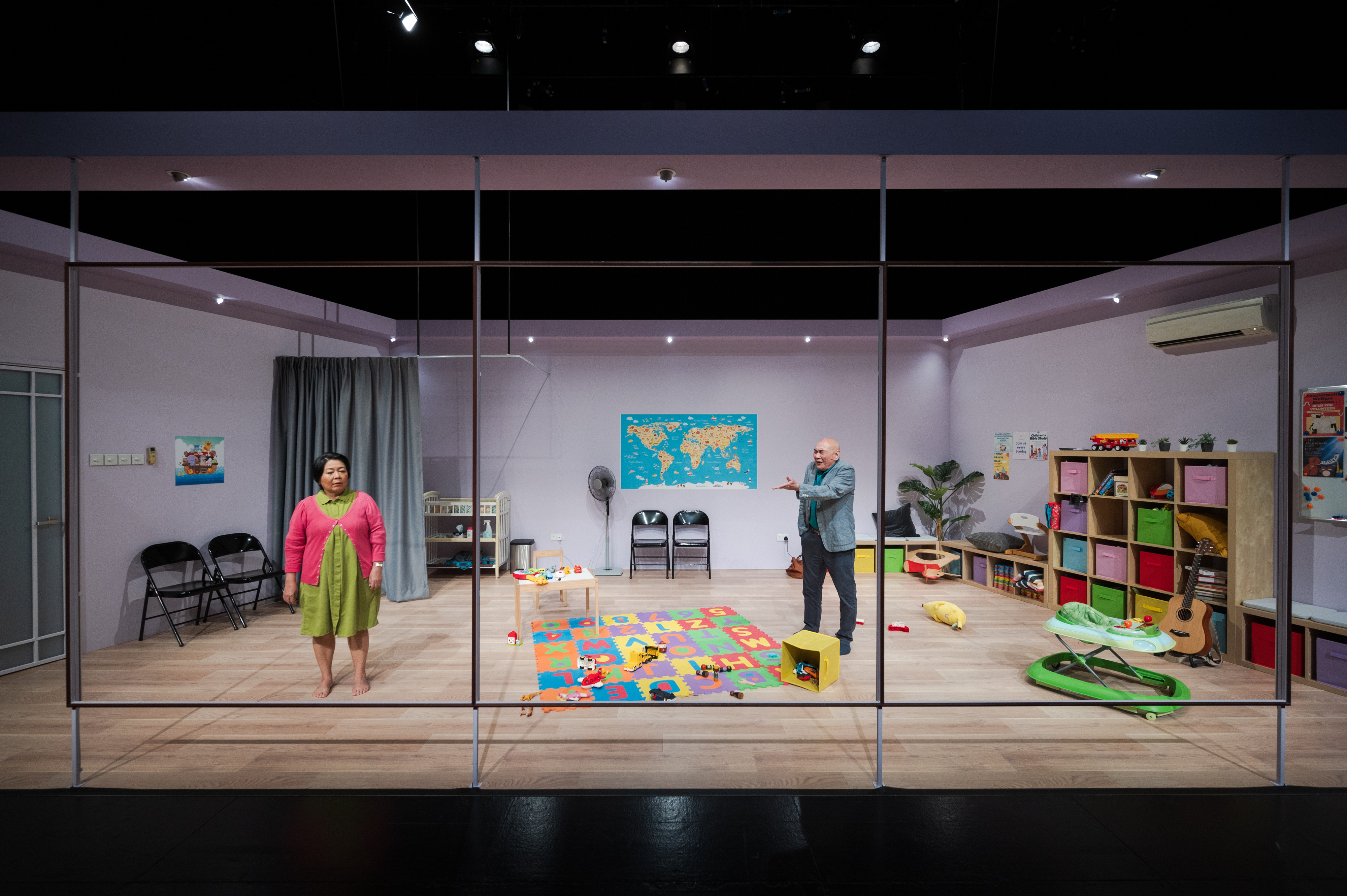
Photo: Joseph Nair / Courtesy of Checkpoint Theatre
Tender Submission
Checkpoint Theatre
20 August 2023
Drama Centre Black Box
17–27 August 2023
In the second production of Checkpoint Theatre’s 2023 season, we are invited, once again, to witness a drama unfolding in real time as the action takes place in one room without intermission.
Unlike Brown Boys Don’t Tell Jokes, which takes us on explosive highs and lows, Lucas Ho’s Tender Submission—as the title suggests—is dramatically meek. But the unearthing of human frailties and desires in the context of faith and marriage is no less affecting.
To escape the heat of the church’s annual general meeting, Catherine and David find themselves in the cry room, where parents can attend to their crying children without missing or disrupting the church service.
A key agenda of the meeting is a vote on whether the church should support a tender submission by Transformation Welfare Services, a community service group within the church in which Catherine (Neo Swee Lin) is actively involved.
She believes that building a community services centre would allow the church to care for the masses. Apart from seeing this as what a church should do, as opposed to the status quo; having a self-satisfied, well-heeled congregation. She also finds fulfilment as her involvement affords her a sense of agency—something she has lost in the midst of being a mother and a wife.

Failure to understand and articulate one’s needs / Photo: Joseph Nair / Courtesy of Checkpoint Theatre
David (Lim Kay Siu) fails to understand her underlying desire. He sees the tender submission as a rushed undertaking, and an inefficient measure of outreach, as it does not necessarily mean more conversions to the faith.
The failure to understand on David’s part, and that of articulating one’s needs on Catherine’s part, send the couple on a tail-spin as all the unresolved conflicts and unmet needs in their thirty-year marriage come to the fore.
Set against the matrices of church politics and differing interpretations of faith, every tug and tussle in the dynamics of a relationship can be seen.
Being married for almost as long as their characters, Neo Swee Lin and Lim Kay Siu bring out the nuance of every parley, push, and pull with much aplomb.
Lim’s David often sulks with folded hands or quickly dismisses his wife, but is stunned with his mouth agape when Catherine reveals the intensity of her hurt or frustration.
Neo’s Catherine tries to keep a lid on her internal frustration and couches her bids for connection in questions that annoy David. While she tries to maintain a calm exterior, she delivers the most brutal lines when the centre cannot hold.
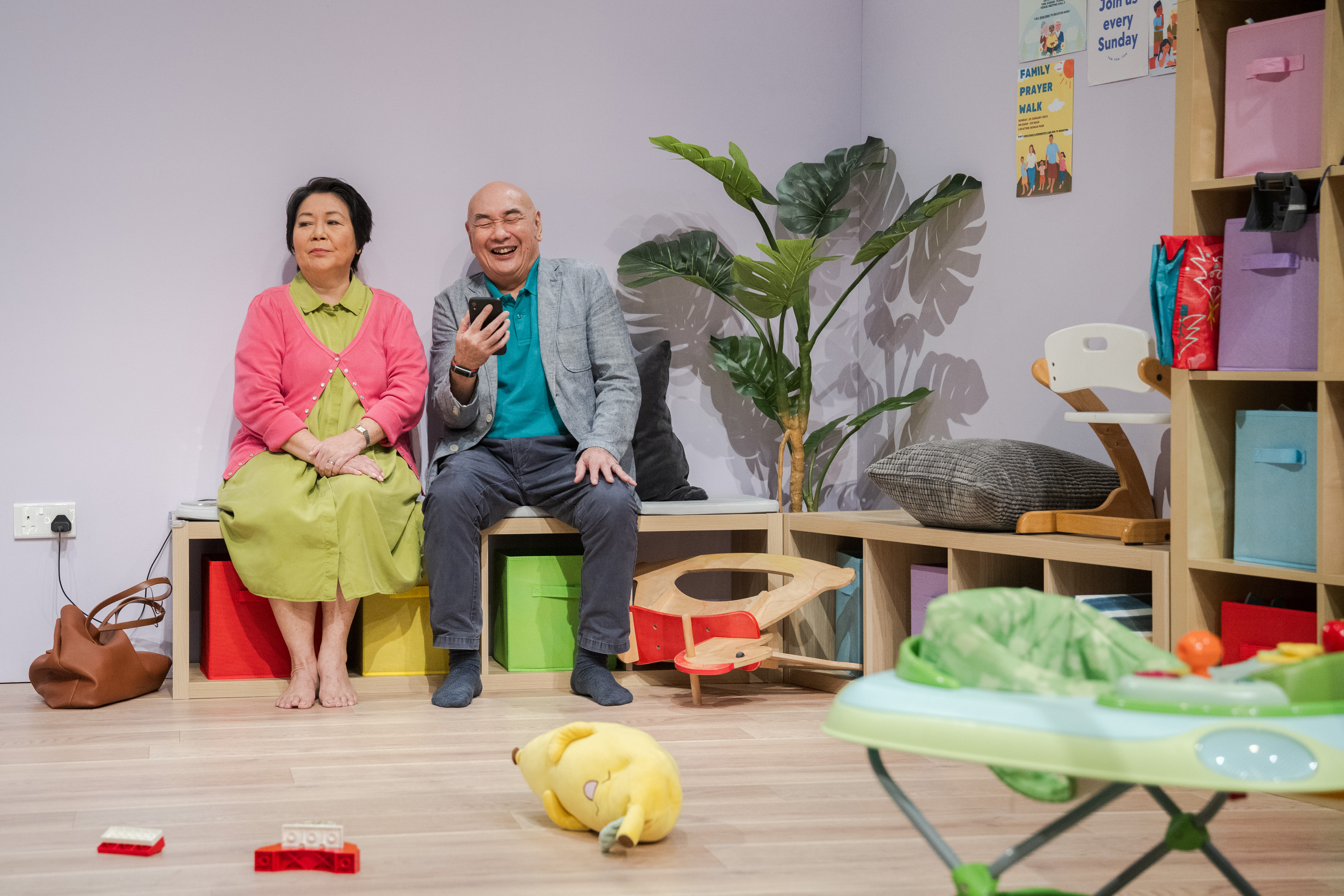
Neo Swee Lin and Lim Kay Siu play out every push and pull of a relationship / Photo: Joseph Nair
Directors Huzir Sulaiman and Chen Ying Xuan keep the ninety-minute text-heavy performance taut with tight pacing and ensuring the actors made full use of space. Additionally, the choice of when the characters clear up the toys or the mess in the room are inspired choices as it provides a symbolic weight to what is going on in the scene.
The highlight of Petrina Dawn Tan’s set is the three empty frames along the fourth wall, which suggest the big windows that those in the cry room could look out into the congregation during the service.
At first glance, it emphasises a goldfish bowl effect as it reminds us that we are looking into the scene, which is too on the nose. However, on further thought, it also affords some potential for blocking as characters could look out into the empty hall (often called sanctuary in Christian parlance), and face the audience head-on while being physically framed.
Moreover, the frames also designate the space where the audience is as the church congregation in the world of the play. But as the theatre audience, we are a kind of congregation as we bear witness to what is going on.
Towards the end of the play, Catherine and David try to find ways to tenderly submit to each other, but the messiness of relationships mean that their long-standing problems and insecurities will not go away.
Far from merely subjecting us to witness a couple’s quarrel, Tender Submission reminds us of our own frailties and foolishness in how we relate to people that we love.
Other Reviews
“Theatre review: Stellar acting in Tender Submission, but it preaches to the choir” by Shawn Hoo, The Straits Times Life
“Review: ‘Tender Submission’ delves deep into the heart of faith and marriage” by Yaiza Canopoli, SG Magazine
“Review: Azura Farid on Tender Submission by Lucas Ho (Checkpoint Theatre)” by Azura Farid, Critics Circle Blog
“‘Tender Submission’ by Checkpoint Theatre” by Corrie Tan, the intimate critic
“Tender Submission“ by Naeem Kapadia, CrystalWords
“Theatre Review: Tender Submission, An Original Singaporean Story That Probes Deeply Into Relationship And Religion” by Xushuang Chen, Weekender
“In Praise of Growing Through Checkpoint Theatre’s Tender Submission: A Review” by Charmaine Tan, Men’s Folio
“Review: Tender Submission by Checkpoint Theatre” by Bakchormeeboy
Further Reading
[Interview] Lucas Ho talks about his latest play, Tender Submission


 Isaac Tan