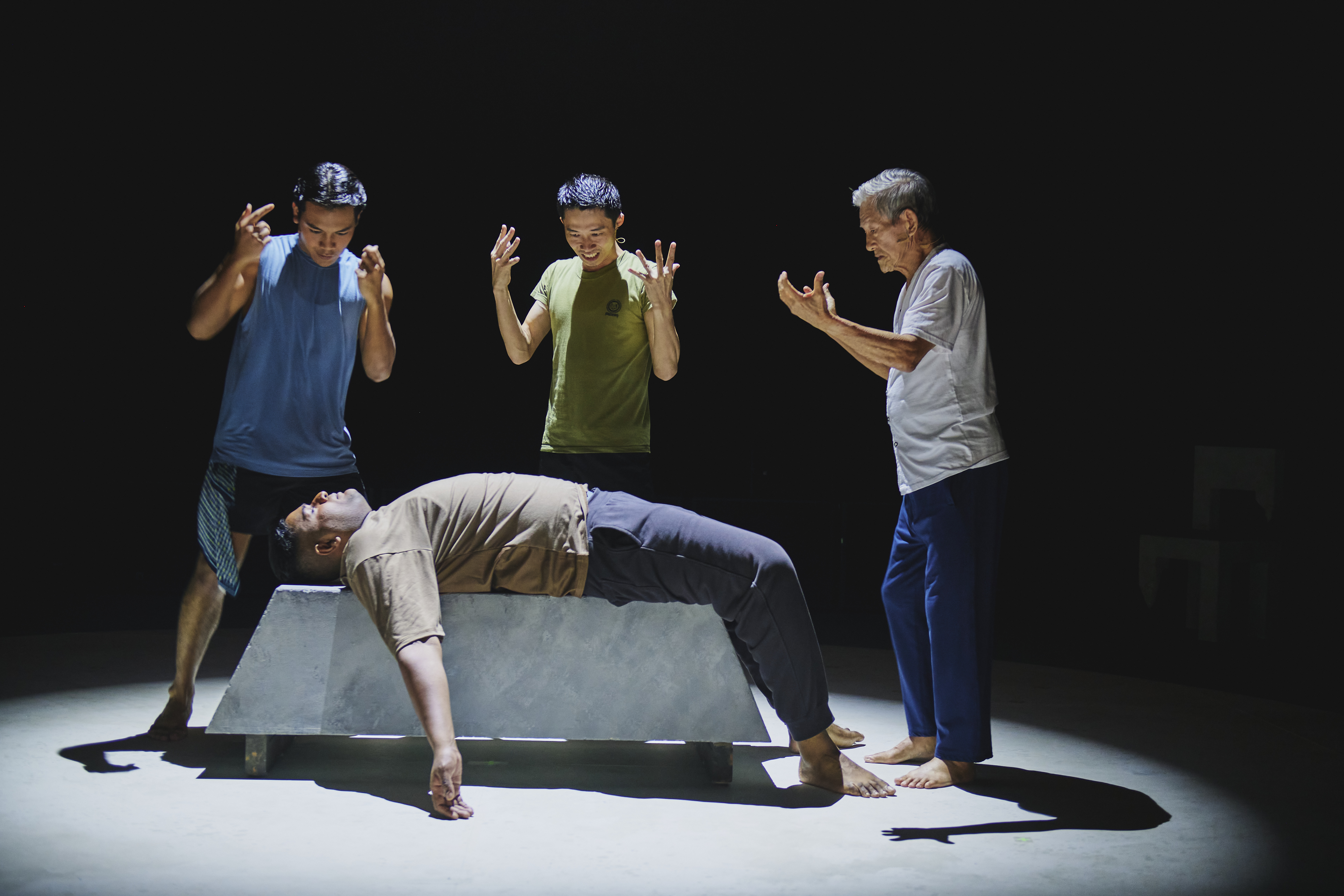
Dissecting masculinity / Photo: Tuckys Photography / Courtesy of The Necessary Stage
No Man’s Land
The Necessary Stage
12 June 2025
Esplanade Studio Theatre
12–15 June 2025
In the programme notes, playwright Danial Martin tells us that “No Man’s Land is not an answer; it is a confrontation” about different ideas about masculinity and how that plays out in society. This is wonderfully realised in the opening physical sequence where five performers enter a circle in grey singlets as they confront each other mano a mano to Ng Jing’s primal, guttural soundscape.
Unfortunately, unlike the flexed muscles and tensed sinews in the movement sequence, the dramaturgy and writing could have grappled with the complexities of masculinity a little more.
Co-directed by Sim Yan Ying and Alvin Tan, with Lim Shien Hein as dramaturg, this interdisciplinary devised piece has several vignettes peppered amidst the physical sequences.
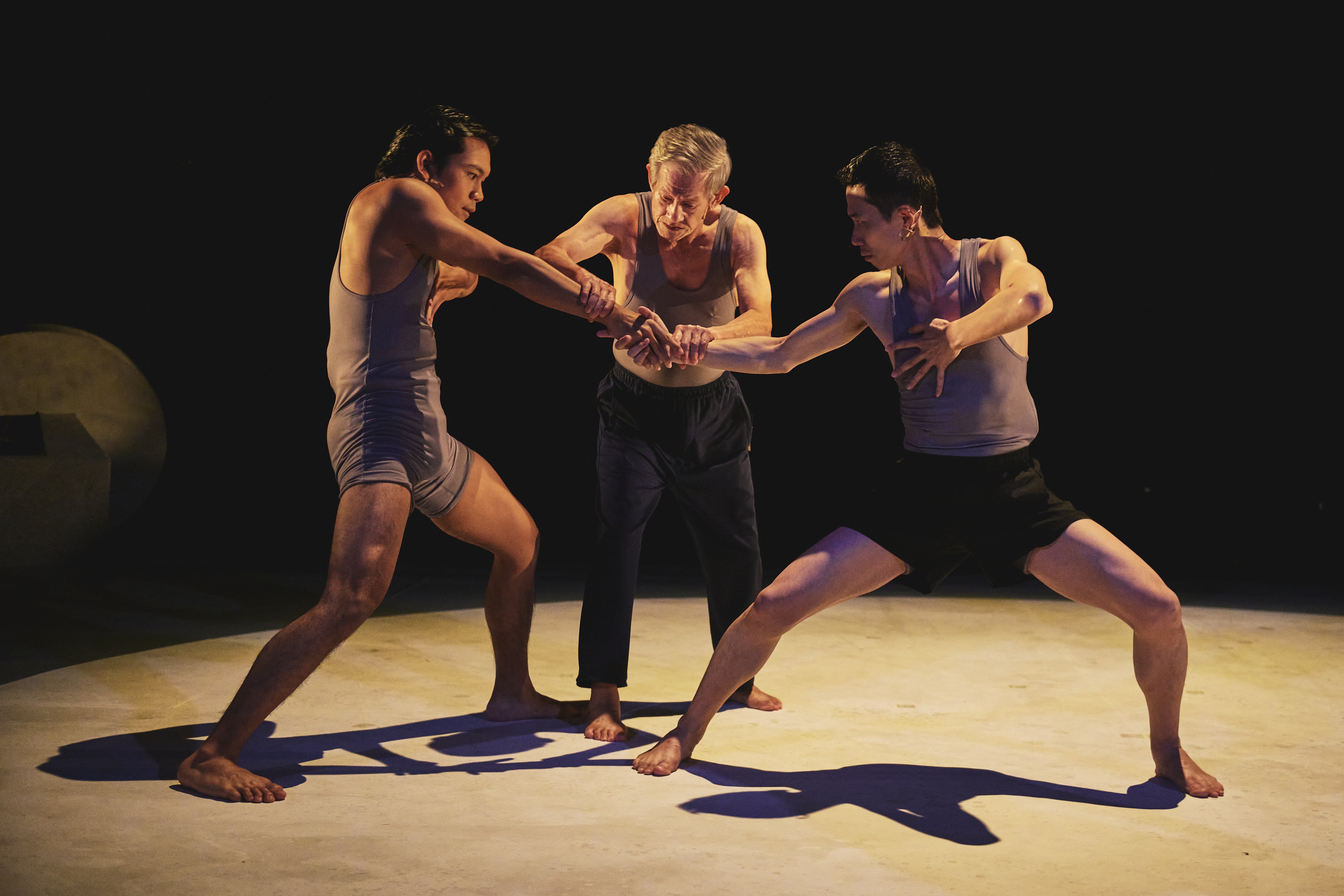
Flexed muscles and tensed sinews of Shahizman Sulaiman (left), Michael Tan (centre), and Neo Hai Bin (right) /
Photo: Tuckys Photography / Courtesy of The Necessary Stage
Initially, these vignettes seem to comprise actors playing stock characters, highlighting the broad issues of masculinity: body image, dealing with infidelity, parental expectations, responsibilities to a woman and child born out of wedlock, sharing intimate photos and videos of women without their consent, kinks, etc.
Imagine my surprise when it later becomes clear that the characters are not one-off, but are related to each other. We do not see them struggling with the implications of their circumstances as things seem to happen to them. Although the characters are not meant to have a naturalistic character arc, the lack of struggle then leaves us with merely examples of men behaving badly. This forgoes the opportunity to invite for us to understand what led them to behave this way.
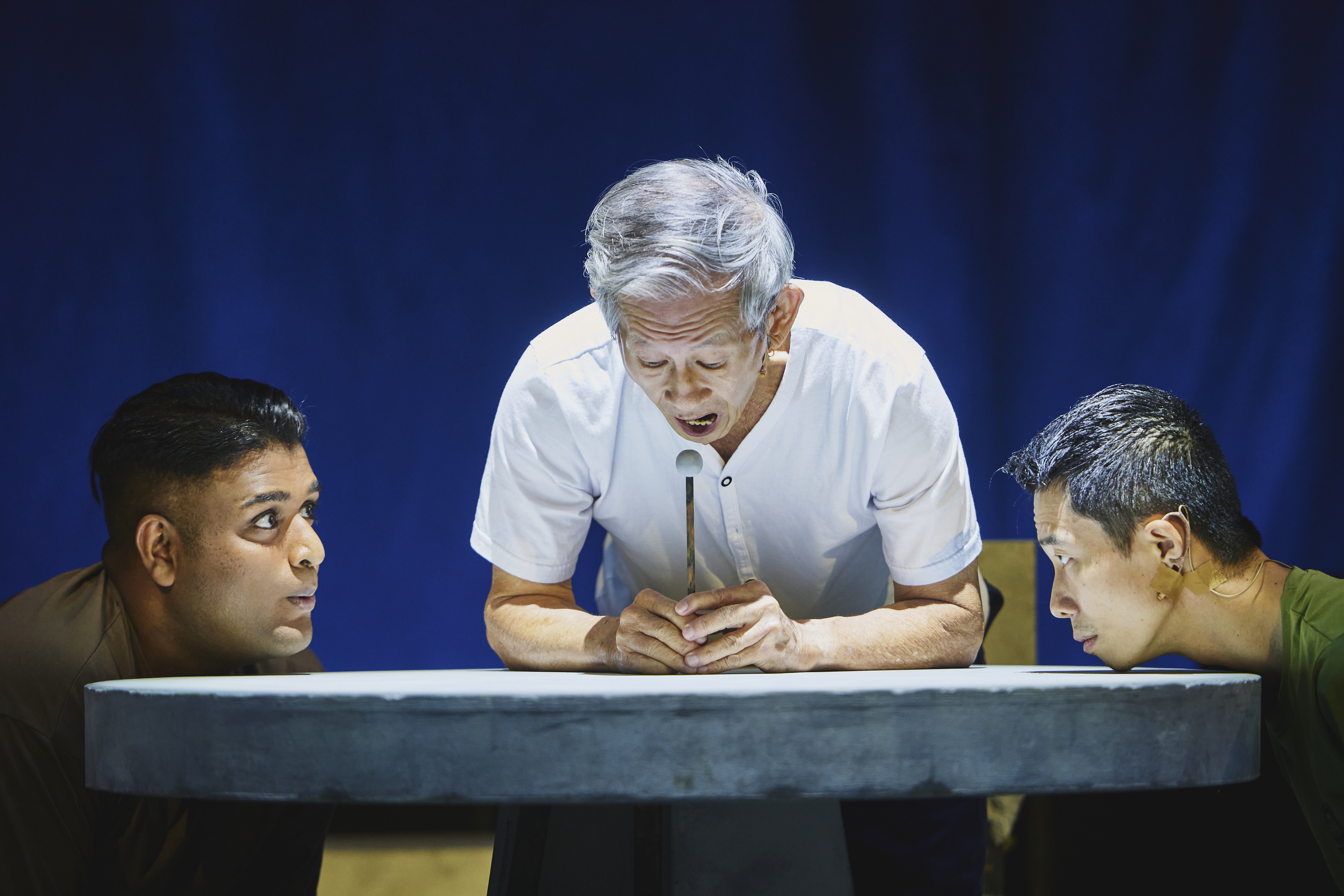
Men behaving badly / Photo: Tuckys Photography / Courtesy of The Necessary Stage
Another device meant to get the audience to confront ideas about masculinity is the metatheatrical moments when the actors comment on the play in two instances. In the “intermission”, which is specifically stated to be slightly over seven minutes, Shahizman Sulaiman explains—or, as the modern lingo would have it, mansplain—the first half of the show to “align” the audience with the artistic intention, thereby resisting alternative interpretations of the show. Some might feel that this parallels the patriarchal narratives of one’s lived experiences.
The other instance is when Suhaili Safari complains that she is the only woman in the cast who not only offers the token female perspective, but also takes on many roles in which she either does the physical or emotional labour in service to men. Neo Hai Bin then laments that he wishes that he lived in a society where this is not so. While it is undeniable that this parallels the experiences of women worldwide, it does not go beyond a complaint.
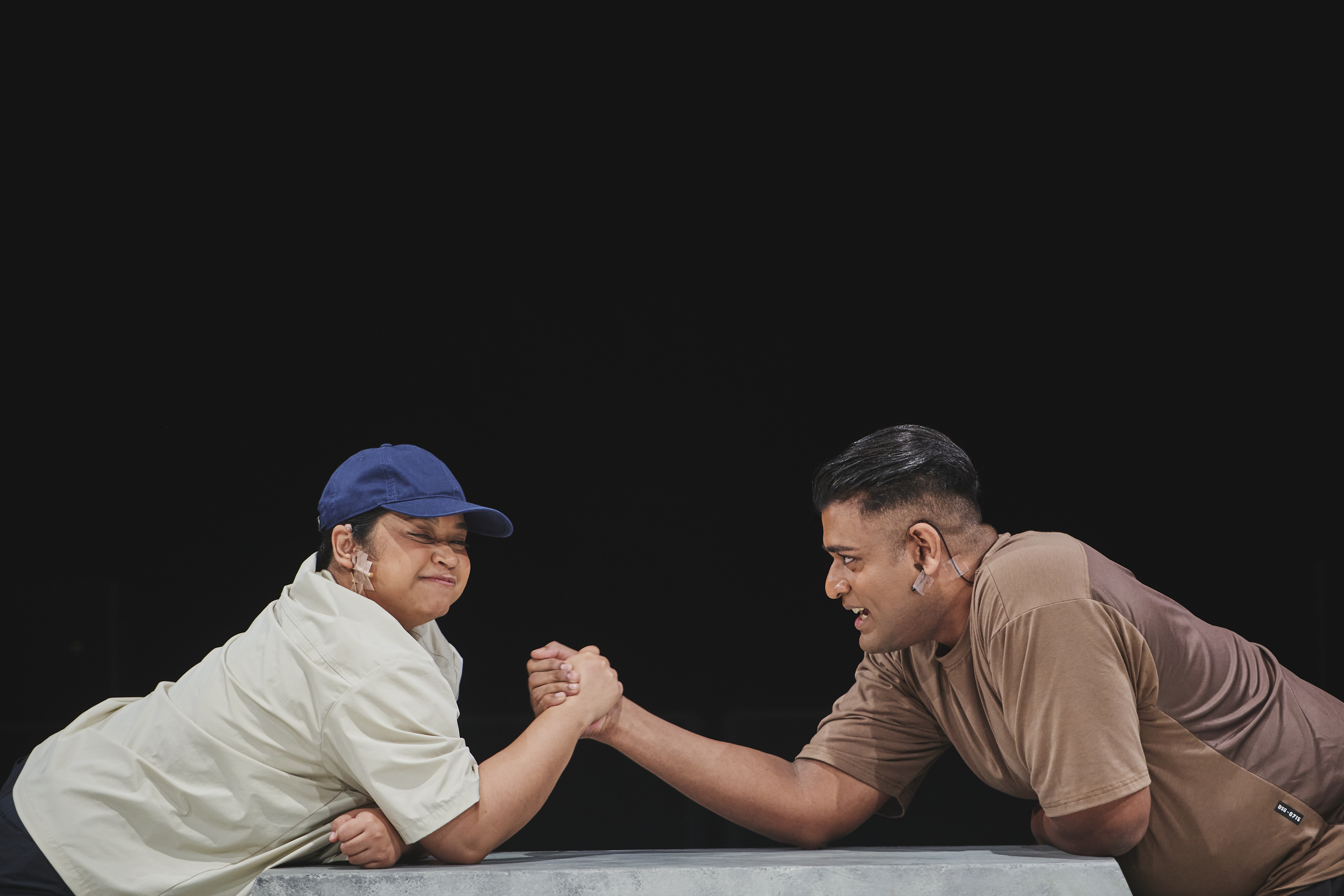
The lesbian sister (Suhali Safari) and her gay brother (Vishnucharan Naidu) deciding if she should return to Singapore /
Photo: Tuckys Photography / Courtesy of The Necessary Stage
In the same scene, Vishnucharan Naidu also apologises to Suhaili saying that his character (a gay man who plays the role of the dutiful son despite his mother not recognising his sexual orientation) has made used of her character (sister who is lesbian who left for Korea because she wants to live life on her own terms) to rediscover himself. This presumes that the self is formed and evolved on one’s own, almost in a vacuum, when we often discover parts of ourselves when encountering a particular situation or interacting with others.
Thus, there is a stronger sense of wondering aloud, rather than a clash of ideas, perspectives, and trade-offs in the show.
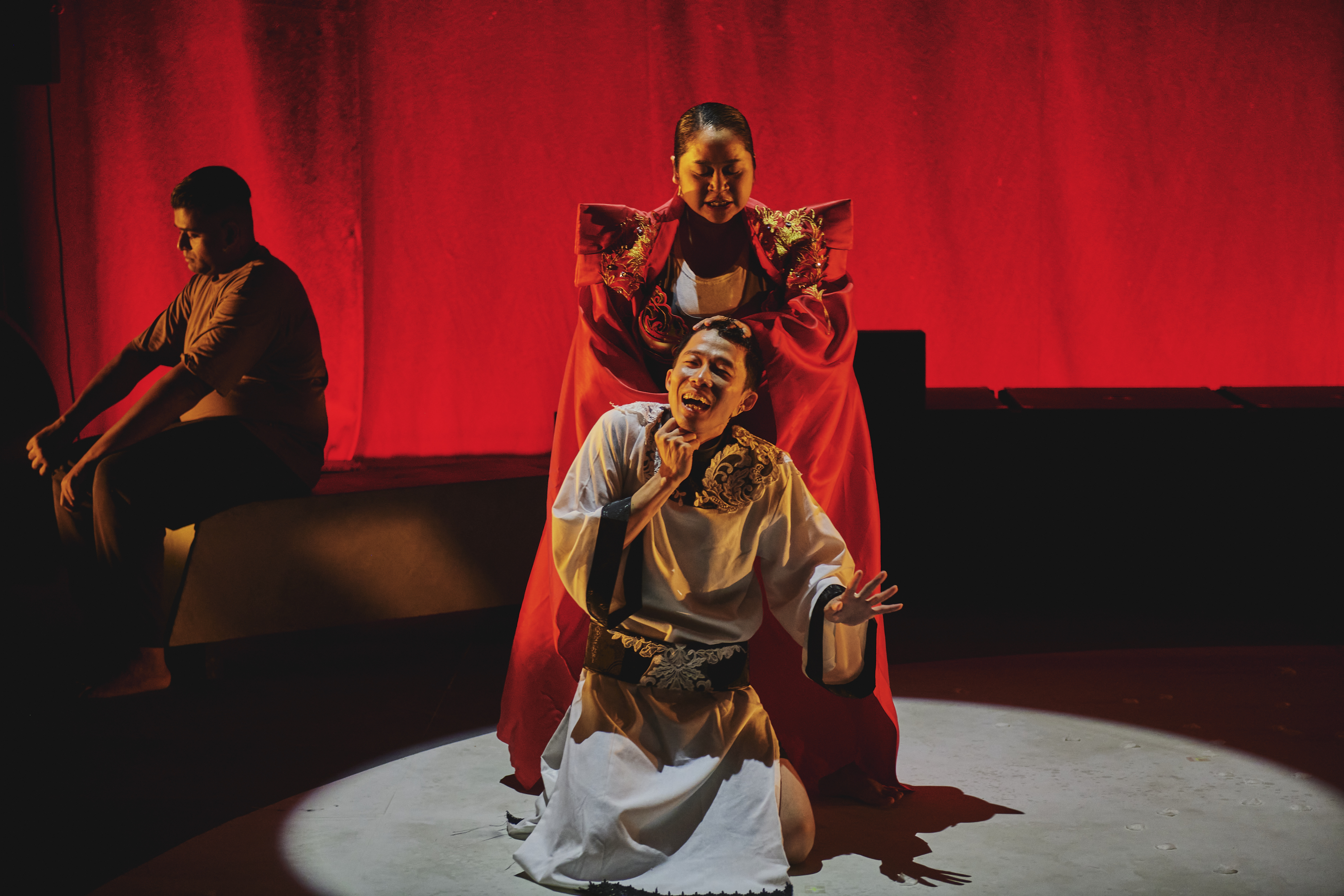
The Empress Dominatrix (Suhaili Safari) controls her Eunuch Client (Neo Hai Bin) /
Photo: Tuckys Photography / Courtesy of The Necessary Stage
That said, there is much to commend the show for.
In the movement sequences, Hafeez Hassan blends various traditions (bharatanatyam, martial arts, wrestling, hip hop, contemporary, etc.) to come up with a cohesive vocabulary for his choreography. Even though there are some performers who are not movement trained, they appear as a synergised ensemble and everyone actively participates in the movement sequences.
The text by Danial Martin may be simple, but there are occasions when it hits one right in the gut. In a scene where an unnamed victim of an explicit Telegram channel (Suhali Safari) delivers a monologue, she mentions that while not all men would indulge in something so sordid, but with 44,000 pairs of eyes on her, it feels like it could be so. In one line, Danial slices through the polarities, and elicits sympathy for the trauma that many girls have experienced.
The way creative captioner Su Paing Tun designs the text to pulse, fade, and appear with accompanying graphics is truly creative and an art on its own.
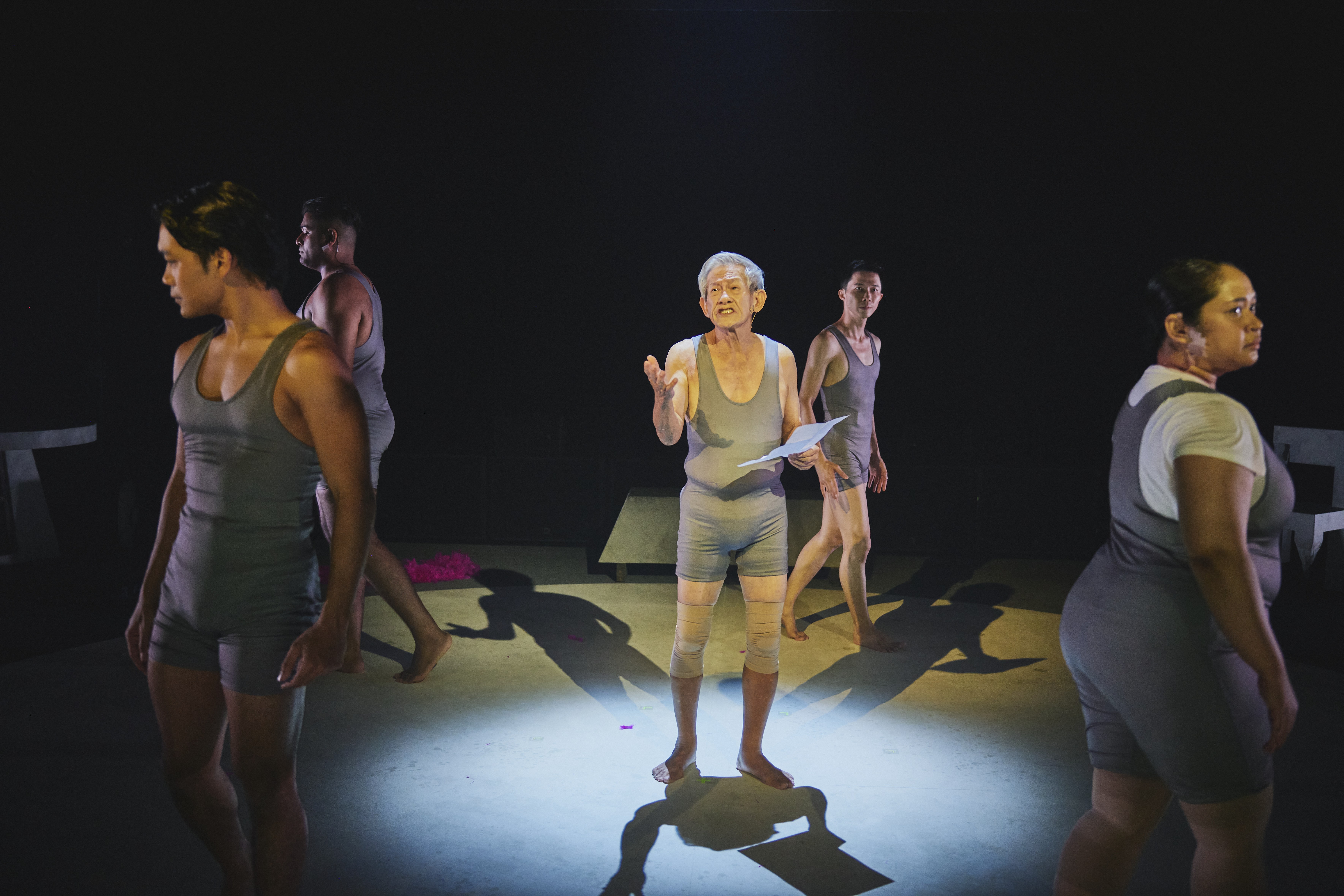
Michael Tan (centre) tenderly reflects on his journey as a man in a letter to his younger self /
Photo: Tuckys Photography / Courtesy of The Necessary Stage
Michael Tan has a certain tenderness in the delivery of two monologues about looking back at his life as a man and discovering self-pleasure at 15. He considers that to be quite young, even though the younger generation will consider it to be quite late; a missed opportunity to explore conceptions of masculinity according to different generations.
Suhaili Safari’s versatility is a treat to behold as she plays characters of varying ages, backgrounds, and a rousing number about men to the tune of “Diamonds are a Girl’s Best Friend”.
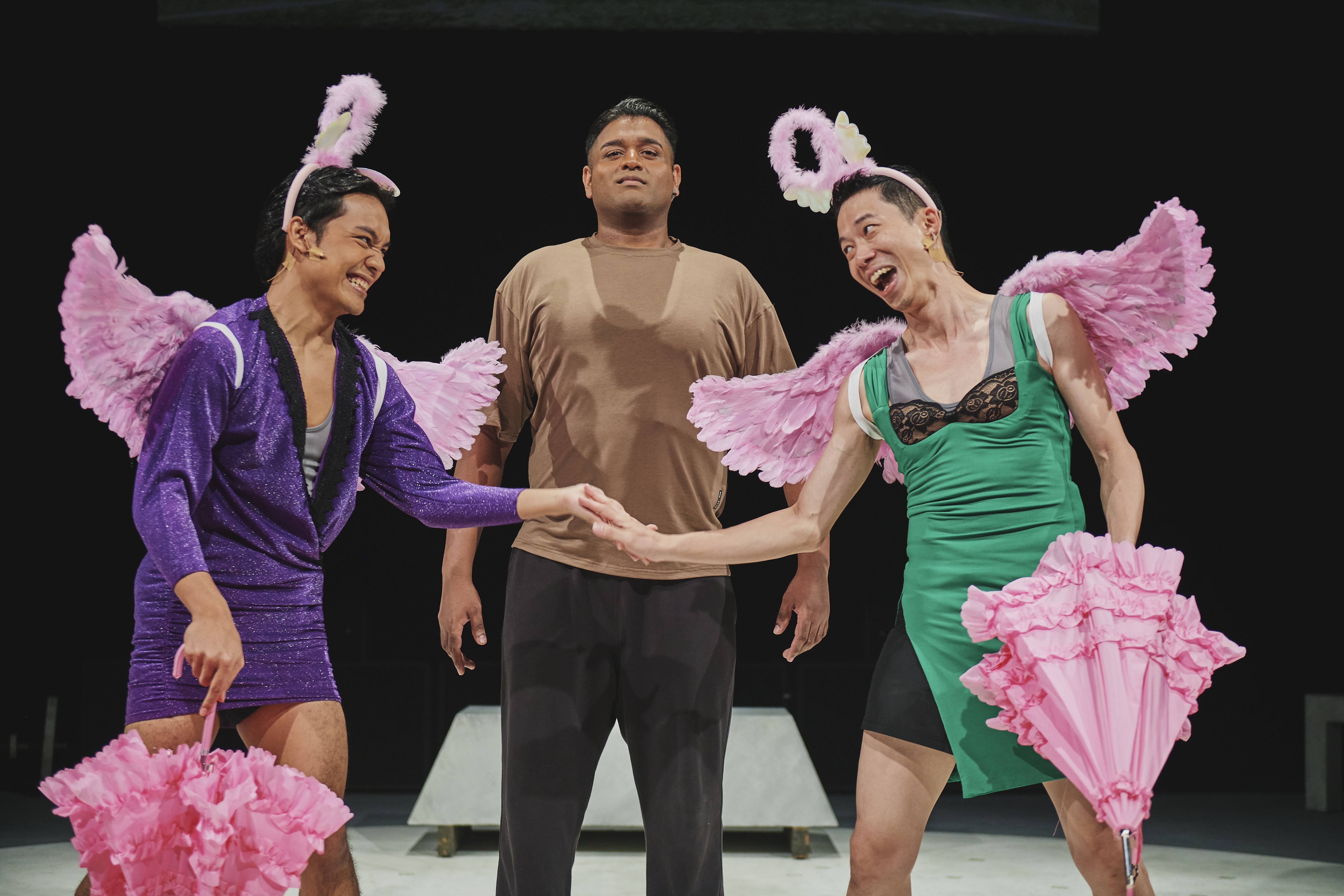
Shahizman Sulaiman (left) and Neo Hai Bin (right), teach Vishnucharan Naidu (middle) how to behave like a man /
Photo: Tuckys Photography / Courtesy of The Necessary Stage
Shahizman Sulaiman and Neo Hai Bin sparkle as fairies teaching Vishnucharan Naidu how to behave as a man. It is refreshing to see Neo in a camp role, but there is also depth to his performance in a silent scene with his father where he cycles the whole gamut of emotions before breaking down.
Shahizman also displays a wonderful physical deftness in the various physical sequences, while Vishnucharan has a subtlety that opens up to tenderness in the scene when he asks his sister to return to Singapore after their parents have died.
While the show could have prod us further to consider the complexities of masculinity, it still exposes us to the possibilities of interdisciplinary performance in examining important issues.
Further Reading
Programme booklet for No Man’s Land
Other Reviews
“Theatre review: Theatrical and funny, No Man’s Land questions ideas of manhood” by Clement Yong, The Straits Times Life! (Article is behind a paywall) | Transcript of review
“【艺评】《无人之境》的意义在第四堵墙裂缝之处” by 孙靖斐, Lianhe Zaobao
“Review: Suria on No Man’s Land by Sim Yan Ying “YY”, Alvin Tan & Danial Matin (The Necessary Stage)” by Suria, Critic’s Circle Blog
“Review: Cheng Nien Yuan on No Man’s Land by Sim Yan Ying “YY”, Alvin Tan & Danial Matin (The Necessary Stage)” by Cheng Nien Yuan, Critic’s Circle Blog
“No Man’s Land: Siapa ajar lelaki jadi begini?” by Pengkritik Sandiwara
“No Man’s Land” by Naeem Kapadia, Crystalwords
“Review: Review: No Man’s Land (The Necessary Stage)” by Aileen Tang, The Flying Inkpot
“[Theatre Review] The Necessary Stage’s “No Man’s Land” Takes on Modern Masculinity, Perfect Watch for Lonely Male Dudes This Father’s Day Weekend” by Alvin Lim, Alvinology


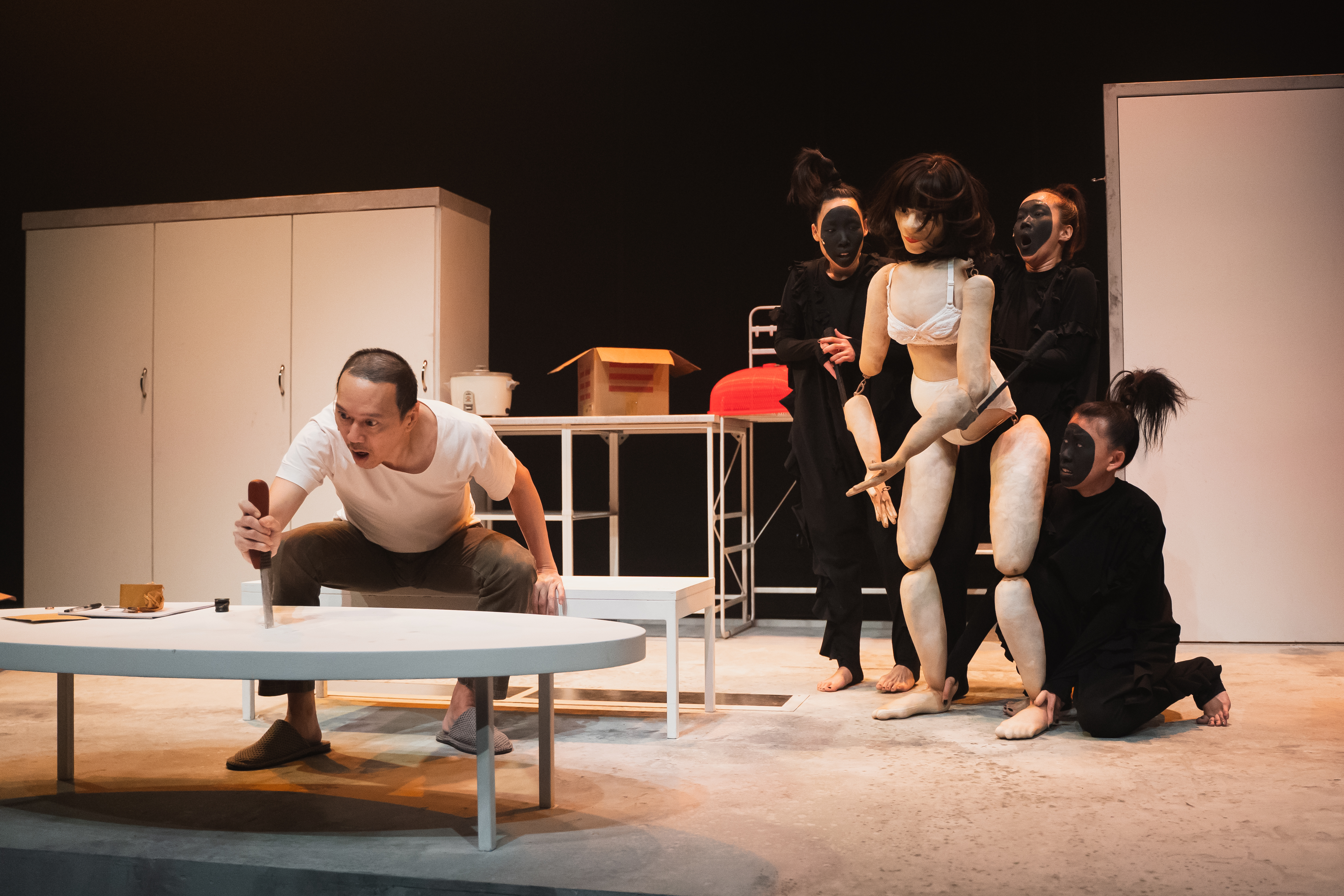






 Isaac Tan