Photo: Moonrise Studio / Courtesy of Arts House Limited
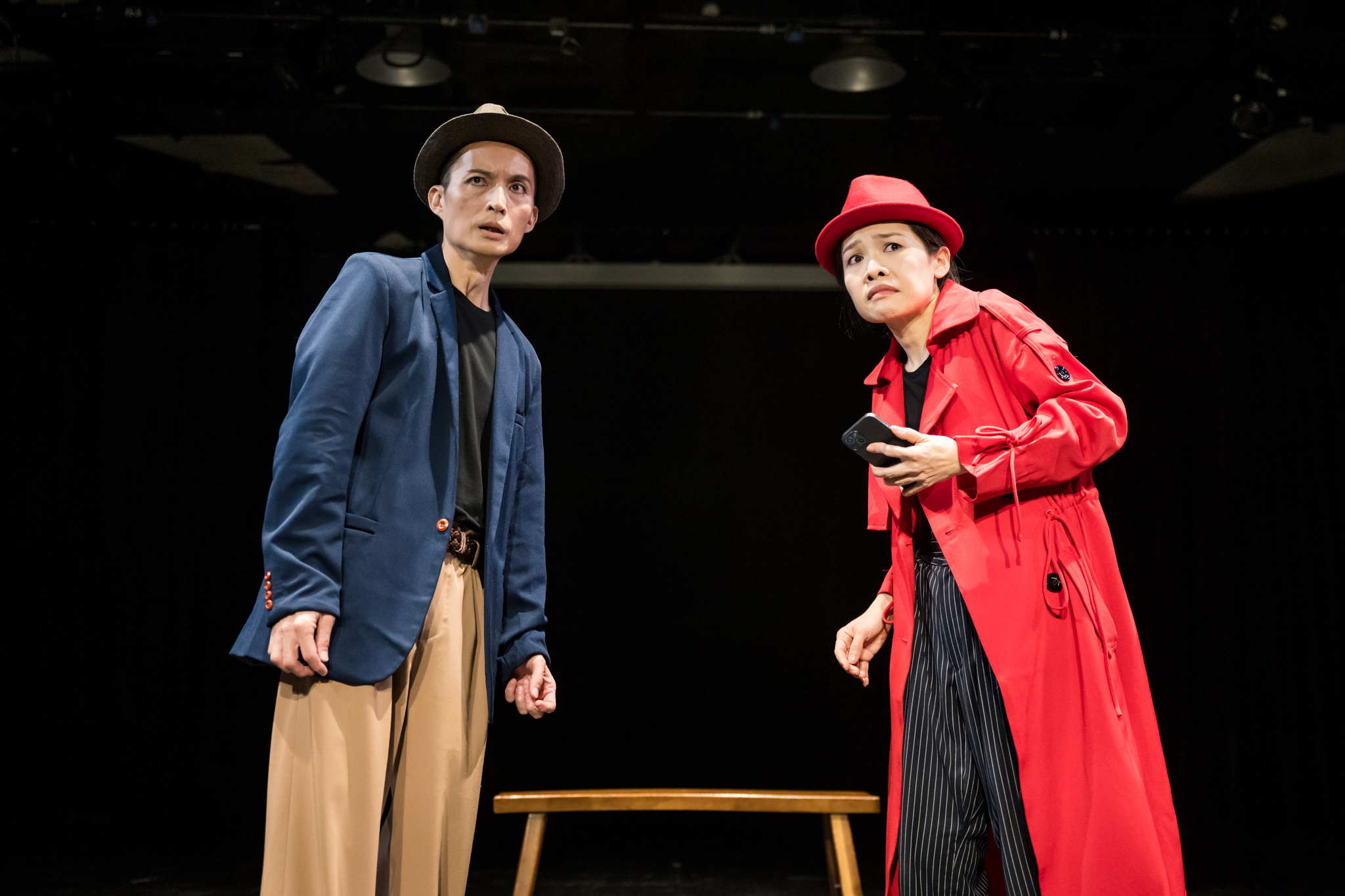
Waiting for Audience was first presented as a work-in-progress as part of the Singapore International Festival of Arts (SIFA) 2024 Tomorrow and tomorrow incubation programme. It returns this year as a full-fledged production as part of the lineup for SIFA 2025.
Nelson Chia (cast, playwright, and director) and Mia Chee (cast and producer) reveal more about the show over an e-mail interview.
Synopsis An old theatre reaches its last performance night. Two actors—A and O—find themselves sharing the stage. They bicker, they compete, they create, they wonder, and they wait… and wait, and wait. “We exist because they exist.” “Every play has a beginning / And an end / Life is the same.”
But will the audience ever come?
Playful yet meaningful, Waiting for Audience challenges us to rethink the bond between performers and spectators, drawing inspiration from physical theatre, clowning, absurdist humour and Chinese crosstalk.
Waiting for Audience invites us to step into the story and play a key role in completing a unique theatre experience, to join in the celebration of the power of live performance to connect what is on and off stage. Don’t miss this bold creation by Nine Years Theatre founders Nelson Chia and Mia Chee.
What inspired you to create the work?
Nelson & Mia: Nine Years Theatre is known for its emphasis on the actors’ craft. At the same time, we focus a lot on the audiences’ experience. As such, we came up with an idea to create a work that was somewhat a “love letter” to the audience. Waiting For Audience turned out to be that fun and curious way of saying to our audiences, “You are the one that completes our work.”
What made you decide to test your ideas through SIFA’s Tomorrow and tomorrow initiative in 2024?
Nelson & Mia: After several rounds of discussion with SIFA’s Festival Director, Natalie Hennedige, we realised Tomorrow and Tomorrow was an invitation for the audience to come create this work with us — precisely what Waiting For Audience was about, and a quite perfect platform for our idea.
Photo: Moonrise Studio / Courtesy of Arts House Limited
Were there any unexpected discoveries or insights from the audience feedback in 2024?
Nelson & Mia: We wouldn’t say they were unexpected, but we were really heartened to learn from the feedback that audiences found the work creative, humorous, and moving. More importantly, we were told by those who watched it that they felt that they were at the centre of the play—exactly how we liked it to be.
Now that the work is a full-fledged production in SIFA’s 2025 season, how has the work evolved since?
Nelson & Mia: The latest version at SIFA 2025 is quite a new version in the sense that it is about 50% different from the previous one. There are new scenes being added, sequences become more complex, and the space is more exciting with designers Emanorwatty Saleh and Ng Jing coming onboard to design the scenography and sound respectively. I feel the work has grown in terms of its characters emotions and the theme’s dimension.
Catch It!
Waiting for Audience by Nine Years Theatre runs from 30 to 31 May 2025 at SOTA Drama Theatre.
First presented as a work-in-progress as part of Singapore International Festival of Arts 2024’s Tomorrow and tomorrow incubation programme, hello, is this working by Drama Box returns to SIFA as a fully-fledged production.
Artists Chng Xin Xuan, Han Xuemei, and Lynette Quek shed light about the production and how it has evolved since it was first presented last year.
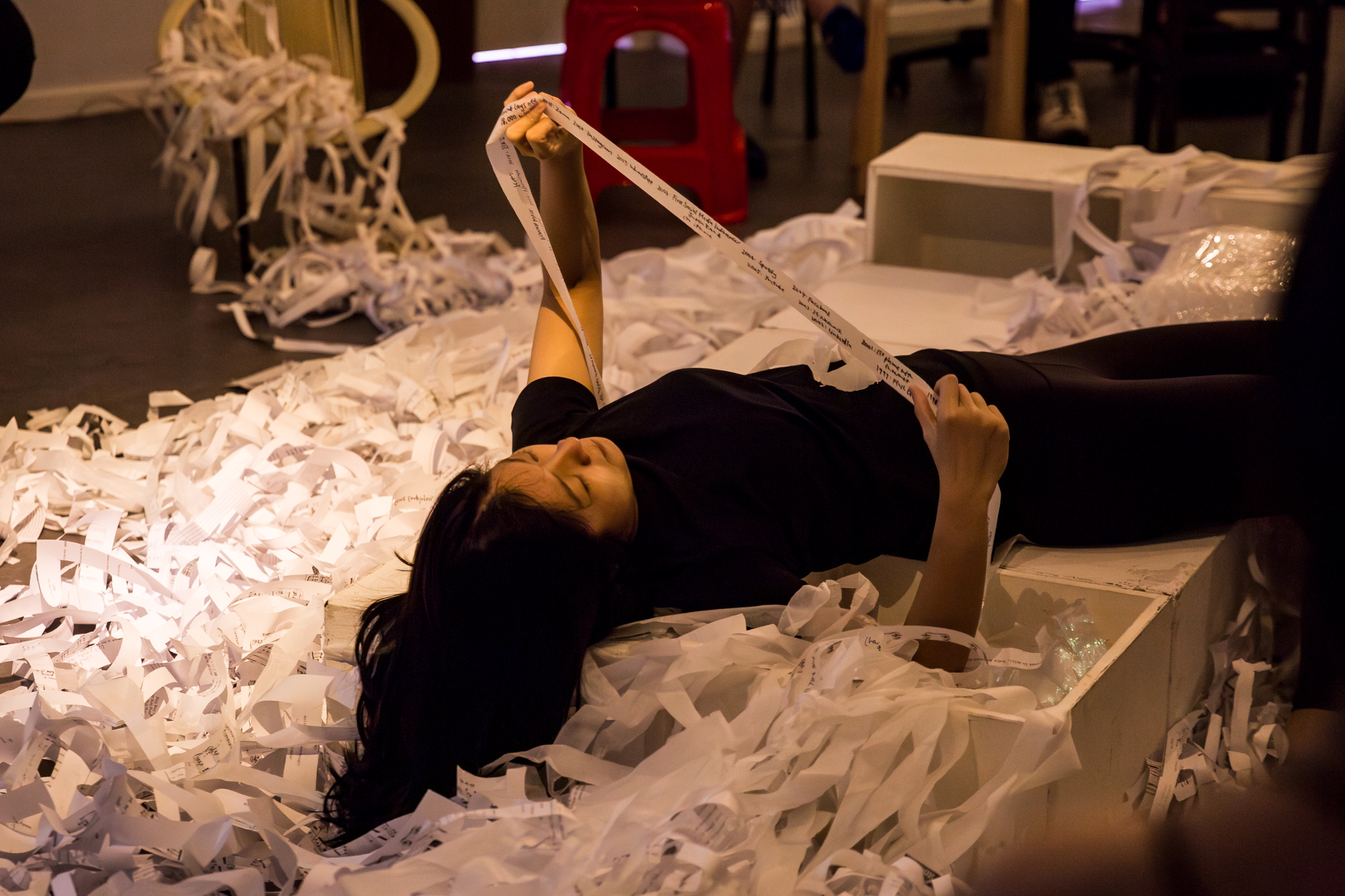
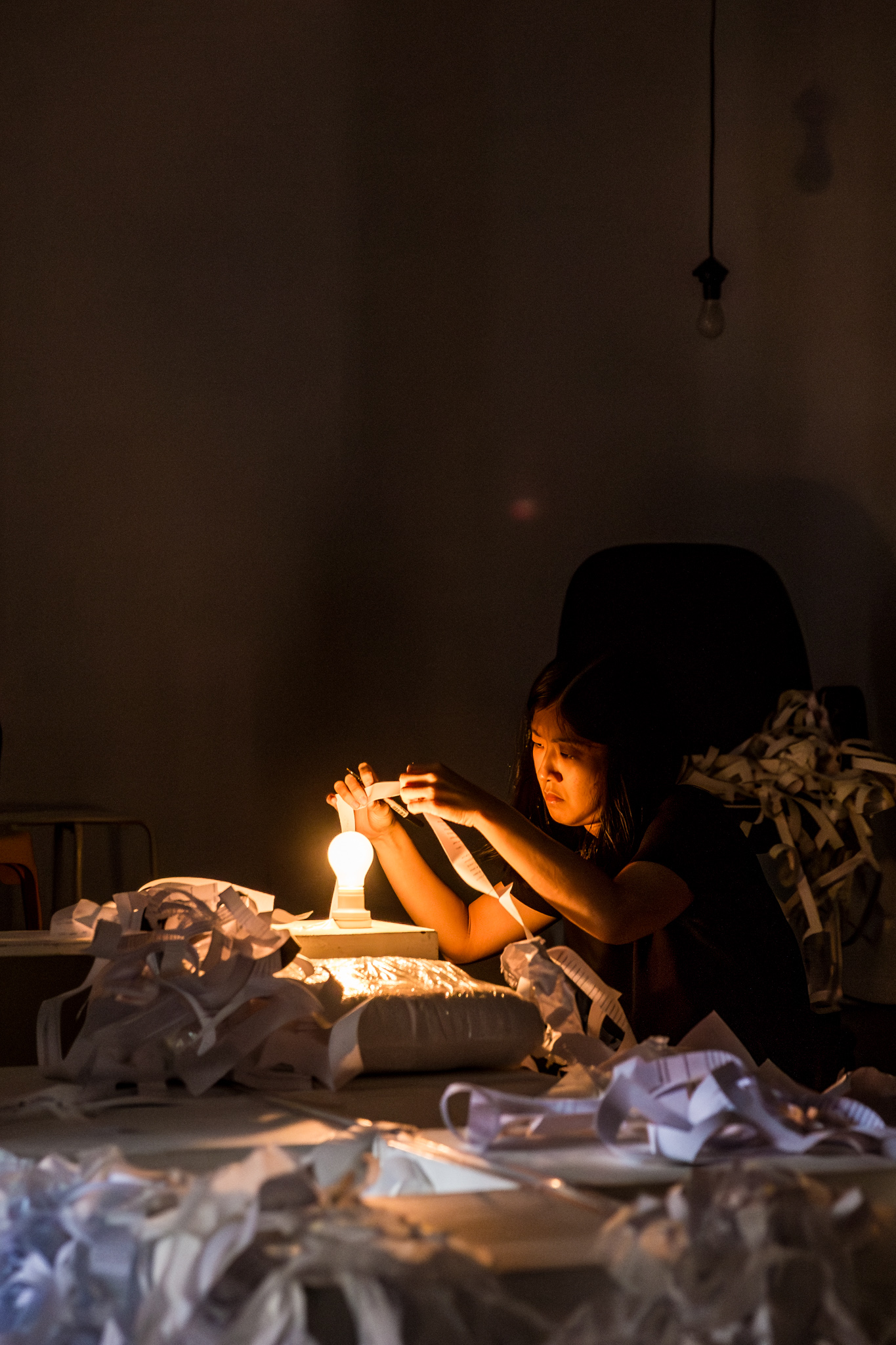
Synopsis If work is a big part of our lives, who would we be without our work? How are different jobs valued? Step into a world where we’ve collectively lost our memories about the work we used to do.
Through a mix of accounts by people of various professions and speculations of a post-AI future, hello, is this working? by Drama Box is a participatory experience that invites us to reexamine our relationship with work now, and to reimagine work in the future.
Times may change, but work, and workers are here to stay. Are you ready, Worker 5.0? The future is calling.
What inspired you to create the work?
Xuemei: Growing up in Singapore, many of us were likely instilled with the idea of “study hard and then get a good job”, to the point it almost felt like life ended with getting a job. I wanted to question this perceived indispensability of work — specifically, working for a living.
There were many questions I was curious about. Why do we work the way we do? Why do we value certain types of work more than others? How did our collective values about work evolve over time, and what needs to change in the future? These are also questions the world is grappling with, as seen in the rise of conversations and social movements such as “lying flat” (躺平 tǎng píng) and “quiet quitting”, especially with the COVID-19 pandemic and the rapid development of artificial intelligence. The time felt right for us to explore these questions more deeply through the arts.
Xin Xuan: I believe I have similar questions and thoughts about work, as shared by Xuemei. For myself, in particular, I recognise my privilege, being able to work as a freelance artist, away from the drudgery of repetition and routine. My work brings me to many like-minded people who share similar lifestyles and beliefs, though sometimes I have this inkling that I’m in an echo chamber. Working alongside Xuemei and Lynette on this project has allowed me to satisfy my curiosity about the work of my fellow Singaporeans who are not in the arts industry, and also presents me with an opportunity to learn more about others. Much of the inspiration comes from them and from the interactions that we have.
Lynette: I guess I was really curious about why people around me are often complaining about their work, how mundane their working days are, how they spend their weekends asleep in bed — it is almost as if they live just to do something that they don’t enjoy. I was really curious on how people stay on so long at a job, what were the little treats in their day, and what they think they would have been doing if not.
Photo: Moonrise Studio / Courtesy of Arts House Limited
What made you decide to test your ideas through SIFA’s Tomorrow and tomorrow initiative in 2024?
Xuemei: Because the subject of “work” is vast and complex, I had been hesitant to start. When the invitation came from SIFA’s Tomorrow and tomorrow, I felt it was the right time and space to plunge in, explore and experiment to figure out where these ideas could go. This opportunity also allowed me to involve other collaborators, and this was how Lynette and Xin Xuan came on board.
Were there any unexpected discoveries or insights from the audience feedback in 2024?
Xuemei: We were really thankful to the audience for the variety and depth of feedback last year. The feedback ranged from sharing their resonance with the work to pointing out areas that were not explored. One particular sharing that I was surprised by was how our perception of work is shaped by social and cultural institutions and, over time, the roles that these institutions play in our lives become very invisible and unchallenged. The example raised in this case was that of the National Library, wherein the library actually has, amongst its many functions, the function of developing “good workers”.
Xin Xuan: Too many to list! I would say that the dialogue that we had after our showings, during the post show talk, was a great space for us to exchange ideas and thoughts about work. And that to me was the most beautiful bit actually.
Lynette: A friend who came to watch the show said she would quit their job immediately! (She hasn’t left.) I find this contrast intriguing as it also states a bigger problem of pressure, sustainability, unease, etc. I appreciated the openness of the audiences and hopefully this piece allowed them to be a little bit more daring with their choices in their line of work.
Photo: Moonrise Studio / Courtesy of Arts House Limited
Now that the work is a full-fledged production in SIFA’s 2025 season, how has the work evolved since?
All: The most visible evolution would be the form the work takes. Last year, it was presented as an intimate performance – one actor to 40 audience – in a room. This year, the physical environment for the work is completely different. We were invited to create our work taking into consideration Ruobing’s installation at Bedok Town Square, which is an open public space. To consider how different audiences can access and experience the work, we have created two types of experiences – between 10am and 4pm, public can freely enter and explore the work in the form of an installation, then at 5pm and 7pm, there will be a 45-minute audio-based participatory experience, where the audience follows a narrative journey set in the year 2056.
The development of a narrative journey is also something that deviates from last year’s work-in-progress. Last year’s exploration had a more modular structure, where each scene or segment played with different ideas and could have no obvious connection to each other.
This year, we also chose to develop the character of the work fairy which appeared in one segment last year, as well as explore more with speculative imaginations of the future of work.
Essentially, “hello, is this working?” is both a philosophical question on what defines work and a speculative reflection on what is functioning and what is broken in our society. How do we make things work, and how do we repair what isn’t working?
Catch It!
hello, is this working by Drama Box runs from 23 to 25 May 2025 at Bedok Town Square.
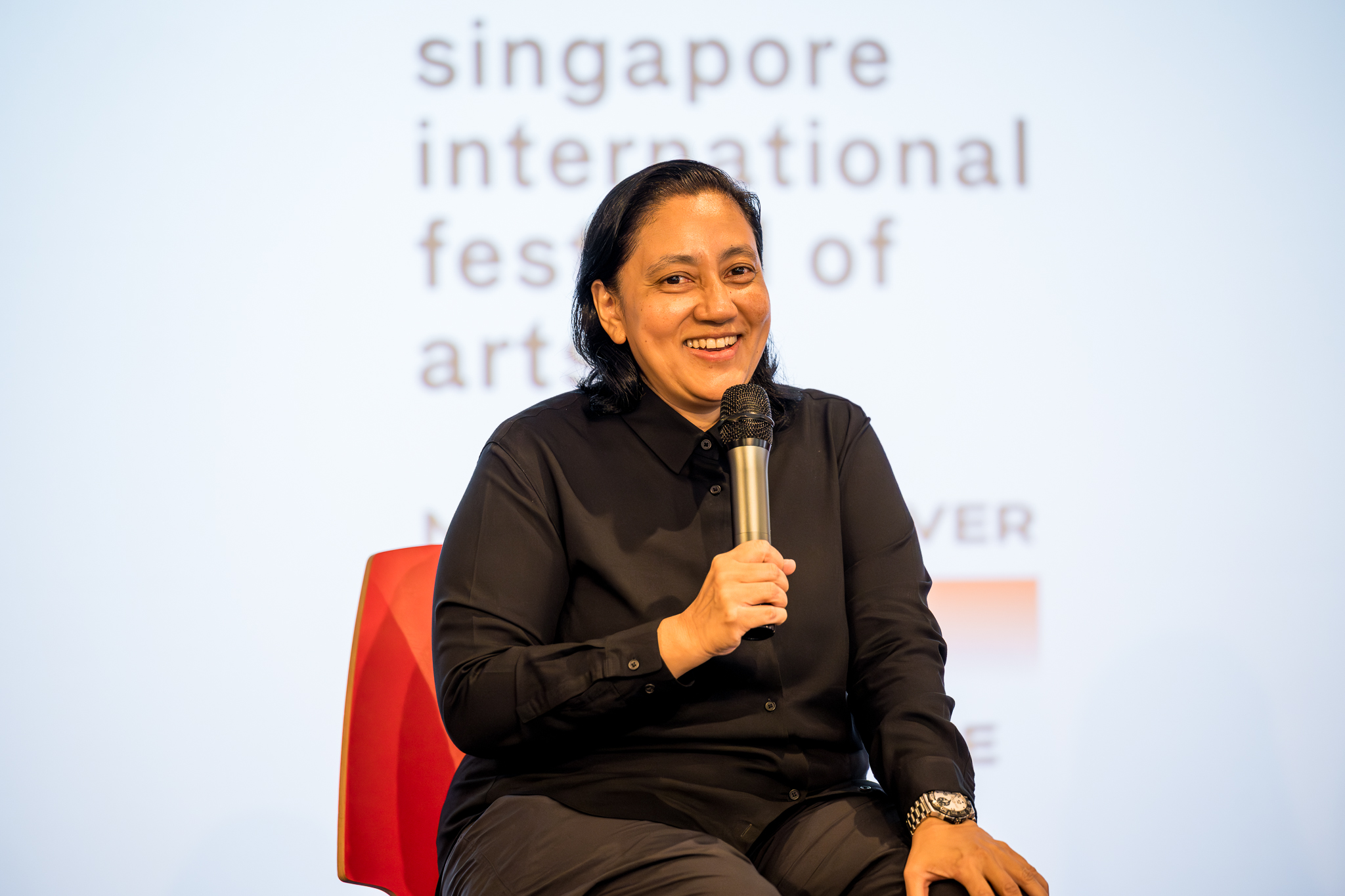
Natalie Hennedige, SIFA’s Festival Director / Courtesy of Arts House Limited
Launched in 2024, Tomorrow and tomorrow is an incubation programme by the Singapore International Festival of the Arts (SIFA) in which theatre groups can present their works-in-progress to an audience.
To find out more about the incubation programme and how some of the works in that programme have developed since, I caught up with Festival Director Natalie Hennedige.
What was your vision for SIFA’s Tomorrow and tomorrow incubator programme when it was introduced in 2024?
Tomorrow and tomorrow was conceived as a platform to enable fertile artistic ground to flourish with works receiving a process showing at the Festival. Stamford Arts Centre was transformed into a sandbox of works-in-process, opening up vistas for future presentations and unearthing Singapore’s fertile ground for contemporary theatre-making.
Ten local theatre groups were invited during the 2024 edition to bring their processes and working methodologies to the fore before audiences who would witness nascent ideas at play. Tomorrow and tomorrow became a platform not only for exploratory ideas, but also for showcasing the dynamic voices shaping Singapore’s theatre landscape, reflecting SIFA’s commitment to nurturing and celebrating local artistic process and innovation.
What is unique about Tomorrow and tomorrow, as compared to other incubator initiatives?
What sets Tomorow and tomorrow apart was the opportunity for audiences to experience a showcase of diverse, in-progress works by ten established local theatre groups, presented together on a single platform. That apart, Stamford Arts Centre became a larger canvas with visual artists commissioned to install works specific to the physical qualities of the center. We also had musicians in nooks and crannies charging the building with experimental sound.
Crucially, Tomorrow and tomorrow shows also eschewed a price tag—creating a space that was open and accessible to all who sought deeper, more unexpected connections. It encouraged engagement through observation, interaction, and conversation, free from the commercial expectations that often frame artistic encounters. At its core, the initiative was about witnessing the genesis of ideas and being part of a living, evolving tapestry of Singaporean theatre and expression.
Waiting For Audience by Nine Years Theatre and hello, is this working? by Drama Box were part of the 2024 incubator programme, and they are being presented as full-fledged productions in SIFA 2025. Why were these two works selected?
Waiting For Audiencecaptures the inextricable link between the theatre and its audience, reflecting too an artform as old as time and how its vitality endures. This resonates with SIFA 2025’s MORE THAN EVER frame, which encompasses why more than ever the arts matters.
hello, is this working? returns under very different conditions; the first iteration of the work occurred in one of Stamford Arts Centre’s rooms. In 2025, it takes place at the SIFA Pavilion at Bedok Town Square in response to the context of the space which includes the neighbourhood bustle and a colossal installation stage doubling as a stage by visual artist Wang Ruobing. All these contribute to an extremely evolved version. It will be exciting to have witnessed the evolution of these works or to encounter them as a first.
Looking back on your tenure as SIFA’s festival director and your artistic career, what does Singapore’s arts ecosystem need more of to foster a vibrant arts scene?
An international festival plays a critical role in shaping Singapore’s arts landscape. It serves as a nexus for experimentation, exchange, and discourse—bringing artists and audiences together to engage meaningfully through the arts.
Beyond fostering artistic dialogue, a festival like SIFA amplifies the visibility of homegrown talent, situating local artists within a global context and creating opportunities for collaboration that drive both artistic and professional growth. It also deepens public engagement by presenting multifaceted perspectives, encouraging audiences to encounter and interpret works through a critical lens.
Singapore’s arts ecosystem benefits from such efforts that connect artists across borders and support long-term artistic development. As a small but vibrant nation, we are constantly negotiating between the local and the global. SIFA mirrors this dual gaze, fostering regional and international collaborations that open pathways for new creations and deeper artistic inquiry.
In varied ways, Singapore artists have made their presence felt on the international performing arts stage. Take Ramesh Meyyappan, for instance—a Glasgow-based Singaporean theatremaker who creates prolifically in the UK and helms LEAR, a reimagining of Shakespeare’s King Lear for SIFA 2025. Though based abroad, Meyyappan remains deeply connected to the arts scene here.
In commissioning LEAR, the Festival not only brings a bold new work to local audiences, but also showcases the vibrancy and reach of Singapore’s arts ecosystem—one that nurtures talent with international resonance. The production is set to travel to Traverse Theatre in Edinburgh and Aberdeen following its premiere at SIFA, further extending the reach of Singaporean artistry to global audiences.
The Singapore International Festival of Arts runs from 16 May to 1 June 2025.
Returning Goh Lay Kuan 14 August 2015 Drama Centre Theatre 13–15 August 2015
Ostensibly, Returning shows the life cycle of a school of salmon and the trials and tribulations they face. Artistically, I see a life cycle of a tree—drawing nutrients from the roots of tradition before bearing fruits that are expressive and confident.
The dance piece is divided into five segments with the first three segments portraying the salmon developing from an embryo to a smolt and the final two showing the salmon returning to the streams to lay eggs.
Choreographers Meenakshy Bhaskar, Jenny Neo, and Osman Abdul Hamid drew on the movement vocabulary of the Indian (Bharatanatyam), Chinese, and Malay dance traditions to chart the developmental stages of the salmon’s life cycle.
As the embryos become alevins, their movements are limited and they struggle to make sense of the environment. The structured and grounded Bharatanatyam movements , conceived by Bhaskar, lends a firm but quiet energy to the piece. The striking facial expressions and footwork of the dancers exudes the eagerness of the alevins that are full of potential.
Neo’s light and youthful Chinese dance choreography captures the energetic fry as they zip around, avoid predators, and pick up the necessarily survival skills. Despite the perilous situation, the dancers punctuate their quick movements with a momentary pose and let out a playful kiss—the fry call out to one another to ensure that they stay together.
The fry become fingerlings and the process of smoltification soon occurs. After this transition, the smolts emerge with a silvery coating. This appears to be a rite of passage and the Malay dance choreography by Osman Abdul Hamid celebrates the fulfilment of the rite. A sense of joy fills the air as the dancers sway gently and gracefully to the lush tones of the accordion.
Reaching maturation and confident of survival, the smolts navigates and overcome all sorts of obstacles with aplomb. This is mirrored by the dancers as they—gaining all the needed technique and strength through their traditional dance training—come together and showcase their versatility in Osman Abduls Hamid’s contemporary choreography. All of them are consummate dancers as the audience is treated to a sequence that is engaging and dramatic. The swirling blue rays of the intelligent lights, designed by Dorothy Png, evoke the tumultuous depths of the ocean which heightens the tension.
The final choreography by Low Ee Chiang continues the drama that culminates in all the dancers taking to the stage. Their synergy is palpable for the renewal of the next generation of salmon depends on them. In one striking moment, they all fall to the floor as the lights goes out. The meditative sound of the flute creeps in slowly as the dancers emerge from their foetal position. The process is consummated and life begins again.
Despite its structure, Returning does not feel segmented and kudos to Mdm Goh Lay Kuan (artistic director) for ensuring that all the choreographies coalesced into a cohesive whole.
The same commendation must go to Julian Wong (music director) for the same achievement with the music. In fact, the structure of the music complements the dance as well. In the first three segments, music from the Indian, Chinese, and Malay traditions take their respective centre stage and instruments that do not typically belong to the tradition serve as accompaniment. However, in the final two segments, composer Ho Wen Yang really brings out the best in all the instruments as they chorus as a wondrous whole.
For us—the younger generation—whatever is known of Mdm Goh’s legacy is probably through interviews and books. With this latest offering, she beckons us to relook at the artistic roots and the possibilities of dance with fresh eyes.
We cannot help but follow her on this journey of return.
Dementia Proton Theatre 13 August 2015 Victoria Theatre 13–15 August 2015 Part of Singapore International Festival of Arts 2015
“Actors on stage. Static sounds. Smell of electrical appliance overheating. Occasional flashing light. Cramped hospital ward—four beds. Various personal items of the patients are seen; well lived-in. Christmas tree. Patient sits in the auditorium as the nurse coaxes her back to the stage.”
These scattershot impressions that Dementia creates as one enters the theatre is unsettling. As the audience takes their seat, a plump man in a sweater—who we later find out to be the doctor—starts getting restless and exuberantly informs us that this is a hospital ward for dementia patients. His uncontrollable laughter underscores his introduction and one wonders whether he is actually a patient himself.
This sense of puzzlement is emblematic of the show.
Is Dementia literally about a rich man buying over the whole building, hurling what is left of a psychiatric ward into the streets, and converting it into a Hungarian equivalent of Babestation? Or is it a metaphor for the state of Hungarian society?
I could not make up my mind throughout the show but I later found out that it is meant to be both as indicated in the progamme booklet.
The ghostly remnant of the hospital ward is inspired by the closure of the National Institute of Psychiatry and Neurology in Budapest (formerly known as Lipótmezei Psychiatric Hospital) in 2007. The government incurred the ire of critics as there was no consultation with healthcare professionals which made the restructuring programme appear as a blatant political move. An unjust move at the expense of the psychiatric patients who were left to fend for themselves as the extant hospitals could not accommodate all of them.
The deafening silence from the authorities as the building stands abandonedcompelled director Kornél Mundruczó to stage Dementia and excavate the alternative voices in society that often go unheard.
Aside from the injustices, we ourselves are like the dementia patients—trapped in our own obsessions as we slowly forget about everything else. With the show being part of the Singapore International Festival of the Arts and its theme being Post-Empires, Dementia is a cautionary message not to fall into a state of post-remembrance.
With a heady mix of live music (played by the patients) and film projection of what goes on in the ward when the curtain falls, Dementia has elements of melodrama and dark comedy that is poised to leave a deep impression. It rarely lets you settle but keeps you on your toes.
Unfortunately, it does not.
While the social message is relevant to any society, the language barrier seems to blunt the immediacy of what the production is trying to evoke. As it is impossible to completely synchronise the English surtitles with the delivery of the Hungarian text, there seems to be an added distance between the audience and the performance.
Safe for the extraordinarily squeamish, the violence, blood, and nudity hardly adds to the shock value. More importantly, there is an uncomfortable asymmetry in the violence done to the women as most of them are sexually humiliated while only two of the male characters experience physical harm. This unnecessarily distracts one from the message of the play.
Despite certain dramaturgical flaws, the play rewards those who are willing to reach out some food for thought and perhaps a moment of clarity. A gift much needed in a demented society which even calculateswhether the able-bodied is deserving of state support.





 Isaac Tan