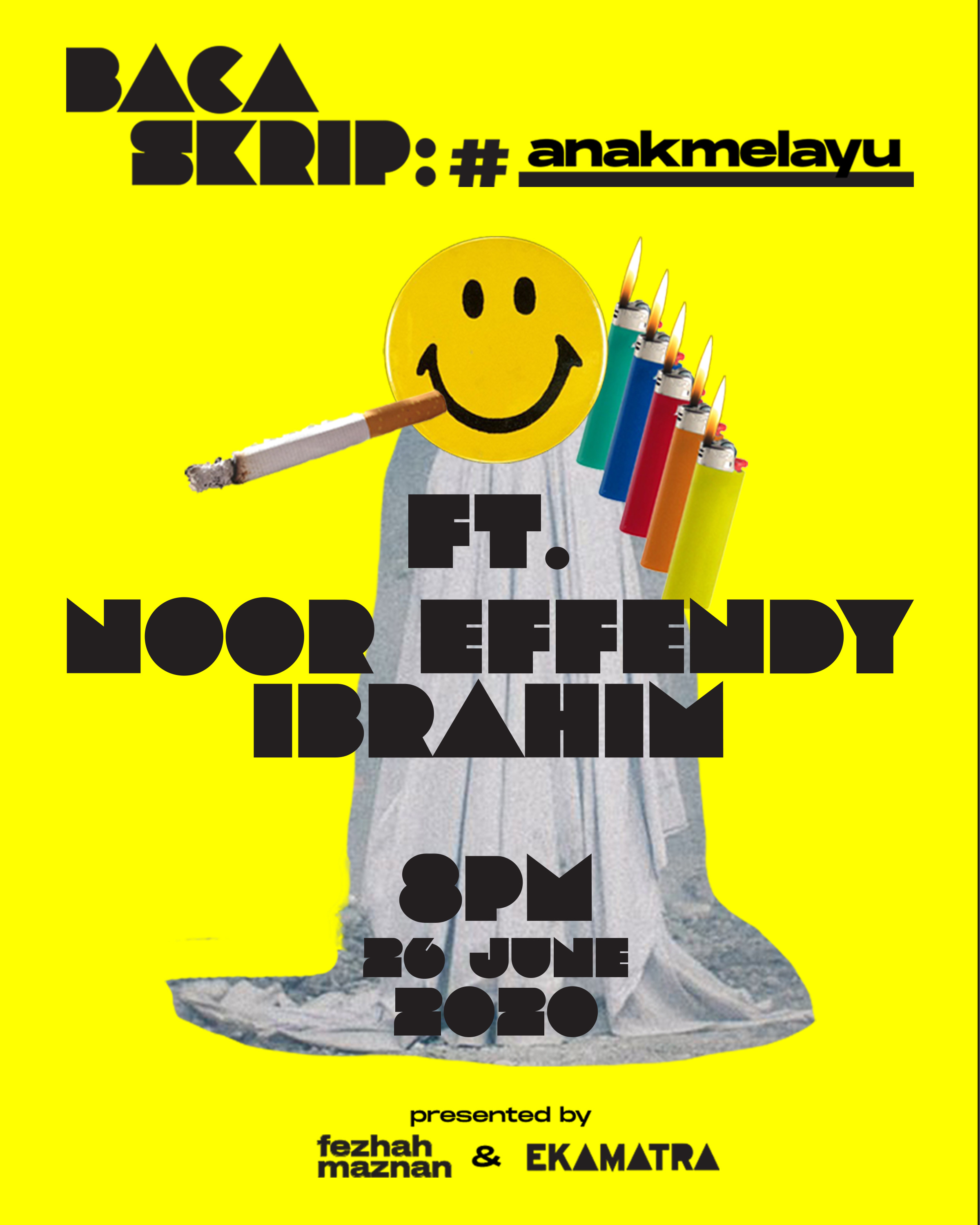
In the second instalment of Baca Skrip, a monthly series of online readings of Singaporean Malay plays, Fezhah Maznan and Teater Ekamatra presents Noor Effendy Ibrahim’s Anak Melayu.
I interviewed some of the actors involved in this read (Izzul Irfan, Rusydina Afiqah, Farah Lola, and Ali Mazrin) to find out about their experiences with performing via a digital medium.
Could you give us some insights as to what the rehearsal process was like?
Izzul Irfan: The rehearsal process has been very interesting for me as an actor because I sort of have to come up with a new vocabulary as a performer. You are playing the dual roles of both performer and technical team in a sense, because if you freeze or get cut off or your connection’s down, it’s on you to bring yourself back online and working well. So, there’s that headspace that I have had to get used to. Other than that, I think learning to connect over Zoom has been interesting—I have always seen this mode as purely a communication platform and not so much a ‘connecting’ platform. But the process has really been about re-learning how to reach out to the audience (when you can’t see them) and it’s been challenging but rewarding.
Rusydina Afiqah: To start off, there was a read to understand the flow of the story and the characters. Then we went straight in to cover the play bit by bit, a little more in depth each time. Questions were raised as we understood this world a little better.
Farah Lola: All of the rehearsals were held over Zoom calls. Other than it being tricky tehnically, the reading and blocking was easy enough to do.
Ali Mazrin: Basically, we have been going through rehearsals online via Zoom. Which includes all the cast, director and also the crew. Having to pick a spot in my own house and making sure everyone at home do not interrupt the rehearsals is quite hard but fun at the same time.

What were some challenges you face, especially when you are not in the same room with the rest of the cast and crew?
Izzul Irfan: Honestly, it drives me crazy that I cannot ‘feel’ everyone’s energy properly because we are not physically present together (which is something I really miss). So I think doing an ensemble piece where there is contant ping-ponging of energy on a virtual space has been difficult. With Anak Melayu, getting the tempo right is important and we’re really working hard towards that.
Rusydina Afiqah: For me, understanding the story took a while longer. There were a lot more things to juggle than just imagining the world. There were five more tiny screens during rehearsals that I had to be aware of, all at the same time.
Farah Lola: Perhaps physical and eye contact. Our eyelines were a little different because we were looking at different points of the screen, and you really needed to refine vocal inflections to know who the character is addressing but we’ve managed to work it out. We also had to bounce off energy more vocally as there was no physical space with other actors to feel out.
Ali Mazrin: Because it is an online rehearsal, we face quite a number of technical challenges such as the connection of the internet and also capturing of the cast’s voice. Being in a different space then the rest of the cast makes it more challenging in having the same energy as everyone during rehearsal.

Has this process made you look at the piece that you are involved in a new way? How so?
Izzul Irfan: Effendy’s plays are always very physical, and as he told us about the past iterations of Anak Melayu, you can clearly see there is a physical vocabulary that he builds and it’s beautiful. He always says he’s not much of a ‘text’ person. But as I was working on this play on a virtual platform, his words really come to life – all the subtexts in all its glory, and three-word lines from one character hold entire worlds in them. While it has been close to 20 years since he created them, his characters are still very much alive and kicking.
Farah Lola: It is my first time familiarising myself with this piece, and my first time doing a play on camera in my own home! I think everything has been whittled down to the subtleties due to it being closer to the audience, therefore it would feel more intimate.
Ali Mazrin: It’s amazing how we still manage to do rehearsals and shows live, online. But I definitely still wish that this was a staged show where everyone is together, so as to also feel the audience’s energy when we are performing.
Baca Skrip: #AnakMelayu will be presented via Zoom on 26 June 2020 at 8 p.m. Tickets at $10 from Peatix.


 Isaac Tan