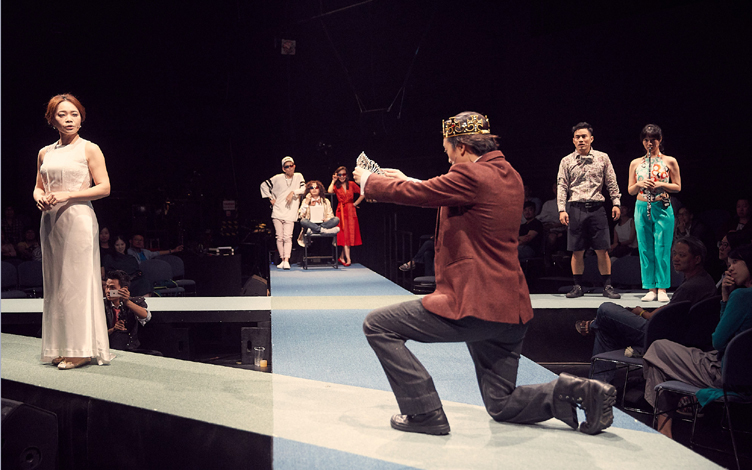
[Flash Theatre Review] Blood & Rose Ensemble — Much Ado About Very Little

Blood & Rose Ensemble
Shakespeare’s Wild Sisters Group
25 February 2018
Esplanade Theatre Studio
23–25 February 2018
Part of Huayi Chinese Festival of Arts 2018

To illustrate the contingency of history, this production is shot through with meta-theatricality.

Several art forms [Foley sound effects, Shuang Huang (双簧), movements from Chinese opera, pop music, etc.] are employed to continuously highlight the performativity of the piece as well as the history of War of the Roses.

While it is generally intriguing and entertaining, the novelty of it fades after a while. Yes, in some senses, history and life as a whole is contingent—so what? It’s much ado about very little.

Furthermore, the lightness of touch erases the humanity of the characters, which what makes Shakespeare’s Henry VI part 3 and Richard III interesting.

You don’t need two hours to tell us that out lives are contingent and—in the grand scheme of things—our desires, struggles, and strife are petty.

[Dance Review] The Immortal Sole — More of a Fairy Tale than Andersen’s Original

Photo: Crispian Chan

The Immortal Sole
Edith Podesta
18 January 2018
Esplanade Theatre Studio
17–20 January 2018

We often describe something as a fairy tale to mean that it is fanciful or one-dimensional. If that is so, then Edith Podesta’s latest attempt to retell The Little Mermaid is more of a fairy tale than Hans Christian Andersen’s original yarn.

The initial portion of the original tale sees the mermaid visiting the world inhabited by human beings. She falls in love with a prince and saves him when a storm hits his ship. As the prince is unconscious, he does not know of her existence. On finding out that humans have an immortal soul, she seeks out a witch. Despite learning that she can become human exchange for an excruciating physical sacrifice, the mermaid consciously agrees to go through the pain.

Such a tale raises questions such as what it means to be human, and whether the mermaid made her choice because she loved the prince or she wanted immortality.

In The Immortal Sole, Podesta appropriates this tale as an allegory of what one must go through to become a woman.

As such, Little Mermaid (Koh Wan Ching) does not fall in love with the prince, but develops an unhealthy obsession with him, and wails lyrics to “Toxic” by Britney Spears to a Ken doll.

Instead of being given a choice, Podesta’s mermaid is cajoled by the witch and her posse (Ma Yanling, Dapheny Chen, and Yarra Ileto) to fit in, as the former endures the group campily lip syncing to Spears’ “Work Bitch”. A similar sequence, but this time with Rihanna’s “Bitch Better Have My Money”, occurs towards the latter half of the show, when the mermaid fails to make the prince fall in love with her.

In terms of movement vocabulary, while there are some beautiful synchronised movements in the shallow pool of water (wonderfully designed by Adrian Tan), we see the choreographic shorthand for internal turmoil—body convulsions and silent screams.

Unfortunately, they are not effective as they have been employed by one-too-many choreographers. Furthermore, these moments are not well-earned as the major conflicts in the story are diluted by the abovementioned lip sync sequences.

In another scene, having attained human legs, we see the mermaid being pressured by the witch and her posse to cock a hip and strike various poses—a patently obvious reference to body image issues that plague women. As the soundscape (also designed by Adrian Tan) intensifies, I thought the scene would culminate into a disclosure of something more profound. But all one gets is the use of strobe lighting, and we see snatches of the whole ensemble striking different poses in mid-air whenever the light flashes. This goes on for quite a while—a waste of technical wizardry and the performers’ athleticism.

In sum, The Immortal Sole is merely a reiteration of broad talking points, but it adds nothing to the discourse.

Worse still, Podesta strips Little Mermaid of her agency and, like a fish out of water, she is completely helpless against the seemingly malicious demands of society. Unlike the mermaid of the original tale, this mermaid hardly elicits any sympathy, and the show does a disservice to women out there who have truly struggled and pushed back.

Leaving the theatre, I realised that I would have a much better understanding of the difficulties women face in society by having a heartfelt conversation with my mother over supper.

More importantly, the ticket price of $27, which came out of my pocketbook, would have made for a rather hearty supper.

Other Reviews

“Notions of ideal beauty gone in a splash” by Germaine Cheng, The Straits Times Life! 

“M1 Fringe Festival 2018: The Immortal Sole by Edith Podesta (Review)” by Bak Chor Mee Boy

[Dance Review] Bosque Adora — Innovative Adoration

Bosque Adora
Rocío Molina (with Eduardo Guerrero and Fernando Jiménez)
27 October 2017
Esplanade Theatre
27–28 October 2017

The conflict between the purists and innovators in dance is a long one that crops up in any genre. Had both sides shared a box during Rocío Molina’s Bosque Adora, they will be confused… in a good way.

Conceptually, the rituals of hunting and mating, and the dynamics between the masculine and feminine are staple themes. Additionally, fans of Molina’s usual abstract approach to flamenco would be surprised by the almost linear progression of her work.
Yet, the work is far from letting the general audience shouting olé at the end of each segment, or the aficionados from clapping the rhythms of the dance. So far, in fact, that we find ourselves in the heart of a forest, after watching an intricate film of Molina racing across the landscape on horseback before being thrown off while she tried to cross the river.

From there, she emerges as an enigmatic and long-snouted vixen, with a mask on the top of her head. A British counterpart likens it to the Teumessian fox. Be it a mythical animal that cannot be caught, or a sleek and alluring animal, this patch of land is clearly hers, and she easily dominates the men (Eduardo Guerrero and Fernando Jiménez). This starts the process of hunting, seduction, mating, hangover, solitude, and being hunted.

Throughout the 90 minutes, Molina employs a movement vocabulary influenced by modern dance, cabaret, flamenco and many others. But rather than cautiously picking out certain things based on genre, her allegiance is to what she is trying to convey.
Even within the flamenco idiom, she is keen to push the envelope by breaking body lines, flexing one’s feet, and having an echo audio effects that would annoy any purist who believes that rhythm is the heart of flamenco.

All these culminate in a thrilling display of corporeal virtuosity that evokes the animalistic nature in all of us. This is complemented by her fellow dancers. Eduardo Guerrero is a suave feline on the prowl, while Fernando Jiménez emanates strength and machismo. Molina manipulates them by straddling the former and snatching an orange from the latter’s mouth, but she soon finds herself entangled in a power play—the hunter and the hunted are both sides of the same coin.

If the dancers are the main course, the music is the sauce. The trombones, electronic effects, and percussion dominate the first half, which create a heady atmosphere for the rituals of hunting and mating taking place. The percussion also adds to the hypnosis when Pablo Martín Jones adds gamelan-like quality to the sound by playing various rhythms with the instruments scattered on the floor. The lilt of the guitar comes in the second half which eases the tension slightly and brings us back to familiar ground.

While the dream that we are thrown into ends abruptly in the final scene, one leaves the theatre with a pleasant hangover; unsure of what just happened, but ever so ready to be thrown back into the forest again.

Other Review

“Bosque Ardora (Forest Worship) – review” by Stephanie Burridge, FiveLines

Interview

“Rocío Molina ‘my work is intuitive’, interview” by Ezekiel Oliveira, FiveLines

[Theatre Review] The Great Wall — An Epic That Needs A Little Focus, And A Bigger Stage

The Great Wall: One Woman’s Journey
Glowtape Productions
18 July 2017
Drama Centre Theatre
14 – 30 July 2017

The six-year birthing process of The Great Wall: One Woman’s Journey—which depicts the folk tale of Meng Jiang Nü’s journey to the Great Wall after her husband, Fan Qi Liang, has been conscripted for its construction— is a refreshingly long, but arduous one. But unlike an actual baby, any kink can be rectified, and a rebirth can be arranged.

Despite careful preparation by producer Grace Low and her creative team, it is unfortunate that Low’s brainchild has slightly weak bones. Jean Tay’s book is torn between allowing Meng to drive the action or to use the tale as a platform to show the power of stories which outlast any empire.

The latter strategy is seen in Fan being a scholar, who defiantly carves classic poems into the wall in opposition to Qin Shi Huang’s efforts to rewrite history and his legacy, and various characters stating when and how they met Meng as a device to move the story along. While either strategy has great potential, alternating between both makes the show schizophrenic.

Furthermore, certain dramatic moments are not given the time and space to breathe. The two main ones are the blossoming romance between Meng Jiang Nü (Na-Young Jeon) and Fan Qi Liang (Nathan Hartono) (accomplished in the span of half a song), and Fan’s arrest. Despite decent performances from the couple, we are hardly invested in them as one wonders why Meng even bothered to make the odyssey in the first place (a decision made in record time).  

Aaron Khek’s and Ix Wong’s inspired choreography draws from the movement dynamics of Taiji and concepts in Chinese philosophy. The fluid quality of the movement sequences have an ephemeral quality that is apt for the spirits tormenting Qin Shi Huang, and the various people that Meng meets. However, the performers appear to be hemmed in by the lack of space in bigger scenes.

Similarly, while the various design elements and scene transitions are thoughtful, and successfully overcome various limitations, this show is screaming for more space. The lack of grandeur, especially when it comes to the wall, is a little jarring. That said, do watch out for how the dead is entombed within the walls as it is exquisitely haunting.  

Despite having slightly weak bones and being a little petite, it will be remiss of me not to report that it is still a healthy child with much potential.

The brightest lights of the show are undoubtedly George Chan as Qin Shi Huang and Na-Young Jeon as Meng Jiang Nü.

Chan benefited from having been part of the process since 2012, as he offers a wonderful and humane portrayal of a tyrant struggling with his inner demons, while being utterly determined to hold on to power. Such a take on the first emperor of a united China is rare, and I would love for a musical on Qin Shi Huang to be written with Chan in that role.

Jeon impresses on various fronts, as she has to tackle the emotional demands of the show; the physical challenges in depicting Meng travelling over various terrains; and David Shrubsole’s demanding score which requires her to hit both extremes of her vocal register. In Jeon’s Meng, we see a refined and demure lady that is led by love and devotion that has a Medean intensity. Yet, despite being in the throes of utter sorrow, she still has the wits about her to ensure that her husband has his dignity restored to him.

Shrubsole’s music is possibly the only element that gives the show the grandeur it deserves. From identifiable conventions (lyrical ballads or percussive Chinese music) to the slightly experimental, it is clear that he composes according to the emotional beat of the story. His lyrics can be quite poetic, but the nuances are sometimes lost in a flurry of harmonies and stage action.

While the show has considerable weaknesses, the boldness of the undertaking must be acknowledged. As long as the creative team adopts Meng’s derring-do in deciding how the story must be told, and aided by more resources, The Great Wall has the potential to scale greater heights.    

Other Reviews

“Promising journey” by Akshita Nanda, The Straits Times Life! 

“Houston, we have a problem” by Christian W. Huber, Centre 42 Citizens’ Reviews

“The Great Wall Musical: Audio review with commentary from Adrian Pang and Tabitha Nauser” by Norman Tan, Tabitha Nauser, and Adrian Pang, Büro 24/7 Singapore

“Review: The Great Wall by Glowtape Productions + Ticket Giveaway!”  by Bak Chor Mee Boy

“The Great Wall Musical: A Moving Tale” by Our Parenting World

“{Media Invite} The Great Wall: One Woman’s Journey|A Night of Stunning Vocals” by Audrey, SAys! Happy Mums

“The Great Wall Musical—A Review” by Vicky Chong, Vicky’s Writings

[Theatre Review] W!ld Rice Ups the Ante in Fourth Staging of Boeing Boeing

Boeing Boeing
W!ld Rice
25 June 2017, 3 p.m.
Victoria Theatre
23 June – 22 July 2017

There are plays which are re-staged because it is canonical, and every re-interpretation is an opportunity to disclose certain aspects of the show. And there are others which are re-staged because they are popular.

Boeing Boeing is the latter. However, director Pam Oei must be commended for not merely turning it into a tent-pole production that the company trots out every few years.

Glen Goei, Oei’s directorial predecessor, has paved the way by re-contextualising Marc Camoletti’s old-fashioned plot—of an architect maintaining affairs with three air stewardesses based on his faith in airline schedules, and the loyalty of his maid, and friend from university—for Singaporean audiences. Oei, having performed in Goei’s staging, makes her mark by pushing her actors to showcase the hallmarks of a farce, and what makes the show such a delicious guilty pleasure.

For starters, she literally pushes the actors closer to the edge by approving Eucien Chia’s set design. Chia takes the intimate space of Victoria Theatre, and makes it even smaller by having the set farther down-stage. With numerous doors fanning out towards the audience, one is pulled into the action. One wonders which one would open, and secretly hopes that it does at an inopportune moment just to see how Bernard, the architect, weasels his way out of the situation. The smaller playing space also makes it more difficult to distract one stewardess, while shooing another one out.

Additionally, Chia’s industrial aesthetic, which is softened by an earthy palette of the furniture and doors, is an urbane and clever complement to the colourful carousel of amorous dalliances that takes place in the show.

While Oei, as director, no longer needs to wear a form-fitting uniform for the show, she does not loosen the corset on the performative elements. After taxiïng to the runway with the introduction of Jeanette (Oon Shu An) from Singapore Airlines (SIA), and Bernard (Rodney Oliveiro) boasting to Roger (Shane Mardjuki), his university friend, about his smooth operation, the show takes on the speed of a Concorde.

The breakneck speed of the physical antics, executed so flawlessly by every single actor, is no mean feat. Rarely are we treated to such a well-coördinated comedy at an early stage of the run.

Jeanette (Oon Shu An), the materialistic Miss SIA; Jayanthi (Rebekah Sangeetha Dorai), the strong-willed but down-to-earth Miss Air India; and Jin Jin (Judee Tan), the patriotic but mawkishly romantic Miss Air China induce raucous laughter by playing their stereotypes to the hilt. Even though naturalism is not expected in a farce, the women endear themselves to the audience in the brief moments when snatches of their personality peek through the stereotypes. Kudos to the three actors who seamlessly juggle both aspects wonderfully.

The intensity of Shane Mardjuki’s Roger peaks too early, but he manages to maintain it without spiralling out of control. Despite being in awe of Bernard’s international harem, the boy from Kuching proves more adept at keeping up the charade, while pursuing his own interests. 

Bibeth Orteza, as the beleaguered maid Rosa, brings much mirth as she punctuates the show by exclaiming, “It’s not easy!” While it is overused, Orteza’s energy and keen sense of timing provides a welcomed break from the flurry of activities among the other characters.

Despite nailing the physical aspects of the show, Rodney Olivero does not add much to the paper-thin character of Bernard. When Roger tries to hint to him that his plans have gone awry, his incomprehension is one-note which stifles the comic potential of the scene. Furthermore, the rapidity of the scenes sometimes proves too much for Olivero as he accidentally calls Jayanthi, Jin Jin at one point. Unfortunately, his scene partners decide to ignore it and forgo an opportunity for improvisation.

In the programme notes, Oei mentions that she wants to offer her audience a “respite from the cares and confusion of the world.” Therein lies the key to the show’s success—working hard to have that light touch. While there are many limitations to the conventions of farce, this iteration of Boeing Boeing ensures that one does not dismiss it right off the bat.

Other Reviews

“Theatre review: Shane Mardjuki shines in fourth staging of Boeing Boeing” by Cheong Suk-Wai, The Straits Times Life

“Comedy Made for Singapore: Wild Rice’s ‘Boeing Boeing'” by Daryl Tan, Arts Equator

“Review: Boeing Boeing by W!ld Rice” by Bak Chor Mee Boy

“Theatre review: Boeing Boeing” by Renée Batchelor, Buro 24/7 Singapore

“Theatre Review of W!ld Rice’s Boeing Boeing : The Year’s Sexiest Comedy” by Gary Lim, City Nomads

“Review: Boeing Boeing by W!ld Rice had audience holding on to their seats!”  by Chris Edwards, The Honeycombers

“W!ld Rice’s Boeing Boeing Brings Non-Stop Laughter and Delight to the Audience – Review” by Our Parenting World

[Theatre Review] A Peter Rabbit Tale — SRT Right at Home with Children’s Theatre

peter-rabbit

A Peter Rabbit Tale
The Little Company, Singapore Repertory Theatre
25 February 2017
KC Arts Centre—Home of the SRT
24 February–14 April 2017

There could not be a better choice to celebrate The Little Company’s 15th anniversary than a tale of Peter Rabbit feeling ill at ease in his own home and seeking out a new life to lead, only to find out that home is where he truly belongs.

While the Singapore Repertory Theatre did not start out as a children’s company, the string of hits by The Little Company—especially with its most recent and stunning staging of Charlotte’s Web—has shown that it is completely at home with children’s theatre.

By entrusting a whole musical to a cast of young actors, safe for the lead, A Peter Rabbit Tale serves as a confident declaration of its expertise.

Such a bold statement is certainly not hot air as the actors prove that performing for children is not a matter of being energetic while portraying good or bad guys. The actors in the supporting roles display a wonderful sense of versatility at every turn.

One should admire the contrasts between Benedict Hew’s playful portrayal of Benjamin Rabbit and the prim and proper Thomas; Siti Maznah’s doting mother and the rock goddess of a Mrs Tiggy-Winkle; and Yvonne Low and Ng Yulin playing Peter Rabbit’s cutesy sisters as compared to the adventurous pair of squirrels. Of course, there is never a dull moment with Joshua Gui as the titular character as he hops along on various adventures, trying to fit into the environment and lifestyles of different animals.

However, the show did suffer from a few minor weaknesses: the volume of the microphones is a little soft; Alison Neighbour’s set could have been a touch more elaborate than a carpet of green and several brown poles as trees; the sequences in which Peter Rabbit gets into trouble could be slightly more intense; and Sarah Brandt’s book could have given Peter Rabbit more material to realise that home is the best place for him to be.  

That said, these are trifling faults and one’s enjoyment is not adversely affected in any way, even for a pedantic audience member such as yours truly.

Happy Birthday to The Little Company indeed.

Other Reviews

“Light, entertaining children’s fare brings clear message that ‘there’s no place like home.’” by Christian W. Huber, Centre 42 Citizens’ Review

“Theatre for kids in Singapore: The HoneyKids review of A Peter Rabbit Tale by SRT’s The Little Company” by Tracy Tristam, HoneyKids Asia

A Peter Rabbit Tale – Review” by Mum’s Calling

A Peter Rabbit Tale Review” by Mabel, Amazingly Still

A Peter Rabbit Tale– a light and heart warming tale” by My Preciouz Kids

A Peter Rabbit Tale Musical Adventure for the family {Review & Giveaway}” by Susan, A Juggling Mom

“TLC ‘A Peter Rabbit Tale’ Review” by The Wacky Duo

“Review of A Peter Rabbit Tale by Angie Sim, Life’s Tiny Miracles

A Peter Rabbit Tale — Review” by Our Parenting World

[Theatre Review] Prism — Polarities Disguised as a Spectrum

prism-publicity-photo-2t

Prism
Toy Factory
23 February 2017
Drama Centre Theatre
23 February–5 March 2017

In the programme booklet, playwright Goh Boon Teck emphasised that “this is not an anti-development play.” However, one is forgiven if one thinks otherwise after actually enduring the show.

The premise of the play is simple, and it ostensibly allows the audience to tune in to the debate. Aman is in charge of facilitating the demolition of Surrounding City, a place that was built as a sanctuary from the ravages of progress. In the course of attempting to convince the current inhabitants to vacate the place, his interactions make him question his job and the merits of progress as prescribed by the authorities.

But burrow deeper and one does not find a debate, but a simplistic rant.

 First, a character decries the demise of culture: What happened to our traditional dances? Where is our traditional Asian clothing? Next, Aman encounters problems in his marriage. In a drunken stupor, he meets some of the inhabitants and is convinced to forgo rationality and indulge in his desires, as if both aspects can be so cleanly demarcated. Very much later, we are presented with a list of nations that were once colonial powers, and we encounter another binary; the colonial experience is completely bad, unlike the diversity and the cultures of Asia. This is followed very quickly by a litany of problems that plague Southeast Asia—Mrs Marcos and her shoe collection anyone?

Taking the trajectory as a whole, we are given the impression that the purity of Asia is soiled by modernity and Western influences. And this is meant to raise questions in an audience that is sitting on cushioned seats, watching an over-the-top performance in a state-of-the-art facility?

To compile the problem, the lack of rhetoric is coupled with a presentation of a society that is incoherent. Instead of giving thought to how the people of Surrounding City function, all we have is an anarchic celebration of diversity. The inhabitants hark back to abstract ancestors and practices without really elucidating what they will lose should the city be demolished. Furthermore, the walls of the city are brutish and they already look post-apocalyptic even before the demolition begins.

Additionally, Rei Poh’s direction seems intent on spending copious amount of time building up a disconcerting atmosphere, only for it to go nowhere. After all, there is only so much blocking and impressive technical effects can do to fill up a thin script.

To top it all off, Fir Rahman’s portrayal of Aman is cautious and tentative. After the first scene, one already senses that he is unconvinced about the merits of the government’s plans. When he recites the statistics about the building materials needed for the new facility, there is hardly any conviction and Fir fails to convey the significance of such precision. As such, his pivotal change of heart leading to his final soliloquy is not stark enough.

That said, if one can bear the whole show, one may catch certain artistic choices that bring delight. A stunning and exquisitely subtle moment occurs just before Aman is left alone for his final soliloquy. A door is thrown open and wads of cash are blown on to the stage as compensation to the inhabitants of Surrounding City. One of them picks up a stack and fans it out into a circle, signifying that the monetary compensation is nothing more than an offering to the dead.

Casting my eyes on the programme again, I cannot help but wonder why Rei Poh took the trouble, when the few hundred words in his directorial message about his neighbourhood engulfed in a sea of concrete is more impactful than the show.

Other Reviews

“Dystopian drama lacks insight” by Helmi Yusof, The Business Times

“Haunting tales of change” by Akshita Nanda, The Straits Times Life! 

“Review: Toy Factory’s “Prism” refracts social reality” by Akanksha Raja, Arts Equator

“Enduring Prism’s lamenting angry lecture on urban change” by Christian W. Huber, Centre 42 Citizens’ Reviews

“Review: Prism by Toy Factory” by Bak Chor Mee Boy

[Theatre Review] Crossings — More of a Roundabout

crossings

Crossings
Young & W!ld
15 February 2017
Centre 42 Black Box
15–19 February 2017

The latest batch of Young & W!ld trainees, under the tutelage of Rodney Oliveiro and Serena Ho, is almost half of the previous batch. This piqued my interest when I found out that Crossings is a double-bill as I had two assumptions. First, this is probably a deliberate choice rather than an expedient way to ensure everyone gets a chance to perform (a problem faced by most training programmes). Second, it fits the main theme as the audience will get to go down two different paths and have two different experiences due to the choices of various characters.

Alas, I am wrong about my first assumption.

In The Mother, The Son, and the Holy Ghost,  YouTuber and social justice warrior (SJW), Vix (Jasmine Blundell), decides that it is her calling to prevent an elderly lady (Natalie Koh)—suffering from dementia—from being kicked out of her house by her son (Aeron Ee). This is despite the fact that said lady accidentally caused her death.

What ensues is a cross between a comedy of errors, and a supposedly poignant story of the difficulties a caregiver has. Unfortunately, any potential that this piece might have is cut short, and the convenient ending feels like an apology for delaying the entrance of the actors in the next piece.

Such an apology is an utter waste as Jasmine Blundell is annoying but endearing as Vix. Aside from her engaging performance, she deliciously plays up every antic that popular YouTubers do in their videos. Natalie Koh pairs well with Blundell as the elderly woman. Koh strikes the right balance in portraying an elderly lady without resorting to the feeble stereotypes. Together, they could be an unlikely duo going on wacky adventures.

Unfortunately, the piece is derailed by the son, Boon (Aeron Ee), who is stiff and yells in every scene. Compared to Ee’s vein-popping histrionics, a pantomime dame feels Chekhovian.

Arbitrio starts off with another odd character. We encounter a Moses-like figure (Mel Bickham), seemingly at an audition, reciting Bible verses. In his desperate attempt to impress the unseen panel, he unfurls a story he has written about the twist and turns of a marriage.

This odd premise keeps the audience in anticipation for a good plot twist or revelation, but it does not materialise. While one’s interest is buoyed up by a series of jokes and wordplay, the trajectory of this piece feels like riding a donkey around a roundabout. The paper-thin dialogue is filler before an opportunity to put in the next punchline arises.

Additionally, the premise of an author figure writing and changing the story is puzzling. Does it mean that the choices of the characters do not really matter? Isn’t that going against the idea of the characters being at a critical crossroads in their lives?

Nothing seems to be carefully considered and promising aspects that the actors (Alison Bickham, Mel Bickham, Sharmaine Goh, Krish Natarajan) could have worked with—such as Chris (Krish Natarajan) being a bigot as he fumes about his friend coming out as gay just before his wedding—are not factored into the later scenes. Coupled with generic portrayals, and the intrusions of the author figure preventing the audience from being emotionally attached to any of the characters, Arbitrio is arbitrary.

While there is potential in this batch—and every bit of it should be encouraged—one should not let it discount the fact that this showcase is, on the whole, ho-hum.

Other Reviews

“We cross our bridges and we come to them and burn them behind us” by Casidhe Ng, Centre 42 Citizens’ Reviews

“Review: Crossings by young & W!LD” by Nigel Choo, Bakchormeeboy.com

[Theatre Review] Actor, Forty – Utterly Brilliant

Photo: Ruey Loon

Actor, Forty  <<员四十>>
The Necessary Stage
Commissioned for Huayi Chinese Festival of Arts 2017
5 February 2017, 3 p.m.
Esplanade Theatre Studio
3–6 February 2017

What could be more narcissistic than staging a solo show about one’s life and career? At best, it is an extravagant CV. At worst, it is a navel-gazing alternation between woe-is-me and look-at-me.

To avoid that trap, playwright Haresh Sharma creates a character which can be described as a version of Yeo Yann Yann in a nearby possible world. For sentimental readers, Yeo plays a character that could have very well been her, had the stars aligned a wee bit differently.

This blend of fact and fiction is not merely a device to avoid criticisms of vanity, but it also allows inter-textual possibilities that capture a slice of the local and regional theatre, television, and movie industries of the ’80s and ’90s. To ground the play in the reality of the character, Sharma ensures that some of these references also reflect the main difficulty of the character dealing with the difficulties of having a child at 40, and how best to balance between motherhood and her acting career.

As such, we have a deliciously complex play that is shot through with meta-theatricality. One could spend hours teasing out the dynamics of life imitating art and vice versa within the reality of the play, and the references to the different roles that we play in various aspects of our lives.

Yet, at another angle, the show is Yeo’s performance CV. Every second of the show is solid proof that, given some time, there is absolutely nothing that she cannot do. Her energy and flexibility disguises her age, while her virtuosity celebrates decades of hard work and experience.

She seamlessly transits from a comical to a poignant moment as if she were casually throwing on a scarf. With Sharma’s writing and Alvin Tan’s direction being quite relentless in this aspect, a lesser actor—or any other actor for that matter—might end up tying a noose with that scarf.  She also manages to breeze through a whole range of characters, and display a sense of ease with a whole spectrum of acting styles.

Underlying all these is a keen sensitivity which is also manifested in the way she handles Cantonese, Hokkien, Mandarin (both standard and a colloquial way of speaking that is unique to Malaysians), and English. At this juncture, it is important to acknowledge Quah Sy Ren’s robust translations as we are predominantly hearing his words throughout the show.   

In the press conference scenes which bookend the show, Yeo’s character teasingly admonishes the press for being nosey about her personal life, but requests them to give the movie as much coverage and as many positive reviews as they can. Usually, I will bristle at such blatancy, but Yeo and The Necessary Stage (TNS) have stripped me of any reason to do so.

Indeed, Actor Forty is a splendid celebration of Yeo’s career and TNS’ 30th anniversary. The company now finds itself in the unenviable position of trying to match this show for the rest of their 2017 season. But of all problems that one could have, this is one that is most welcomed.

Other Reviews

“Theatre review: Actor, Forty affectionately welcome Yeo Yann Yann back to local stage after hiatus” by Adeline Chia, The Straits Times Life! 

“《演员四十》写给新加坡剧场的一封告白” by 邹文森, Lianhe Zaobao

“Nobody will write a review for you” by Jocelyn Chng, Centre 42 Citizens’ Reviews

“一人分饰多文化的困惑 | REVIEW: ACTOR, FORTY” by Wong Chee Meng (黄子明), Theatrex Asia

“Actor, Forty” by Naeem Kapadia, Crystalwords

“[Review] Huayi Festival 2017: Actor, Forty by The Necessary Stage” by Nigel Choo, Bakchormeeboy.com

[Theatre Review] Pretty Butch — Pretty Overstretched

Pretty Butch
Tan Liting
Part of M1 Singapore Fringe Festival
11 January 2017
Centre 42 Black Box
11–15 January 2017

Exploring what it means to be butch is an important conversation to be had in Singapore theatre. Apart from a few notable exceptions, plays exploring sexual identity have been dominated by men. And none of those exceptions are as specific and insightful as what Pretty Butch could be.

So imagine my disappointment when the teething problems of Tan Liting’s first full-length play fail to afford us enough bite to chew on this important issue.

Her workings on the page—a monologue, two duologues, and a sprinkling of ensemble sequences that are dream-like or absurd—reveal a novice learning from her predecessors. There is nothing wrong with that in itself and, taking the elements individually, Tan proves to be a competent playwright whose writing is engaging, funny, and poignant. However, rather than exploiting these elements to its full potential, her play feels like a mix-tape of what is characteristic of small-scale productions in Singapore.

Clearest case in point? Consider the lesbian couple (played by Farah Ong and Shannen Tan) signing up for a prenatal class. The clash with bureaucracy (a three-headed synchronised monstrosity, played by the rest of the cast), which insists that one must go for the “Daddy’s class” while the other, the “Mummy’s class”, and the eventual compromise is a campy nod to The Coffin is Too Big for the Hole. It is hardly a variation on a theme, but merely an addition of curlicues to the treble clef, crochets, and quavers.

Thematically, Tan offers variety: a butch (Deonn Yang) facing pressures from society and constantly being mistaken for a man; a couple of guys on holiday struggling with being masculine (Fadhil Daud and Henrik Cheng); and a lesbian couple going through pregnancy, with the “masculine” one of the pair carrying the child (Farah Ong and Shannen Tan).

Unfortunately, she could not quite handle the variety and ends up being overstretched. The two-hander with Fadhil Daud’s character struggling with perceptions of being effeminate while Henrik Cheng’s character struggles with gynæcomastia is the worst hit. The only struggle we see is both characters finding it difficult to admit their struggles to one another. That said, Tan should be credited for her perceptiveness in her idea of being butch and this could be a play on its own. Perhaps Handsome Butch or Pretty Hulk?

As for the other two stories, they mostly circle around issues of conformity and societal perceptions. Apart from the story about the two men, Tan could not get into the meat of the issues because—as a director—she chose to invest too much time on literal signifiers such as getting the cast to dress and undress.

When it comes to the performers, they are the best and worst thing of the production. Deonn Yang is nothing like her character as she gives an assured and self-aware performance. Aside from handling the difficult moments sensitively, she knows exactly how her body is perceived and plays with such perceptions to show the absurdity of societal norms.

Farah Ong and Henrik Cheng have the unenviable position of trying to keep the scene afloat as their less-than-stellar scene partners threaten to drag everything down.

It is refreshing to see Ong tackle a text-based work after having seen her in a couple of avant-garde productions. In this outing, she showcases her versatility as she spans the spectrum of playfulness, anxiety, and sorrow without overplaying the emotional beats.

This is in stark contrast to Shannen Tan, who presents a “duotonous” performance throughout the show. She either tries to connect with her scene partner by focusing on the playfulness rather than the emotional connection, or she tries to be emotionally wrought by becoming shrill and high-pitched. Yet, she is not quite the dead fish because she sheds two droplets of tears in one scene that immediately triggers sniffles in the audience who would think it is a heart-wrenching performance.

Cheng manages the delicate balance in which his character struggles with a physical condition (gynæcomastia) but, while it does affect his self-confidence, it is very different from the other character struggling with being called effeminate. The playwright does him a disservice by not fleshing out his character a little more. One looks forward to more of Cheng’s work, and hopes that he does not return to New York so soon after his graduation from the Intercultural Theatre Institute.

Fadhil Daud’s performance lies on two extremes. For the campy ensemble bits, he plays it to the hilt, and is endlessly entertaining. But for his main role of a young man trying to be masculine, he is as confused as his character as one is never sure what he wants to do with the text. Thus, we are left with him being extremely colourful or extremely bland.

Speaking of flavours, my comments may leave a bitter taste, but it is important to note that Tan has a good palette. She just has to choose a couple of ingredients, and cook it well.

More Information about Pretty Butch

Centre 42’s Boiler Room interview with Tan Liting

Other Reviews

“Navigating the conflict between self and social perceptions” by Akshita Nanda, The Straits Times Life! 

“Measure of a woman” by Helmi Yusof, The Business Times

“Pretty Butches, Walking Down the Fringe” by Cordelia Lee, Centre 42 Citizens’ Reviews

Pretty Butch the profundity of queer anxiety” by Bernice Lee, Five Lines Asia

“M1 Fringe Festival 2017: Pretty Butch by Bak Chor Mee Boy

“Judity But(ch)ler” by Dumbriyani