[Theatre Review] Two Songs and a Story – Taking Stock of Locks and Barriers

Courtesy of Checkpoint Theatre

Two Songs and a Story
Checkpoint Theatre
Online, Sistic Live
6–31 August 2020

Apart from being a health crisis, the COVID-19 pandemic has turned out to be a life audit. We are forced to reëvaluate all aspects of our lives and confront uncomfortable truths that we would rather conveniently forget.

For Checkpoint Theatre, they cancelled their first production of the 2020 season and turned The Heart Comes to Mind and A Grand Design into audio presentations. Two Songs and a Story marks the company’s first major production conceived to be presented online in adherence to the government’s guidelines.

As the title suggests, we get five writer-performers taking stock of certain aspects of their lives with a monologue largely bookended with two songs.

While the format may sound like an open mic gig on film, directors Huzir Sulaiman and Joel Lim worked closely with the performers and the cinematography to ensure diverse and surprising modes of presentations.

ants chua performing “at least i have words now” / Photo: Courtesy of Checkpoint Theatre

In “at least i have words now”, ants chua explores the dynamics of friendships vis-à-vis romantic relationships and how the former is much more ambiguous with lack of rituals and clear markers of beginnings and endings.

It is a wise choice to anchor the monologue with a childhood story about making friends on the school bus as a reflection—and almost an allegory—of the friendships made and lost later in life. The situation is simple enough to understand, but there is a sense that one carries a certain naïveté into later life, which results in hurting others. This is in stark contrast to chua’s insightful analysis of the difference between romance and friendships—a realisation for which chua has the words to articulate now.

chua’s restrained performance allows the text to breathe and sink in as we inevitably reflect on our own friendships.

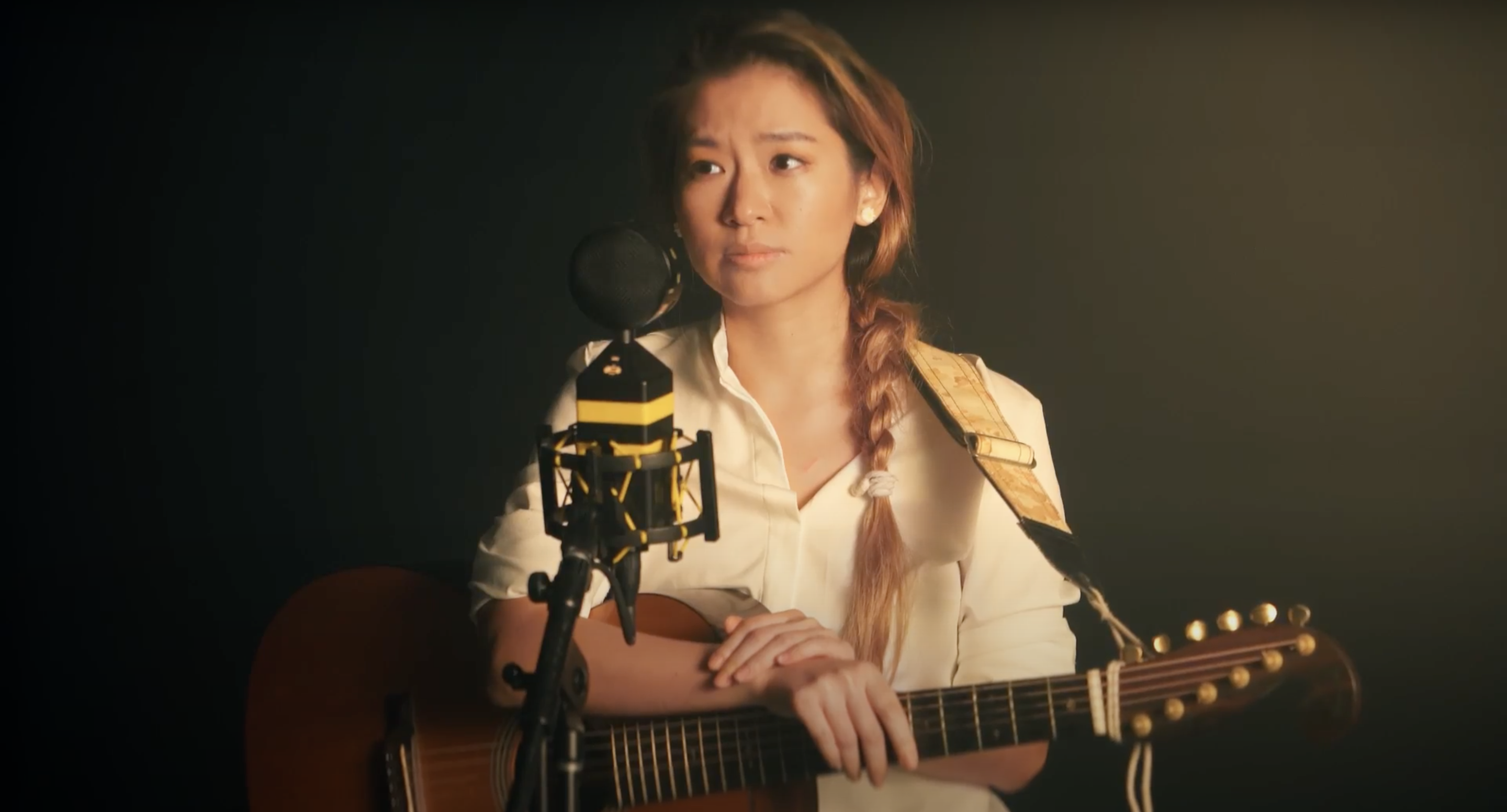
Inch Chua performing “Super Q” / Photo: Courtesy of Checkpoint Theatre

It is easy to think of Inch Chua as a singer, but if her consistent forays into theatre over the past few years is not enough to rid you of the idea that she is merely “dipping her toes” in the theatre industry, then “Super Q” should do the trick.

Chua plunges into the heart of the COVID-19 crisis by relaying her experiences as a volunteer in sanitising operations. The disjuncture between the comforts of her home and the seemingly draconian measures at the workers’ dormitories is disconcerting to say the least.

Chua’s experimentation with rhythm and poetry in her text enhances the emotions of frustration and confusion it evokes. This is complemented by the cuts and lighting design in the way the video was edited.

If the first piece is contemplative, Chua is on the other end as she bores into your heart with original songs written for the show. She cries: “All this must mean something more / when you have the privilege to be bored.”

Jo Tan performing “A Bit” / Photo: Courtesy of Checkpoint Theatre

Ever since the success of Forked (2019), Jo Tan has been prolific in writing and performing monologues that feature quirky characters, but their experiences or desires reveal something insightful about the circumstances that we live in.

In “A Bit”, Tan plays Bit Wah. An unassuming office lady who gets through life merely doing what is expected of her. While her lack of ambition makes her existence seems mechanical, she finds solace in her favourite anime.

Tan’s comic timing makes this short piece a joy to watch, and the ending is oddly entertaining.

To a culture that glorifies productivity, watching anime may seem frivolous. But if all that hustling is akin to the conformity of the grey skyscrapers of Tokyo, perhaps Bit Wah has a point in wanting life to be a little bit more colourful.

Rebekah Sangeetha Dorai performing “And Then I Am Light” / Photo: Courtesy of Checkpoint Theatre

Rebekah Sangeetha Dorai’s “And Then I Am Light” is a refreshing change as the diagonal angle of the shot and the breezy delivery of her monologue feels like a casual interview as compared to the performative nature of the other pieces.

On the whole, it is heartfelt and life-affirming as she comes to terms with being able to accept herself and move on from her trauma of her childhood and past relationships.

However, with the breezy delivery and tight pacing of the editing, one does not feel the full gravity of her words. This results in the piece losing some of its bite as it sometimes feels like a behind-the-scenes interview for a sleek music video.

This is a pity as the potential of the monochromatic shot of her monologue transiting into full-blown colour when she sings in a beautiful blue costume with embroidery is lost. However, the option of turning on the captions and reading the text does compensate a little.

That said, this does not completely detract from the heart of the piece and Rebekah’s luscious vocals is always a treat.

weish performing “Be Here, With Me” / Photo: Courtesy of Checkpoint Theatre

Fresh from her collaboration with Checkpoint Theatre on Displaced Persons’ Welcome Dinner (2019), weish takes centre stage in “Be Here, With Me”. An evocative performance about her struggles with trying to get over a traumatic experience.

In her music practice, weish uses live loops of singing, vocal percussion, and instrumentation. While we see that here, it not merely a transposition of her forte into this piece. Instead, the live loops that are present in her songs and monologue become a soundscape of her mind.

This allows us to see how she tries to appear normal so not as to burden others, while desperately wanting affirmations from others, even though she knows that it does not assuage her insecurities, self-doubt, and blame.

Having the camera suddenly charge up to her face-on after her opening song is uncomfortably confrontational, but it creates a sense that she is speaking directly to us as a particular person rather than an audience in general.

This is an inspired move as we then get to see her slowly crumble as she tries to explain herself and her experience—a rather different side of her as compared to the one who is in absolute control of the sonic textures, rhythms, and tempo when she is singing.

Despite its seemingly simple premise, Two Songs and a Story proves that Checkpoint Theatre is equally adept at bringing their brand of producing local works for the digital medium.

Other Reviews

“Theatre review: Checkpoint Theatre’s Two Songs And A Story presents intimate, heartbreaking monologues” by Olivia Ho, The Straits Times Life!  
♦ Article is behind a paywall. 

Resources

Two Songs and a Story: Artist Dialogue

[Listing] BODY X : The Culprit

After two successful runs in 2014 (BODY X The Wedding) and 2016 (BODY X The Rehearsal), BODY X returns with a brand new murder-mystery online: BODY X The Culprit.

This happened 35 years ago during the economic crisis of the mid-1980s.

Lacking substantial evidence, the case was left unsolved.


While tackling the challenges of an unprecedented recession and rapid business decline,

a neighbourhood kopitiam had to face another murderous impact —

a Regular Patron was found dead outside the shop in the early morning,

lying face-down at his usual spot.


All who were in contact with him the previous night

—Big Boss, Kopi Auntie, Cleaner, Beer Girl, Stall-owner—

had valid alibi and were not at the scene of the crime.

However, they all had disagreements with the victim before.


Was it an accident? Or is the murderer one of them?

Body X is a pioneering immersive-interactive Mandarin murder-mystery in Singapore theatre. An original and innovative theatrical format conceived and created by seasoned theatre practitioners, Li Xie and Danny Yeo. Both directors emphasised that the 2020 online version should retain important features—the involvement of and the autonomy in choice-making for the audience, the exploration of performance space, as well as the experimentation of unknown theatrical practices.  

So, are you behind-the-scene or in-the-scene? You decide. 

Come traverse through time and space to help solve this murder-mystery with us… this time, virtually. 


Body X The Culprit runs from 9–13 September 2020 via Zoom. Performed in Mandarin with no subtitles. Tickets from $18 at Peatix

AMBOI! Teater Ekamatra Launches a Fundraising Challenge

Despite several cancelled performances, Teater Ekamatra has rolled with the punches and continued to put up performances to champion minority voices. In its efforts to safeguard the future of the arts and to ensure that minority voices have a place within it, Teater Ekamatra has launched a fundraising challenge with a goal to raise $10,000. 

Titled AMBOI!, a colloquial Malay word that expresses wonderment, the fundraising challenge will run from 24 July till 31 August 2020.

It has the unique effect in which every dollar donated will be multiplied four-fold. This is made possible by a private donor who has generously committed to match dollar-for-dollar up to $10,000. The total amount will then be doubled through the Cultural Matching Fund. This will translate into the company being able to receive $40,000 should they be able to achieve the fundraising target.

Furthermore, reaching this fundraising milestone of $10,000 will “unlock” a special reward in the form of a free mini festival of performances via Zoom on 25 September 2020. The two-hour session will feature performances by surprise guests and collaborators of Teater Ekamatra as a way to thank all donors who contributed to the AMBOI! fundraising challenge

The funds raised will help to support Teater Ekamatra’s future programmes, including upcoming digital projects such as a reimagining of recently cancelled production Berak; children’s programme Mat Champion; its long-runnning Playwright Mentorship Programme; and Baca Skrip, a new Zoom play reading series. It will also cover overhead expenses such as rental and staff salaries. 

“As a word with multiple meanings, AMBOI! is an apt rallying cry to galvanise the community with the same spirit of playfulness, thrilling delight and creative expression that is associated with the work of Teater Ekamatra. We hope this fundraising challenge, with its 1:4 feature, will inspire more giving. It’s equally a challenge to ourselves to keep finding ways to carve out space for the ethnic minority voice in Singapore in the years to come.”

Shaza Ishak, Teater Ekamatra’s Company Director

If you would like to support Teater Ekamatra’s artistic endeavours, please donate generously via their giving.sg campaign page. This challenge runs from 24 July till 31 August 2020. 

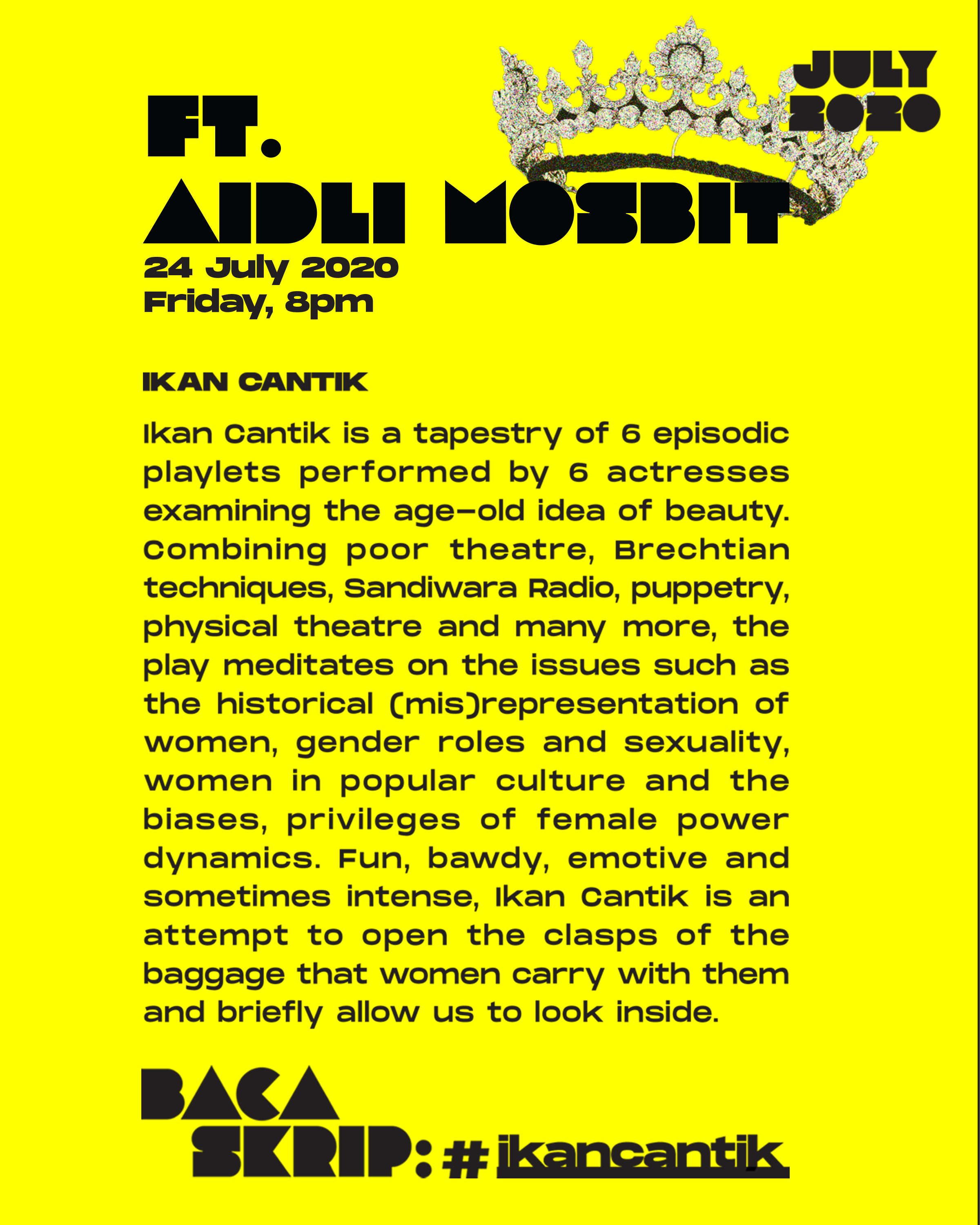
Teater Ekamatra presents Baca Skrip: #IkanCantik

The third instalment of Baca Skrip features Aidli Mosbit’s Ikan Cantik which meditates on issues such as the historical (mis)representation of women; gender roles and sexuality; women in popular culture and the biases; and privileges of female power dynamics. 

To find out more about the processes that go into present an online reading via Zoom, I interviewed some of the actors involved (Farah Ong, Suhaili Safari, Rafeyah Abdul Rahman, Elnie S. Mashari) in the presentation. 

Could you give us some insights as to what the rehearsal process was like?

Farah Ong: Reading. Just listening to the voices and tapping into those memories from a long time ago, and re-creating some experiences. There are a lot of technical details involved: checking of sound, angling of camera, and testing the intensity and colour of the lighting.

Suhaili Safari: The rehearsal process has been very technical when it comes to setting up our space every night. Having it being consistent especially with lighting and sound makes it easier for us to make a good show.

Rafeyah Abdul Rahman: What goes on behind the scenes is amusing. My rehearsal space is filled with costume and makeup on the right and IT peripherals, wastepaper basket (and snacks ssshhhh) on the left. The blinding ring light is in front of my laptop. Being older, presbyopia is a bane. Otherwise, getting on board and switching into character is easier than connecting through zoom on a weak wireless connection.

Elnie S. Mashari: Rehearsals started a month ago, with five or six sessions lasting two hours each. It was pretty refreshing to get into a “rehearsal” mode after months of not being actively involved in a production. It took a couple of sessions to get into the flow of the rehearsal process. It  would take 30–45 minutes to set up the technical elements  before the actual read. The session would end with a round of notes. While we plan for our rehearsals to last for two hours, it would usually stretch to three, which is fine as we had nowhere to go except to sleep after that. 

What were some challenges you face, especially when you are not in the same room with the rest of the cast and crew?

Farah Ong: The technical part is really challenging. The internet connection determines how you’re gonna sound, whether it’s going to lag. So, it takes a lot more energy and focus and listen. It’s listening plus something else.

The satisfaction is completely different, of course. Rehearsing on Zoom takes away the joy of human connection. So, your brains got to work double and triple hard to process.

Suhaili Safari: While needing a consistency in the quality of lighting and sound, sometimes we have to deal with unannounced noise bleeding from our environments because we are playing in our own homes . We also have to work with the latency of visual and sound when our network gets wonky and our Bluetooth earphones run out of power. Basically, we got to get our technology right at its peak at all times which is the main challenge of making online live shows. Besides that, having it directed in a tinier space made me feel claustrophobic, but that’s only because I had to think outside the conventions of stage playing and more of working within the idea of probably what film/TV would entail like eye line in film acting.

Rafeyah Abdul Rahman: Synergy. But fortunately, it’s a read. Nevertheless, the lag in connection requires a lot of waiting and patience from cast and crew. What’s interesting is that we get to use digital apps to get things up and make things work when otherwise it’ll purely be us on stage.

Elnie S. Mashari: I guess getting into a robust or an active discussion is hard because rehearsals were done over Zoom, and we we would not be able to hear each other at all if we accidentally talk over each other. It is like being in class, where we need to raise our hands before we share our opinion. 

Has this process made you look at the piece that you are involved in a new way? How so?

Farah Ong: It’s interesting that all these issues are probably still happening now. Just in a different language and vocabulary. The root of the problem and the issues are still the same. I guess humanity hasn’t evolved that much, you know…This whole Zoom process makes me miss the actual rehearsal and creation process of making theatre in general.

Suhaili Safari: Well, this is my first time working with #ikancantik as opposed to the rest who are revisiting it. Finding relationships with characters of actors I’ve not worked with before from behind my laptop screen made me imagine myself in a fishbowl and talking to fishes from other fish bowls. 

If this is rehearsed as a show rather than a script read, I wonder what dynamics will need to be in place to highlight relationships of characters without having them meet in the same space?

Rafeyah Abdul Rahman: It gets cast and crew to think of solutions that befit a zoom read. We have to lift the words off the script and how to do that without ‘acting’? Mastering the text and improve on eloquence—thus providing depth for each word, phrase, and sentence. The script still feels light-hearted but belies the weight of so much research, careful representation and deliberation.

Elnie S. Mashari: It definitely opens up a new perspective into performing for Zoom  or acting for a live-stream. The stage version allowed us to express ourselves more with body language and gestures. For Zoom, we need to capture our emotions and intention within that single frame. Using only our voice, facial expressions and upper body reactions. This gives me the tool to access insights to the character’s psyche and the sensitivity required in the delivering of the lines. I think that’s the main new change I experienced.

In addition, 22 years have passed. Our collective years of experiences have provided new insights to the issues raised in the 1998 production. We have now a bigger pool of information and experiences to support our choices for the characters.


Baca Skrip: #ikancantik will be presented via Zoom on 24 July 2020 at 8 p.m. Tickets at $10 from Peatix.

Reconsidering Singapore Malay Theatre with Fezhah Maznan

After successful runs of the first two instalments of Baca Skrip, a monthly reading of plays in the Singapore Malay theatre canon presented by Teater Ekamatra and Fezhah Maznan, I interviewed Fezhah to find out more about the project.

 What drew you to this project?

The pandemic got me in a paralysis. Not only based on what was happening in Singapore but also what I had experienced internationally having flown in and out of Singapore in March due to a death in the family. The time that I took to retreat and recalibrate gave me the opportunity to look at what was happening in Singapore theatre and to consider how I would like to respond.

One of the biggest absence I observed then was the lack of Malay theatre programmes. It’s not surprising as there are not that many active Malay theatre companies and the main headliner, Teater Ekamatra had been decimated by two cancelled productions. At the same time, I was and still am very concerned by how my theatre colleagues suddenly found themselves without jobs for the unforeseeable future. Having been a freelancer at the start of my journey in the arts, I know how hard it is to put food on the table. It’s even harder in a pandemic.

It was also then that Centre 42 went onto Zoom to celebrate their 6th anniversary and presented a reading of WRITES by Robin Loon. I was very blown away by how simple and affective the reading was, and I must credit Centre 42 for being the trigger to this project.

What made the production team decide to revisit some seminal works instead of creating a new piece?

We are always caught up in the newer, fresher and the never-been-done-before. If nothing else, this pandemic has really taught me to sit still and appreciate what we already have. So this project started with a simple idea—to sit and (re)consider works from Singaporean Malay playwrights, works that you cannot not mention when you recount the history of contemporary Malay theatre in Singapore. When else could you sit again with these texts? Additionally, there is very little effort in documenting the work done in Singapore Malay theatre. So revisiting these works also help to record a slice of history from the perspective of the playwrights.

I actually imagined this to be a simple reading but Irfan Kasban and Noor Effendy Ibrahim have pushed the bar further by reworking on their scripts and directions for their 2020 audience and also for the digital platform. I am fuelled by their enthusiasm and I admire how patient they are to play around with the digital plane in delivering a ‘live’ reading.

Coming out from our first presentation with Irfan’s Hantaran Buat Mangsa Lupa, our audience did appreciate how the reading was directed and the earnestness that came through the screen.

What were some of the difficulties in creating this work given that everyone cannot be in the same room?

At the start of the rehearsal, under normal circumstances, there is always time to breathe and be together. There are hugs, jokes, greetings and commiserating. Unfortunately, this doesn’t automatically translate when we rehearse digitally. We came in and immediately started to work. However, this was something that didn’t work out very well for us. So after the first rehearsal with the first cast, we decided to begin our rehearsals with ample time to be together before going into notes or reading.

There is of course the unpredictability of technology. We are not sure if the WIFI connectivity is going to drop or if the platform is going to fail us. There is a HUGE amount of uncertainty. Every rehearsal we find ourselves faced with new issues to deal with from lighting to echoes to mysterious issues that blacked out our surtitles.

All of these sound scary but I am sure it’s only happening because we are just getting to know the virtual platform. I am confident (foolishly or not) that this will only get better with time and lots of practice!

Has this process made you look at some of the scripts in a new way? How so?

One of the things that we didn’t want to do is to over direct the work. It’s a very conscious effort to put the text in the foreground. Hence, each read is accompanied with the original text and English surtitles. Audience members do also have the option to focus on the actors or the text or, if they choose to, to look away and listen to the reading like an audiobook. These options give greater autonomy to the audience to appreciate the text based on their preferred mode.


The next instalment will be a presentation of Aidli Mosbit’s Ikan Cantik on 24 July 2020. Tickets from Peatix. Stay tuned for more information.

[Review] A Grand Design – Natural Inspirations

A Grand Design (An Audio Experience)
Checkpoint Theatre
Spotify and Soundcloud
1-12 July 2020

As the COVID-19 pandemic compels everyone to recalibrate their plans, rather than putting their season on hold, Checkpoint Theatre opts to tease their audience by reconceiving some of their shows as audio experiences.

A Grand Design was supposed to be a lecture-performance held at the Lee Kong Chian Natural History Museum as Cheyenne Alexandria Phillips educates and regales some of her experiences as an environmentalist and educator.

In this audio experience, sound designer Shah Tahir compensates for the lack of physical exhibits that we would have experienced in the museum by immersing us in his soundscapes. He plunges us into the depths of the ocean or plonks us amidst excited children as we look at orangutans with our minds’ eye. This is a nice contrast to the concrete jungle that one faces due to the current situation.

Phillips’s musings about the odd encounters when educating people about nature, or what drew her to environmental studies are entertaining and educational. She manages to go into some technical detail without turning someone like me, with very little science background, off.

But what makes this experience valuable are the surprisingly profound insights that one gains from her observations. In the last segment, what starts off as an explanation of a well-known event unexpectedly evolved into a meditation of life, survival, existence, and death.

Coïncidentally, it started to rain outside towards the last few minutes of my audio experience. Clearly, nature had to get in on the action and add its finishing touches to a well-designed experience.


There will be a live staging of A Grand Design in the near future. Please check Checkpoint Theatre’s website and their social media for updates.

Teater Ekamatra presents Baca Skrip: #AnakMelayu

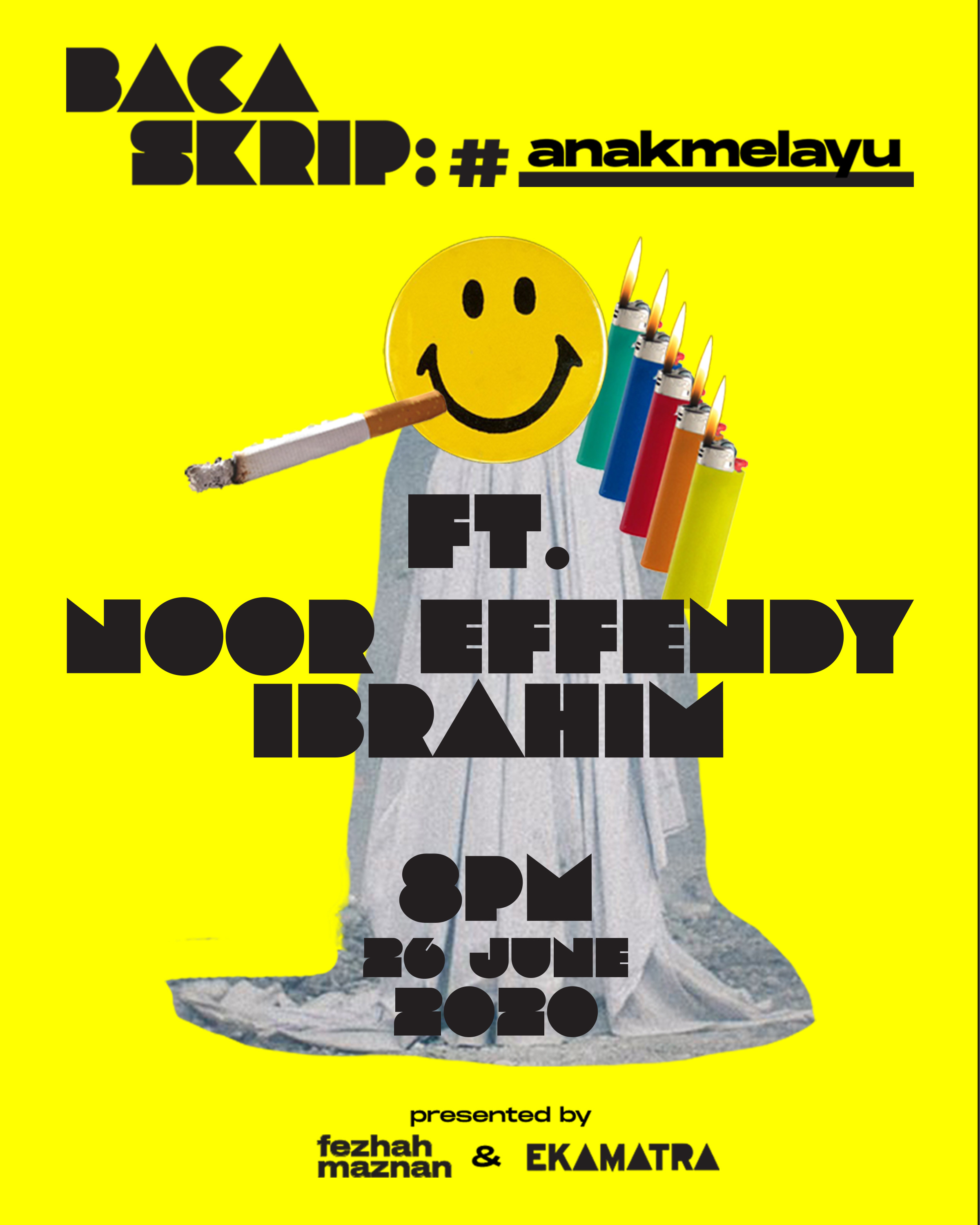
In the second instalment of Baca Skrip, a monthly series of online readings of Singaporean Malay plays, Fezhah Maznan and Teater Ekamatra presents Noor Effendy Ibrahim’s Anak Melayu

I interviewed some of the actors involved in this read (Izzul Irfan, Rusydina Afiqah, Farah Lola, and Ali Mazrin) to find out about their experiences with performing via a digital medium. 

Could you give us some insights as to what the rehearsal process was like?

Izzul Irfan: The rehearsal process has been very interesting for me as an actor because I sort of have to come up with a new vocabulary as a performer. You are playing the dual roles of both performer and technical team in a sense, because if you freeze or get cut off or your connection’s down, it’s on you to bring yourself back online and working well. So, there’s that headspace that I have had to get used to. Other than that, I think learning to connect over Zoom has been interesting—I have always seen this mode as purely a communication platform and not so much a ‘connecting’ platform. But the process has really been about re-learning how to reach out to the audience (when you can’t see them) and it’s been challenging but rewarding.

Rusydina Afiqah: To start off, there was a read to understand the flow of the story and the characters. Then we went straight in to cover the play bit by bit, a little more in depth each time. Questions were raised as we understood this world a little better.

Farah Lola: All of the rehearsals were held over Zoom calls. Other than it being tricky tehnically, the reading and blocking was easy enough to do.

Ali Mazrin: Basically, we have been going through rehearsals online via Zoom. Which includes all the cast, director and also the crew. Having to pick a spot in my own house and making sure everyone at home do not interrupt the rehearsals is quite hard but fun at the same time.

What were some challenges you face, especially when you are not in the same room with the rest of the cast and crew?

Izzul Irfan: Honestly, it drives me crazy that I cannot ‘feel’ everyone’s energy properly because we are not physically present together (which is something I really miss). So I think doing an ensemble piece where there is contant ping-ponging of energy on a virtual space has been difficult. With Anak Melayu, getting the tempo right is important and we’re really working hard towards that.

Rusydina Afiqah: For me, understanding the story took a while longer. There were a lot more things to juggle than just imagining the world. There were five more tiny screens during rehearsals that I had to be aware of, all at the same time.

Farah Lola: Perhaps physical and eye contact. Our eyelines were a little different because we were looking at different points of the screen, and you really needed to refine vocal inflections to know who the character is addressing but we’ve managed to work it out. We also had to bounce off energy more vocally as there was no physical space with other actors to feel out.

Ali Mazrin: Because it is an online rehearsal, we face quite a number of technical challenges such as the connection of the internet and also capturing of the cast’s voice. Being in a different space then the rest of the cast makes it more challenging in having the same energy as everyone during rehearsal.

Has this process made you look at the piece that you are involved in a new way? How so?

Izzul Irfan: Effendy’s plays are always very physical, and as he told us about the past iterations of Anak Melayu, you can clearly see there is a physical vocabulary that he builds and it’s beautiful. He always says he’s not much of a ‘text’ person. But as I was working on this play on a virtual platform, his words really come to life – all the subtexts in all its glory, and three-word lines from one character hold entire worlds in them. While it has been close to 20 years since he created them, his characters are still very much alive and kicking.

Farah Lola: It is my first time familiarising myself with this piece, and my first time doing a play on camera in my own home! I think everything has been whittled down to the subtleties due to it being closer to the audience, therefore it would feel more intimate.

Ali Mazrin: It’s amazing how we still manage to do rehearsals and shows live, online. But I definitely still wish that this was a staged show where everyone is together, so as to also feel the audience’s energy when we are performing.


Baca Skrip: #AnakMelayu will be presented via Zoom on 26 June 2020 at 8 p.m. Tickets at $10 from Peatix.

Flawed Review Yields Unexpected Insights

I am pleasantly surprised that my review of Peter Brook’s Battlefield, an adaptation of the Mahabharata, is cited in an essay contained in The Methuen Drama Handbook of Interculturalism and Performance (2020).

Initially, I was slightly confused as to why my review was cited, especially when I was a novice back then, and have provided links to reviews written by reviewers from mainstream publications. While I did not have access to the full essay, I was amused to find out that Dr Tan is a Singaporean theatre academic, and his concerns in the essay is about sound design. That is certainly not my forte and my review did not cover sound design at all.

Upon closer reading of the excerpt and my review, I realised that my review detailed four reactions by different audience members, and it served as an indication of the audience members’ reactions to the performance. Hence, it allowed Dr Tan to cite that as anecdotal evidence that the audience was “uninspired and bored”.

At the time of writing, I knew that the review would ruffle many feathers had it gained a wider readership. It was a special review to me because I uncharacteristically privileged reportage over anything else.

Personally, I am not in favour of providing too much reportage. It spoils the show for those who are about to watch it, and it takes the space away from wider analysis, which differentiates one critic from another. Reportage should be in the form of examples to substantiate a wider point.

In that review, I made such a deliberate but uncharacteristic choice in response to the widespread adoration of the show, which seemed to be earned due to Brook’s reputation rather than the direction or performance itself.

I wanted to show that the drama in the stalls is much more interesting that what was happening on stage. And I have used this technique several times since.

That said, if I were to receive that review now, I would still stand by the writer’s decision, but advise him to add a little more context and details of the show.

At that time, I was quite a stickler for keeping to the word count as I believed that most people would not read beyond 500 words. While I am still of that opinion to a large extent, a clear and exciting review would put the readers in a forgiving mood.

[Interview] Finding Resonances in Poop! with Berak

To kick off their 2020 season, Teater Ekamatra presents Berak, a transcreation of Chong Tze Chien’s Poop!, which chronicles an aftermath of the suicide. 

I spoke to transcreator Zulfadli Rashid (ZR) and director Mohd Fared Jainal (MFJ) to find out more about the piece and what drew them to Chong’s original play, which can be considered a modern classic in our theatre canon. 

The work is described as a transcreation of Chong Tze Chien’s Poop! Could you explain what do you mean by “transcreation”?

MFJ: Transcreation is becoming quite synonymous to our line of work at Ekamatra. Apart from creating original plays, we find originality within these scripts that resonate strongly as viewed through the lens of an ethnic minority.

In Harap (2017), it was about suicide and homosexuality; Potong (2018) talks about dementia in the family with a transgender character; and A Clockwork Orange (2019) was about violence.

Poop! is a great play written by Chong Tze Chien and it’s one of those that strike an emotional chord based on the plot and premise—a broken family whose father committed suicide and a daughter fighting cancer and on the brink of her impending  fate.

What drew you to transcreate Poop! in the first place?

ZR: I watched Poop! a few years ago. I remembered that I left the theatre with such sorrow. No silver lining, no moral of the story. Still so beautiful. I loved how honest it chose to be. Then, sometime in 2018/2019, Shaza asked if I was interested in adapting Poop!  I just had to do it.

MFJ: As depressing as it may seem, on a micro level, these characters represent people who have lost so much—dignity, will, trust, identity, and the meaning to live. They could be our family; friends; neighbour; colleague; the person sitting opposite us in the train; the taxi driver; the stall owner; the man in suit; the lady on a bicycle. Just anyone.

But on a larger view, it reflects how the system is causing people to struggle, to have a skewed perspective and face death way before we are boxed up. 

Are death and berak taboo subjects in a “Malay” cultural context and in Islam? If so, could you elaborate on this?

ZR: I don’t think the Malays view these things as taboo. We talk about both death and passing motion all the time, but some do it  “beralas” (Malay-styled euphemism).

Islam also does not view these subjects as taboo. Death is merely a rite of passage for a human being, and it is not the final destination. How one dies, however, will determine one’s fate in the afterlife.

MFJ: About 98 per cent of Malays are Muslims by default and these plays may contain difficult issues or taboos that do not sit comfortably to some. However, they deserve the attention as we continue to represent a wider spectrum of people within our community. It may not lead us to any solutions, but the bottom line is to acknowledge and say that some people need more help than others. Let’s not sweep it under the carpet.

Are there any interesting discoveries that occurred in the process of transcreation and rehearsals?

ZR: I am always discussing with Fared and Safuan (the sound designer) on how to ensure that Berak is not merely a translated play performed by Malay actors. Berak must exist in a Malay universe with all its absurdities and peculiarities. Only then, I feel that we can have an honest conversation with regards to the play’s subject matter.

MFJ: Zulfadli Rashid (Big) is a bilingual writer who has strong sensitivity towards the Malay language, culture and psyche. He has been brilliant in trans-creating the works at Ekamatra, especially Berak. However, the creative input is not just limited to the playwright or director. Actors, designers, managers and crew help to carve and colour that world, and make it as authentic as possible.

Perspectives definitely change and heightened once culture is brought into the picture. The process of transcreation gives us the artistic licence to build a world within our own parameters and identity.


Berak runs from 25–28 March 2020 at Ngee Ann Kongsi Theatre, WILD RICE @ Funan. Tickets from Sistic

Update: This performance has been cancelled due to the COVID-19 pandemic.

[Interview] 4.48 Psychosis is “already an intercultural work to me”, Director Andy Ng Wai-Shek

In slightly over a week, the graduating cohort of Intercultural Theatre Institute (ITI) will present the first ever multi-lingual adaptation of Sarah Kane’s 4.48 Psychosis. I spoke to director Andy Ng Wai-Shek, an award-winning practitioner from Hong Kong  and alumnus of ITI’s pioneering batch, to find out more about the production.

Andy Ng Wai-Shek / Courtesy of ITI

How does it feel to return to your alma mater as a guest director? How has ITI changed over the years since you were a student?

I still feel very much part of the school even though I have met different faces. There is a vibration that keeps reminding me this is where I came from. After 17 years, I’ve come to realise how this programme isn’t just about simply doing theatre — it’s about personal perceptual experiences.

This programme synthesises the differences between cultures; perceptions of different bodily experiences; the possible marriage of body and mind; and, most importantly, the unanswerable question of how to put different training methods into one. It sets a foundation of life-long research for a person in the evolution of his life. In fact, this is the research I’m still doing all these years since my graduation. I suggest ITI can also play a role to encourage the research.

4.48 Psychosis is not immediately thought of as an intercultural work. What drew you to adapt this piece for ITI?

It is already an intercultural work to me when I knew that I had to work with students from Taiwan, Malaysia, India, and Korea. 4.48 Psychosis is more on personal thoughts and feelings than drama. The structure of it drifts on a stream of consciousness. It is logically disrupted. In other words, it can be very personal.

Though the work is in English, I would like them to try certain scenes in their mother tongue. The idea of it is that there are five storytellers telling the story, sometimes deeply immersing themselves into the very thoughts and feelings of “I”. One of my interest when directing is the connection between one’s consciousness and his or her being. Now, the text says it. The actors need to find their ways to reveal it. They show me according to what they can do individually. That’s already intercultural.

ITI’s graduating cohort rehearsing 4.48 Psychosis / Courtesy of ITI

Given that your actors are from different countries and from all walks of life, were there any interesting conversations about mental health that arose during the rehearsals?

I had depression since last August and have recently stopped my medication. I shared my experience with the students. They shared their experiences with me and their fellow peers. Some students have also consulted a counsellor. I think depression or mental health is already a common issue nowadays, it is just a matter of seeing whether it is serious enough for a person to consult a doctor or not. I am not interested in telling a story of mental disorder. I think the playwright did try her last call for help. Why? I hope that the audience can understand that.

Could you give us a glimpse of what the show would be like? Do you tap on the actors’ intercultural training in your direction of the show?

Five storytellers telling this story, using a psycho-physical approach to develop the work of a visual poem. Yes, some of the scenes to use their intercultural training, but it’s a different look. How so? You will have to come to the show to find out.


4.48 Psychosis by Intercultural Theatre Institute runs from 12–14 March 2020 at The Drama Centre Black Box. Tickets from Peatix.